Intelligence DispatchesJanuary 26, 20268 min read
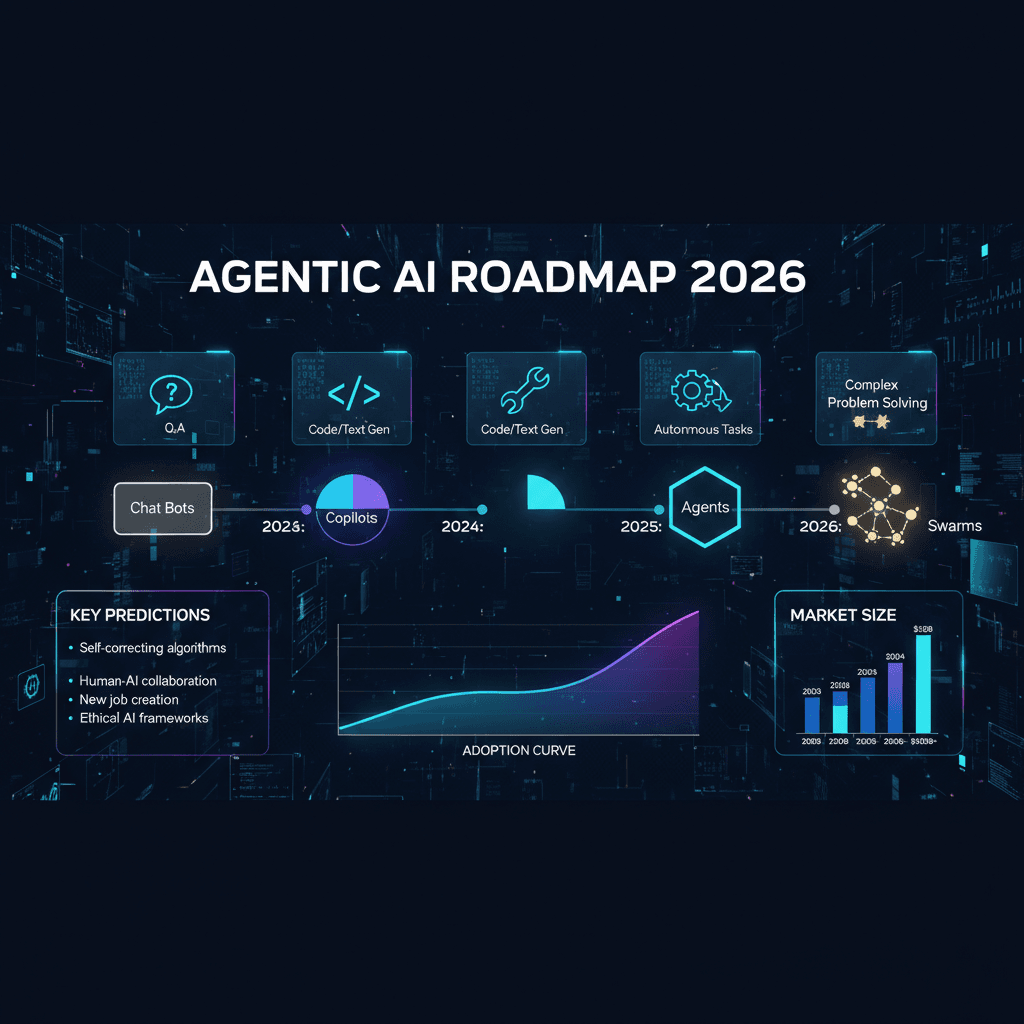
Agentic AI Roadmap 2026: From Multi-Agent Systems to Enterprise Orchestration
A strategic blueprint for creators, founders, and executives to deploy agentic AI systems in 2026. Updated with LangGraph, CrewAI, MCP protocol, and OCI GenAI patterns.

🎯
Reading Goal
Block 45 minutes with your leadership circle. Map each section to an action you can take this week, then assign owners inside your Daily Intelligence ritual.
Why 2026 belongs to multi-agent orchestrators
The past year transformed agentic AI from experimental to essential. Claude Opus 4.5, GPT-5, and Gemini 2.0 proved that large-context reasoning is baseline. But the real shift? 72% of enterprise AI projects now use multi-agent architectures (up from 23% in 2024). Gartner predicts 40% of enterprise apps will embed AI agents by end of 2026.
Teams stopped asking if AI could help and started demanding orchestration systems—LangGraph for stateful workflows, CrewAI for team coordination, MCP for universal tool integration. That is the shift from single agents to agent ecosystems, and it is why the FrankX Intelligence Atlas now focuses on production patterns.
This roadmap article distills the highlights of Volume I and previews the next nine drops. Use it as your field manual for deploying agentic AI across creative studios, growth funnels, and regulated enterprises. Every section aligns with FrankX specs, the Daily Intelligence ritual, and the delivery cadence posted on the new Roadmap hub.
Signal: adoption metrics that justify immediate action
The numbers are staggering: the AI agents market grew from $5.4B (2024) to $7.8B (2025), projected to reach $52B by 2030 at 45.8% CAGR. OpenAI's Agents SDK replaced experimental Swarm. Anthropic's MCP protocol became critical infrastructure, with tool search improving accuracy from 49% to 88% on complex tasks. Oracle made OCI GenAI Agents generally available with 50+ pre-built agents in Fusion Cloud. Creative platforms kept pace: Suno v4.5 revolutionized music generation, and text-to-video entered production pipelines.
What this means for you:
- Creators must treat AI collaboration as a baseline expectation. Your audience already consumes AI-enriched content; your differentiator is curation, brand, and community rituals.
- Executives can no longer call pilots a strategy. The board expects governance, risk mitigation, and measurable ROI.
- Families and educators need accessible guardrails so curiosity leads to literacy, not confusion.
Activation checklist
- Pull the latest adoption numbers into your leadership decks; cite the data reference index inside Volume I.
- Segment your audience by readiness—creator studios, enterprise stakeholders, households—and define the adoption stories that match each segment’s urgency.
- Use the Agentic Readiness Assessment from Volume I to baseline cultural and technical maturity.
System: orchestrating creative and commercial workflows
Agentic AI is more than “prompt, respond, repeat.” It is about designing multi-agent ecosystems where perception, planning, execution, and evaluation are coordinated through rituals your team understands. FrankX breaks this into three operating systems:
- Vibe OS for music and experiential storytelling.
- Agentic Creator OS for campaign planning, copy, and content distribution.
- Enterprise Intelligence Systems for governance, change management, and measurable ROI.
Each OS is informed by the Atlas volumes, cross-referenced in the specs hub, and wired into the Daily Intelligence ritual.
Creative studios (Volume II preview)
- Build a “room of rooms”: perception agents that harvest inspiration, planning agents that storyboard and sequence, and production agents that render assets in Suno, Runway, or ElevenLabs.
- Maintain a Creative Integrity Framework (Volume I, Framework Library #3). It stores style guides, approvals, attribution notes, and versioning.
- Combine human live sessions with agent rehearsals. Let agents explore variations, then bring humans in to select, arrange, and perform.
Growth and narrative teams (Volume III preview)
- Use the Revenue Ladder Canvas (dropping with Volume III) to pair offers with automation depth. Low-touch digital drops, mid-tier memberships, and high-touch advisory can share the same agent backbone.
- Deploy evaluation harnesses that grade outputs before they leave the system. LLM-as-a-judge, rubric scoring, and human QA keep launches trustworthy.
- Connect Atlas data to CRM and analytics platforms so recurring revenue, retention, and NPS metrics reflect agentic influence.
Enterprise transformation (Volume V preview)
- Map workflows through the Governance Maturity Model: Aware → Structured → Integrated → Leadership.
- Pair every automation sprint with a risk sprint. Document data lineage, retention policies, and human escalation paths.
- Publish changelogs. Enterprises that tell the story of their AI evolution maintain stakeholder trust and satisfy regulators.
Activation checklist
- Identify the OS (Vibe, Creator, Enterprise) that maps to your current initiatives and score its readiness.
- Pull the relevant frameworks from Volume I: Agentic Workflow Blueprint, Compute Strategy Canvas, Governance Sprint Kit.
- Schedule a weekly Atlas Sync to inspect agent telemetry, experiment backlog, and shipping velocity.
Stewardship: guardrails, ethics, and human connection
Agentic scale collapses without intentional stewardship. FrankX centers three principles:
- Transparency. Declare which agents, models, and datasets power your outputs. Adopt C2PA or equivalent watermarking for media.
- Inclusion. Evaluate agents for bias, accessibility, and cultural sensitivity. The Governance Sprint Kit includes bias spot-check prompts and remediation paths.
- Community. Keep feedback loops open. The Community Resonance Loop ritual catalogs sentiment, prioritizes changes, and communicates back to your audience.
Families and educators get a dedicated volume (IV) that translates these ideas into age-appropriate workshops, device policies, and curriculum guides. Executives receive a governance playbook that ties AI controls to risk committees, legal reviews, and board communications.
Activation checklist
- Run quarterly governance retrospectives. Measure incident response times, evaluation coverage, and stakeholder participation.
- Add transparency statements to your launches. Include model versions, human reviewers, and data sources.
- Invite your community into the roadmap. Publish contribution guidelines (Volume I, ) and share how you incorporate feedback.
The 2025 timeline at a glance
FrankX releases one Atlas volume per month. Here is how to align your initiatives:
| Month | Volume | Core Focus | Anchor Deliverables |
|---|---|---|---|
| January | Volume I | Landscape & frameworks | Executive summary, adoption heat map, readiness assessments |
| February | Volume II | Multi-agent creative studios | Studio archetypes, session templates, evaluation harnesses |
| March | Volume III | Revenue engines | Monetization ladders, launch OS upgrades, pricing heuristics |
| April | Volume IV | Families & education | Household charters, classroom toolkits, civic partner playbooks |
| May | Volume V | Enterprise governance | Policy codex, risk dashboards, compliance rituals |
| June | Volume VI | Music & media | Vibe OS live show package, licensing guardrails, hybrid performances |
| July | Volume VII | Infrastructure & sustainability | Compute sourcing templates, energy metrics, partner interviews |
| August | Volume VIII | Community ecosystems | Resonance loops, ambassador programs, co-creation rituals |
| September | Volume IX | Capital & investment | Investor briefings, venture archetypes, intelligence KPIs |
| October | Volume X | Futures & stewardship | Foresight canvases, planetary governance scenarios, atlas changelog |
How to keep pace
- Bookmark the Roadmap hub for living updates, success metrics, and next-action status.
- Subscribe to the intelligence bulletin (CTA on the Roadmap and Intelligence Atlas pages) for publication alerts.
- Contribute field research to hello@frankx.ai—client telemetry, case studies, governance breakthroughs.
Tooling stack for builders in 2025
Volume I highlighted a hybrid stack that balances frontier APIs with open-source momentum. For 2025 we recommend:
- Perception & planning: GPT-4.1, Claude 3.5 Sonnet, Gemini 1.5 Pro, Mixtral 8x22B, combined with Retrieval Augmented Generation (RAG) using Weaviate or Pinecone.
- Execution agents: CrewAI, LangChain Components, Frigate, or the upcoming FrankX Agentic Creator OS modules.
- Evaluation: OpenAI Evals, Anthropic Workbench, SynthLabs, alongside human rubric reviews.
- Governance: Policy Codex stored in Notion/Confluence, incident tracking in Linear or Jira, and transparency logs published via GitHub Pages or docs.
- Creative tooling: Suno for composition, Runway + Pika for video, ElevenLabs for voice, and LumaDream for volumetric experimentation.
Activation checklist
- Document your agent stack in the Daily Intelligence ritual with owner, purpose, and fallback.
- Implement prompt/version control (Github + Gitness) for every agent script.
- Use synthetic telemetry dashboards to monitor response time, evaluation pass rate, and human override frequency.
Your next three moves
- Run the roadmap automation. Open your terminal and execute
npm run roadmap:check. The new CLI summary echoes the hub and highlights blockers, in-progress initiatives, and shipping work. - Host an Atlas Sync. Bring your core operators together, review the Milestones section above, and assign actions. Log decisions in the Daily Intelligence document so every agent has a human steward.
- Publish your intent. Share your 2025 agentic AI plan on LinkedIn, in your newsletter, or inside the FrankX community. Signal the rituals you are adopting and invite collaborators.
Closing: architect the era together
Agentic AI is not a spectator sport. It is a collective practice that blends creative risk-taking with systems thinking and relentless stewardship. FrankX will keep publishing the research, templates, and automation that guide the journey. Your role is to ground those insights in your own mission—whether you are building a Suno-powered studio, leading a transformation initiative, or teaching families how to co-create with dignity.
We will see you at the next Atlas drop.
Want the roadmap in your inbox? Visit the Roadmap hub and join the intelligence bulletin for weekly prompts, release notes, and contribution invitations.
Related Articles
- What is Agentic AI? — The fundamentals of autonomous AI
- Intelligence Revolution 2025 — How we got here
- Agentic Creator OS — Build your own AI operating system
Get Started
Build your first AI system
Step-by-step guide to setting up ACOS, creating your first agent, and shipping real products with AI.
Start buildingTemplates & Blueprints
Production-ready architecture
Download AI architecture templates, multi-agent blueprints, and prompt engineering patterns.
Browse templatesInner Circle
Join the builder community
Connect with creators and architects shipping AI products. Weekly office hours, shared resources, direct access.
Join the circleRelated Research

Read on FrankX.AI — AI Architecture, Music & Creator Intelligence
Stay in the intelligence loop
Weekly field notes on AI systems, production patterns, and builder strategy.
Continue Reading

Intelligence Dispatches8 min read
Agentic AI Roadmap 2025: From Studio Rituals to Enterprise Governance
A strategic blueprint for creators, founders, and executives to deploy agentic AI systems in 2025, aligned with the FrankX Intelligence Atlas roadmap.
Read article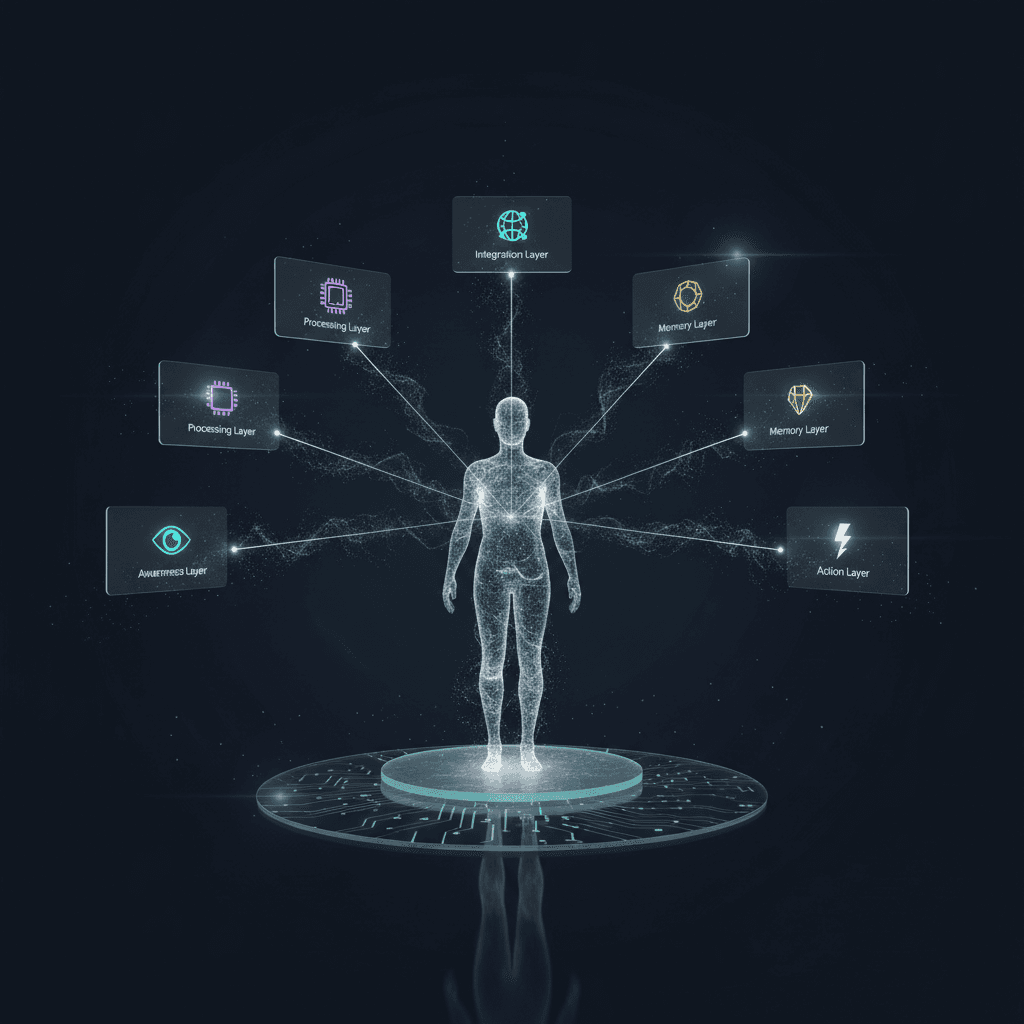
Intelligence Dispatches6 min read
Agentic AI Integration OS: 7 Layers To Align Teams, Agents, and Trust
A practical operating system for leaders who want intelligent AI integration—grounded in governance, creativity, and measurable value—across 2025 initiatives.
Read article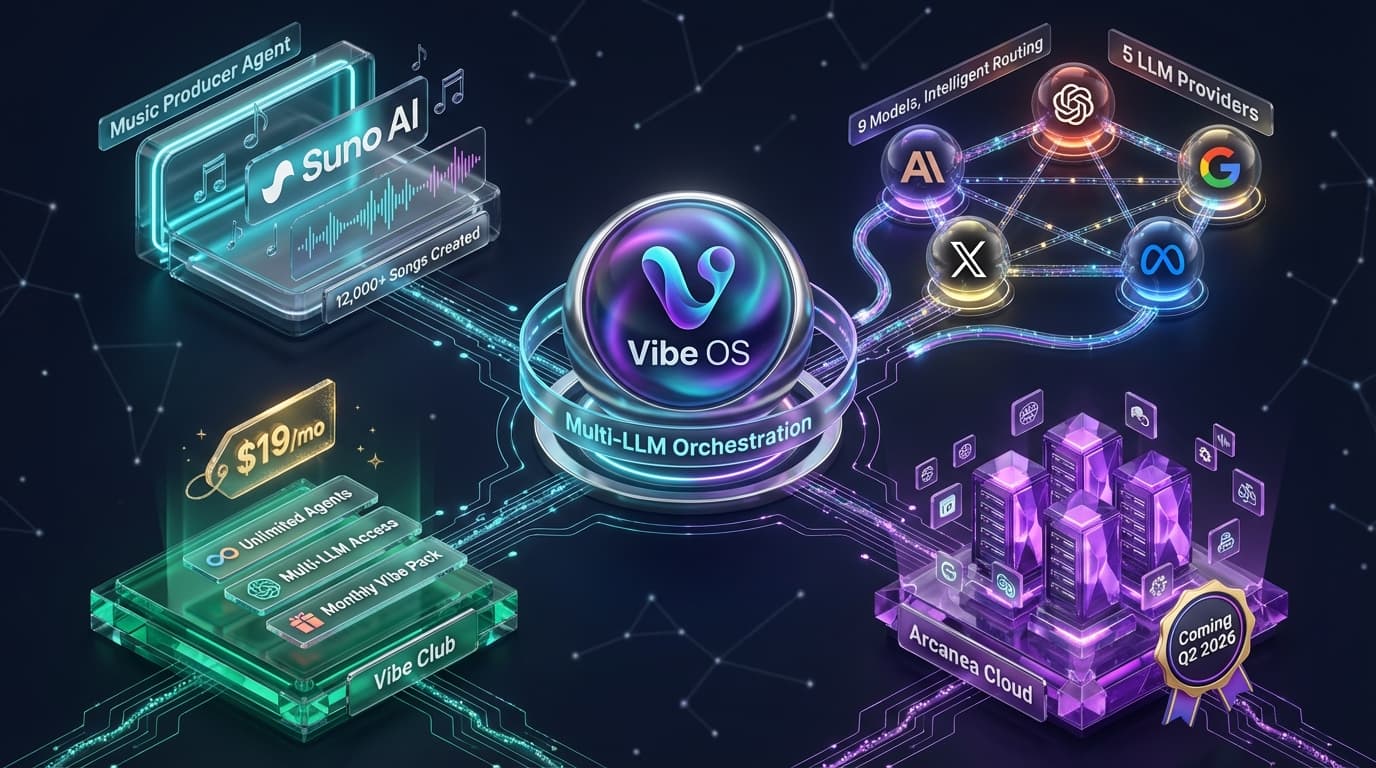
AI & Systems9 min read
Vibe OS: Multi-LLM Agent Ecosystem for Music Creation and AI Orchestration
An integrated platform combining AI music production, multi-LLM orchestration, and intelligent agent coordination. Built on Claude, GPT, Gemini, Grok, and Llama.
Read article