Product VisionApril 9, 202612 min read
Trinity AI — The Conscious Operating System for Human Potential
Trinity AI is a 5-layer conscious operating system that remembers you, reads your body, and compounds intelligence daily. Built on Claude Agent SDK, Vercel, and sovereign data principles.


🎯
Reading Goal
Understand what Trinity AI is, how its 5-layer architecture works, and why sovereign AI matters for individuals and families.
Trinity AI — The Conscious Operating System for Human Potential
Your AI should know your name tomorrow. It should know your stress levels, your business context, and what your grandfather built. Today's AI does none of this. Trinity AI changes that.
TL;DR
Trinity AI is a 5-layer conscious operating system that treats you as sovereign. It combines ethical guardrails, persistent memory, biometric awareness, specialized agents, and multi-generational knowledge into a single system that compounds intelligence daily. Built on Claude Agent SDK + Vercel + Supabase with a clear sovereignty ladder from cloud-native to fully self-hosted. Community pricing starts at EUR 49/mo. This article explains the architecture, the technical stack, and why this category of product needs to exist. If you've used ACOS and wanted it to know your body and your family history — this is what comes next.
Why Does Every AI Conversation Start From Zero?
Open ChatGPT right now. It doesn't know your name. It doesn't know you slept 4 hours last night. It doesn't know your business partner sent a concerning email at 2am. It doesn't know your grandfather ran a textile business for 67 years and encoded decades of negotiation wisdom into how he operated.
Every AI interaction in 2026 still starts from a blank slate.
This is the core problem. Current AI tools are stateless assistants — powerful in isolation, amnesiac across sessions. They can write code, generate images, and answer questions. But they cannot:
- Remember what matters to you across days, weeks, and months
- Sense your physical state and adapt their assistance accordingly
- Accumulate wisdom that compounds over time
- Protect your data sovereignty while delivering personalized intelligence
I build AI Center of Excellence frameworks for Fortune 500 companies at Oracle. The enterprise world solved the continuity problem years ago — persistent knowledge bases, role-based access, institutional memory. But for individuals? For families? For creators? Nothing equivalent exists.
Trinity AI is the architecture that fills this gap.
What Is Trinity AI, Exactly?
Trinity AI is a conscious operating system — not a chatbot, not a wrapper, not another AI app. It's a 5-layer architecture where each layer builds on the one below it, creating a system that knows you deeper over time.
Layer 1: Guardian Protocol
Every Trinity AI instance starts with the Guardian Protocol — ethical guardrails combined with personality persistence. This is not a system prompt. It's a constitutional layer that defines:
- Behavioral boundaries: What the system will and won't do, configured by the user
- Personality continuity: Your AI maintains consistent character across sessions — tone, priorities, communication style
- Override protection: No prompt injection, no jailbreaking, no third-party manipulation of your AI's core values
The Guardian Protocol means your Trinity AI instance is yours. It reflects your ethics, your boundaries, your priorities. Not a corporation's content policy applied uniformly to 200 million users.
Layer 2: Living Memory
Living Memory is the 24/7 second brain. It captures everything — conversations, decisions, context, preferences, outcomes — and organizes it into retrievable, sovereign data.
Key properties:
- Always-on capture: Every interaction enriches the memory graph
- Sovereign storage: Your data lives in your Supabase instance. You own it. You can export it. You can delete it
- Contextual retrieval: The system surfaces relevant memories at the right time — not keyword search, but semantic understanding of what matters now
- Decay and reinforcement: Important memories strengthen over time. Noise fades. The system learns what to keep
This is the layer that makes Trinity AI fundamentally different from ChatGPT or Claude. After 90 days of use, your Trinity AI has a rich model of who you are, what you're working on, and what you care about. After a year, it has institutional-grade context about your life.
Layer 3: Vital Intelligence
Vital Intelligence reads your body. Through wearable integrations — Apple Watch, Oura Ring, Whoop, Garmin — Trinity AI has access to:
- Sleep quality and duration
- Heart rate variability (HRV)
- Stress indicators
- Activity levels and recovery scores
This biometric awareness changes how assistance works. When your HRV drops and your sleep was fragmented, Trinity AI adjusts: it reschedules demanding cognitive work, surfaces lighter tasks, and flags that today is a recovery day. When you're in peak flow state, it protects that time and queues interruptions.
No current AI product treats the human body as an input signal. Trinity AI does.
Layer 4: Agent Constellation
Four specialized agents handle distinct domains of your life:
| Agent | Domain | What It Does |
|---|---|---|
| Wellness Agent | Health & energy | Correlates biometrics with habits, suggests interventions, tracks patterns |
| Strategy Agent | Business & career | Monitors competitive landscape, surfaces opportunities, prepares briefings |
| Creative Agent | Content & creation | Manages creative projects, generates drafts, maintains your creative voice |
| Legacy Agent | Knowledge & family | Encodes multi-generational wisdom, preserves family knowledge, manages estate intelligence |
Each agent runs as a subagent within the OpenClaw orchestration framework. They share context through the Living Memory layer but operate with specialized tool access and domain expertise.
Layer 5: Collective Wisdom Engine
This is where Trinity AI transcends individual utility. The Collective Wisdom Engine encodes multi-generational knowledge into queryable intelligence.
Proof case: Hashems 1959.
My family's textile business has operated continuously since 1959 — 67 years of business knowledge, negotiation patterns, supplier relationships, market intuition, and hard-won operational wisdom. Most of this knowledge exists in the heads of family members. Some in scattered documents. None of it is structured, searchable, or transferable.
The Collective Wisdom Engine takes this raw knowledge — interviews, documents, stories, financial records — and transforms it into an AI-accessible knowledge base. The result: a family member can ask "How did grandfather handle the 1987 supplier crisis?" and get a structured, contextual answer drawn from actual family knowledge.
This isn't hypothetical. This is the architecture I'm building for my own family. And it scales to any family, any business, any community with institutional knowledge worth preserving.
What's the Technical Stack?
Trinity AI is built on production-grade infrastructure, not research prototypes.
| Component | Technology | Purpose |
|---|---|---|
| Orchestration | Claude Agent SDK + OpenClaw | Agent spawning, subagent coordination, tool calling |
| Frontend | Next.js on Vercel | Dashboard, configuration, interaction interface |
| Database | Supabase (PostgreSQL + pgvector) | Living Memory storage, vector search, user data |
| Payments | Stripe | Subscription management, marketplace transactions |
| Integrations | MCP Servers | Wearables, email, calendar, file systems, APIs |
| LLM | Claude API (cloud) / Local LLM (sovereign) | Core intelligence, reasoning, generation |
Each user gets their own instance — their own Jarvis. The system supports a shared intelligence layer for families and teams (the "brotherhood layer"), but personal data stays personal.
The architecture follows the same principles I use in enterprise AI design: separation of concerns, least-privilege access, audit trails, and graceful degradation.
How Does the Sovereignty Ladder Work?
Not everyone needs — or wants — full data sovereignty on day one. Trinity AI offers a graduated path:
Tier 1: Cloud-Native
The starting point. Your Trinity AI runs on managed infrastructure:
- Compute: Vercel serverless functions
- Data: Supabase managed instance
- LLM: Claude API
- Cost: Lowest. No infrastructure management
This is where most users begin. The data is yours (portable, exportable), but it runs on shared infrastructure.
Tier 2: Hybrid
For users who want privacy for sensitive operations:
- Public queries: Still use Claude API for general tasks
- Private queries: Route to your own local LLM (Llama, Mistral, or similar) for confidential business data, health records, family information
- Data: Self-hosted Supabase or any PostgreSQL + pgvector instance
Tier 3: Full Sovereignty
Complete independence:
- Own servers: Run everything on your hardware or private cloud
- Own fine-tuned LLM: Train on your data, optimized for your use case
- Own skill/agent hub: Custom agents, custom tools, custom integrations
- Zero external dependencies: No API calls leave your network
The sovereignty ladder means Trinity AI meets you where you are and grows with your comfort level. Start cloud-native. Graduate when ready.
What Does a Day With Trinity AI Look Like?
6:00 AM — Your Oura Ring data syncs overnight. Trinity AI processes it: HRV is down 15% from baseline, deep sleep was 40 minutes below target. The Wellness Agent flags this and adjusts your day. Two high-cognitive meetings get a reschedule suggestion. Your morning block shifts to lighter review work.
8:30 AM — You open your dashboard. The Strategy Agent has a briefing ready: a competitor launched a product overnight that overlaps with your Q2 roadmap. Relevant context from 3 previous strategy sessions is already surfaced. Two response options are drafted — one aggressive, one observational.
11:00 AM — Midmorning stress spike detected via Apple Watch. The Wellness Agent sends a subtle nudge: "Your heart rate has been elevated for 20 minutes. Your pattern shows a 5-minute walk resets this effectively." No judgment. Just data and a proven intervention.
2:00 PM — You're preparing a family business proposal. You ask: "What pricing strategy did the family use during the 2008 recession?" The Legacy Agent queries the Collective Wisdom Engine and returns a structured answer: your uncle reduced margins by 12% but increased volume commitments, preserving all three key supplier relationships. The strategy worked — revenue dipped 8% while competitors lost 30%.
6:00 PM — End of day. Trinity AI generates a daily compound report: decisions made, energy patterns, open loops, tomorrow's priorities. Your Living Memory has added 47 new contextual entries. Your intelligence baseline has shifted slightly upward.
Day after day, this compounds. After 30 days, Trinity AI knows your work patterns better than you do. After 90 days, it anticipates needs before you articulate them. After a year, it's an extension of your cognitive capacity.
What Does Trinity AI Cost?
Community economics. The model is designed so that power users fund the platform while contributors earn from their expertise.
| Tier | Price | What You Get |
|---|---|---|
| Core | EUR 49/mo | Guardian Protocol, Living Memory, 2 agents, cloud-native |
| Pro | EUR 199/mo | All 5 layers, 4 agents, Vital Intelligence, hybrid sovereignty option |
| Sovereign | EUR 999/mo | Full sovereignty support, custom LLM fine-tuning, dedicated infrastructure guidance |
| Marketplace | 70/30 split | Build and sell custom agents, skills, and integrations. You keep 70% |
The marketplace is where this becomes a community, not just a product. If you build a specialized agent — say, a real estate investment analyzer or a music production assistant — you can publish it. Other Trinity AI users can install it. You earn 70% of every transaction.
Why Does This Matter?
The AI industry has spent four years building increasingly powerful models and increasingly forgettable products. Every chatbot, every wrapper, every "AI assistant" treats you as a new user every session. Your context is disposable. Your data is the product. Your growth doesn't compound.
Trinity AI proposes a different relationship between humans and AI:
- Your data is sovereign. Not monetized, not shared, not used to train models you don't control
- Your intelligence compounds. Every interaction makes the system more useful, not just more trained
- Your body matters. Physical state is an input signal, not an afterthought
- Your history has value. Multi-generational knowledge is worth preserving and making accessible
This is the architecture I've been building toward through ACOS, through my work in enterprise AI, and through years of building systems that treat humans as the center of the design.
Trinity AI is the next step. Not another AI tool. A conscious operating system that treats the human as sovereign.
Frequently Asked Questions
How is Trinity AI different from personal AI assistants like ChatGPT or Claude?
ChatGPT and Claude are stateless conversation engines — each session starts fresh. Trinity AI is a persistent, multi-layer operating system that maintains continuous memory, reads your biometrics, runs specialized agents, and compounds intelligence over time. The difference is between a tool you use and a system that grows with you.
Do I need wearable devices to use Trinity AI?
No. Vital Intelligence (Layer 3) is optional. Trinity AI works fully without wearables — you still get Guardian Protocol, Living Memory, Agent Constellation, and Collective Wisdom Engine. Wearable integration adds biometric awareness but isn't required.
How does data sovereignty work in practice?
At every tier, your data is portable and exportable. Cloud-native users run on managed Supabase, but own their data. Hybrid users can self-host their database. Sovereign users run everything on their own infrastructure. At no point does Trinity AI use your personal data to train shared models.
What is the Collective Wisdom Engine, and who is it for?
The Collective Wisdom Engine encodes multi-generational knowledge — family business history, cultural practices, institutional wisdom — into queryable AI intelligence. It's designed for families with knowledge worth preserving, small businesses with decades of operational wisdom, and communities with shared institutional memory.
Can I build and sell custom agents on the Trinity AI marketplace?
Yes. The marketplace operates on a 70/30 revenue split — you keep 70%. Custom agents, skills, integrations, and templates can all be published. This creates a community economy where builders earn from their expertise and users access specialized intelligence.
What LLMs does Trinity AI support?
Cloud-native uses Claude API. Hybrid and Sovereign tiers support any compatible LLM — Llama, Mistral, Gemma, or any model that supports the OpenAI-compatible API format. Sovereign users can fine-tune their own models on their own data.
When will Trinity AI be available?
Trinity AI is currently in architectural design phase. The research and development updates will track progress. Early access will open for ACOS community members first.
Get Started
Build your first AI system
Step-by-step guide to setting up ACOS, creating your first agent, and shipping real products with AI.
Start buildingTemplates & Blueprints
Production-ready architecture
Download AI architecture templates, multi-agent blueprints, and prompt engineering patterns.
Browse templatesInner Circle
Join the builder community
Connect with creators and architects shipping AI products. Weekly office hours, shared resources, direct access.
Join the circle
Read on FrankX.AI — AI Architecture, Music & Creator Intelligence
Stay in the intelligence loop
Weekly field notes on AI systems, production patterns, and builder strategy.
Continue Reading
Intelligence Dispatches12 min read
NVIDIA GTC 2026: An AI Architect's Breakdown of Vera Rubin, Groq LPUs, and the Agentic Infrastructure Shift
Seven chips, five racks, one $1 trillion bet. A technical breakdown of NVIDIA GTC 2026 — Vera Rubin, Groq 3 LPUs, Dynamo, NemoClaw — and what enterprise AI architects should do next.
Read article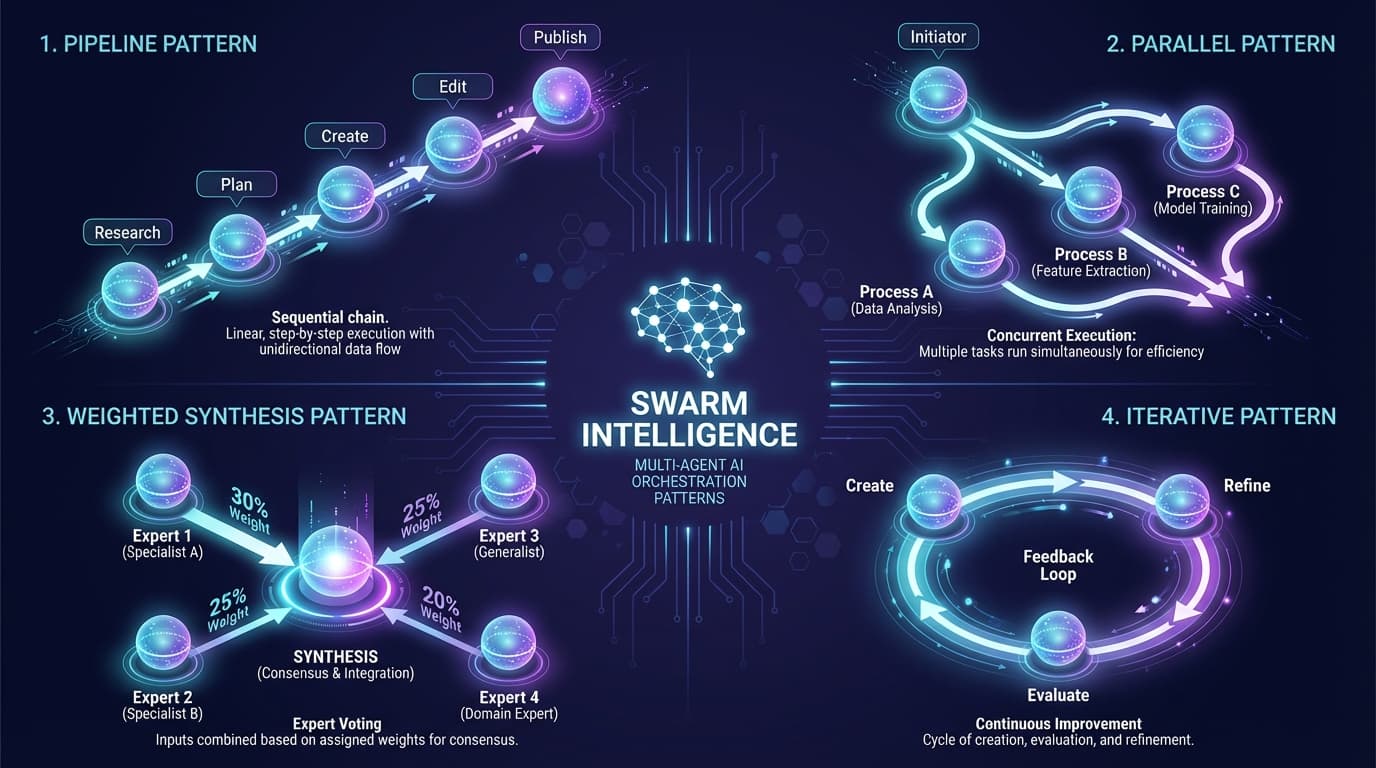
AI Architecture14 min
Swarm Intelligence: Multi-Agent Orchestration for Creators
Learn the 4 orchestration patterns that make AI agents work together: Pipeline, Parallel, Weighted Synthesis, and Iterative. Real examples from ACOS production use.
Read article
Creator Systems12 min
Build Your Own Jarvis: Turn Claude Code Into Your Personal Intelligence System
Stop using AI tools like everyone else. Build a personal AI system that knows your work, executes your workflows, and gets smarter every day. Here's exactly how.
Read article