Creator SystemsFebruary 14, 202618 min
The FrankX Intelligence Ecosystem: How 5 Systems Work Together to Build What Matters
A complete technical guide to the FrankX creator intelligence stack — Vibe OS, GenCreator OS, ACOS v10, Starlight Intelligence System v4, and Arcanea. How they interconnect, what each does, and why the whole is greater than the sum of its parts.

🎯
Reading Goal
Understand how five interconnected intelligence systems form a complete creator operating stack — and how to install each one.
The FrankX Intelligence Ecosystem: How 5 Systems Work Together
The architecture behind 12,000+ AI songs, this website, enterprise consulting, and a creator business that runs while I sleep.
TL;DR
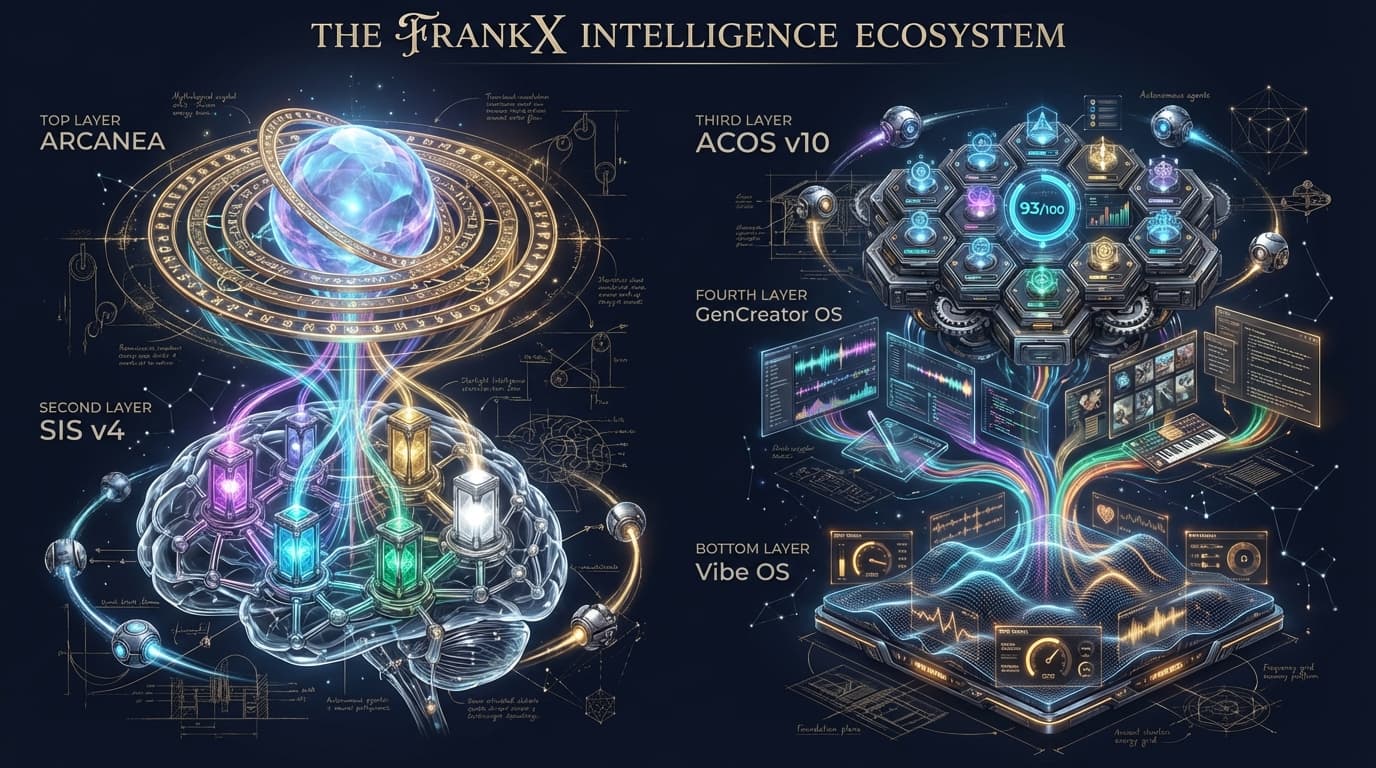
Five systems. One intelligence stack. Vibe OS manages your creative state through neuro-state engineering with AI music. GenCreator OS is your multi-modal creative studio spanning text, image, music, and code. ACOS v10 is an autonomous operating system for Claude Code with 22 skills, 8 agents, and self-improving intelligence. Starlight Intelligence System v4 provides persistent memory, trajectory learning, and intelligence scoring across every session. Arcanea wraps it all in a 10-Gate creative progression framework. Each system is powerful alone. Together, they compound — every session makes the next one smarter. This is how one person ships like a team of ten.
Why an Ecosystem, Not Just Tools
Most creators collect tools. A writing app here, an image generator there, maybe an automation platform. The tools don't talk to each other. Context gets lost between sessions. Every project starts from zero.
That's not a system. That's a toolbox with no workshop.
An ecosystem is different. Each component is designed to feed into the others. Your creative state informs your content generation. Your content generation trains your operating system. Your operating system syncs to persistent memory. Your memory compounds into intelligence that makes everything faster, better, and more aligned with who you actually are.
The difference between a toolbox and an ecosystem is compounding returns. A toolbox gives you linear improvement. An ecosystem gives you exponential improvement — every session builds on the last.
Here's how ours works.
Layer 1: Vibe OS — The Foundation
What it is: A creative state management system using the RPM Model (Result/Purpose/Map) for neuro-state engineering with AI music.
The problem it solves: You can't create at your best when your internal state is wrong. Anxiety produces anxious work. Scattered energy produces scattered content. Most creators try to power through bad states instead of engineering good ones.
How it works:
Vibe OS treats creative states as programmable. Using Tony Robbins' RPM framework adapted for creators:
- Result: What specific creative outcome do you need right now?
- Purpose: Why does this matter to your larger creative mission?
- Map: What sequence of actions, in what state, will get you there?
The "state engineering" piece is where AI music comes in. Specific frequencies, tempos, and sonic textures reliably shift neurological states. This isn't meditation music with whale sounds — it's precision-engineered audio designed for specific creative modes:
- Alpha state (8-12 Hz): Deep writing, long-form content
- Beta state (12-30 Hz): Coding, technical architecture
- Theta state (4-8 Hz): Ideation, brainstorming, creative exploration
- Delta bridge: Recovery between intense creative sessions
What you get: A repeatable process for entering peak creative states on demand, not waiting for inspiration.
Install: Vibe OS ships free with the Creator's Soulbook — 7 pillars of creative intelligence delivered as an Obsidian vault you can start using immediately.
Cost: Free.
Layer 2: GenCreator OS — The Creative Engine
What it is: A multi-modal creative studio spanning text, image, music, and code generation — unified under one system.
The problem it solves: Creators use 5-10 different AI tools, each with separate contexts, separate prompts, separate workflows. The image you generate in Midjourney knows nothing about the article you're writing in Claude. Your music production is disconnected from your visual brand. Nothing compounds.
How it works:
GenCreator OS unifies creative generation across four modalities:
| Modality | Engines | Output |
|---|---|---|
| Text | Claude, custom prompts | Blog posts, documentation, marketing copy |
| Image | Gemini 3 Pro Image, DALL-E, Midjourney | Brand visuals, infographics, social assets |
| Music | Suno AI, Web Audio API | AI songs, frequency tools, interactive instruments |
| Code | Claude Code, ACOS | Full-stack applications, components, APIs |
The key innovation isn't multi-modal generation — lots of tools do that. It's cross-modal context. When GenCreator OS generates a blog hero image, it knows the article's theme, tone, and target audience. When it creates background music for a content session, it knows whether you need alpha-state focus music or beta-state coding energy.
Example workflow:
- Write a blog post about AI architecture (text)
- Generate a Da Vinci-style infographic to illustrate the concepts (image)
- Create a focus playlist for readers engaging with the technical content (music)
- Build an interactive demo component embedded in the article (code)
All four outputs share context. The image uses brand colors. The music matches the article's energy. The interactive component references the same technical concepts. One system, four modalities, total coherence.
Install: GenCreator OS is integrated into the ACOS skill system. The core commands are available through Claude Code with ACOS installed.
Cost: Free (open-source). Requires API keys for individual generation services.
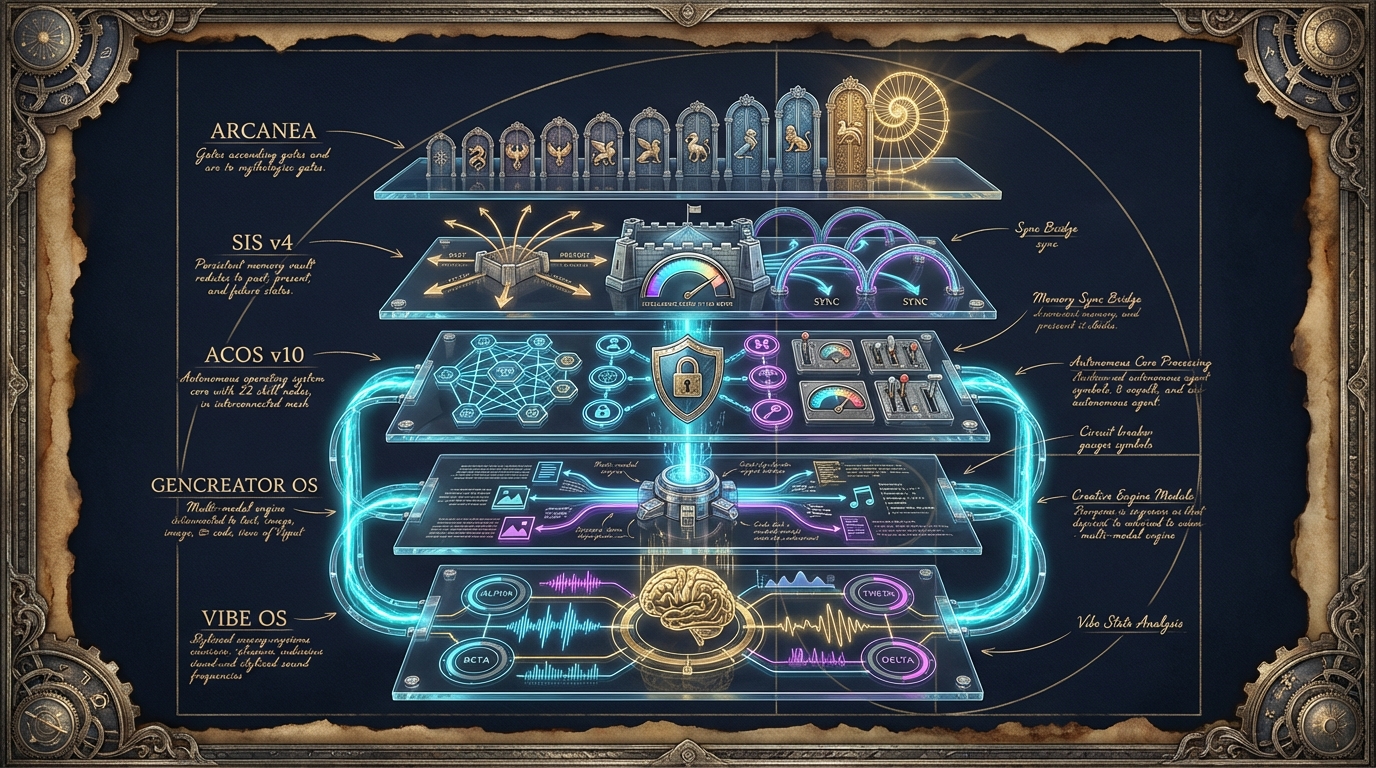
Layer 3: ACOS v10 — The Autonomous Operating System
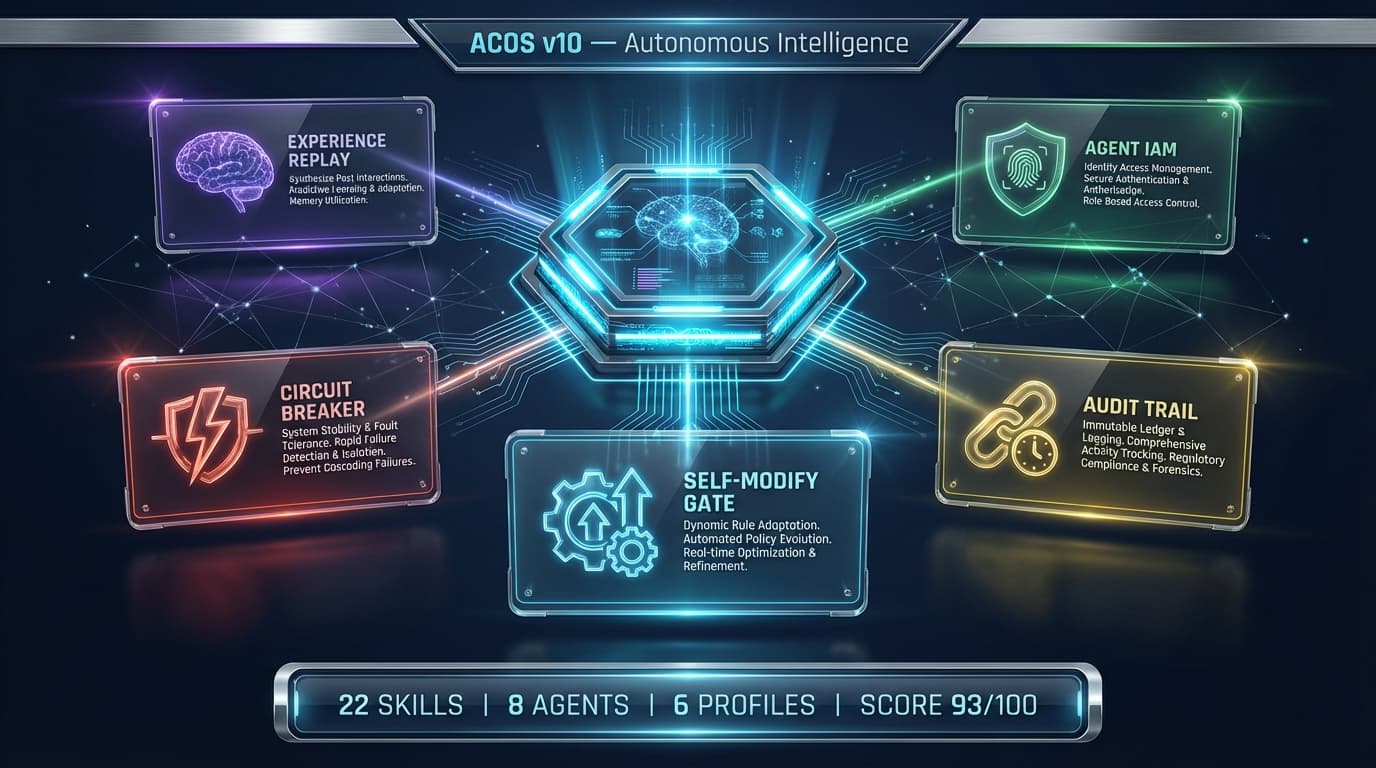
What it is: An autonomous intelligence operating system for Claude Code. 22 curated skills, 8 specialist agents, 6 IAM-scoped profiles, experience replay, circuit breakers, and self-improving intelligence loops.
The problem it solves: Claude Code is powerful but stateless by default. Every session starts fresh. It doesn't know your codebase conventions, your brand voice, your deployment workflow, or the mistakes it made yesterday. ACOS gives Claude Code a brain.
How it works:
ACOS v10 is built on five foundational systems:
1. Executable Routing
Every user prompt is classified into one of 8 domains (code development, deployment, content creation, music production, etc.) and routed to the appropriate specialist agent with the right skill set pre-loaded.
User: "Deploy the blog post to production"
→ Domain: deployment
→ Agent: DevOps Engineer
→ Skills: vercel-deployment, git-pr-workflows
→ Context: Two-repo architecture, production worktree
2. Agent IAM (Identity & Access Management)
Not every agent should have access to everything. The music producer doesn't need to touch .claude/ configuration files. The content writer shouldn't run destructive bash commands.
ACOS v10 implements per-profile tool and directory scoping:
| Profile | Tools | Directories |
|---|---|---|
| content-architect | Read, Write, Edit, Glob, Grep | content/, components/, data/ |
| music-producer | Read, Write, Bash (restricted) | content/blog/, public/images/ |
| devops-engineer | All tools | All directories |
| frontend-designer | Read, Write, Edit, Glob | app/, components/, public/ |
3. Experience Replay
Before starting a new task, ACOS searches past successful trajectories for similar work. The top 2 matches get injected as context — like giving Claude Code a memory of what worked before.
4. Confidence Circuit Breaker
Tracks failures per file. Warning at 3 failures, restricted access at 5, full circuit break at 8. Prevents the agent from repeatedly breaking the same file. Resets on success or session end.
5. Self-Modify Gate
ACOS can modify its own configuration — but carefully. Before any self-modification, it snapshots the current config. After the change, it validates the intelligence score. If the score drops by more than 5 points, it auto-reverts. Evolution with guardrails.
Current intelligence score: 93/100 (up from 72 in v9.3).
Install:
# Clone the ACOS configuration
git clone https://github.com/frankxai/acos-config .claude-flow/

# The .claude/ directory contains hooks, settings, and skill rules
# ACOS activates automatically on Claude Code session start
Cost: Free (open-source). Requires Claude Code (Claude Pro/Max subscription).
Layer 4: Starlight Intelligence System v4 — The Memory Layer
What it is: A persistent intelligence layer providing memory vaults, ACOS trajectory synchronization, and unified intelligence scoring. Zero runtime dependencies. TypeScript strict mode.
The problem it solves: ACOS makes Claude Code intelligent within a session. But what about across sessions? What about across projects? What about measuring whether your system is actually getting smarter?
SIS v4 is the answer to "where does the learning go?"
How it works:
SIS v4 has three core capabilities:
Memory Vaults
Persistent, categorized knowledge storage with confidence scoring:
interface Memory {
  id: string;
  content: string;
  category: "pattern" | "decision" | "insight" | "error" | "preference";
  tags: string[];
  confidence: number; // 0-1
  createdAt: string;
  source: string;
}
Every important observation — a debugging pattern, an architectural decision, a user preference — gets stored with metadata. Search by category, tags, or content. Knowledge compounds across sessions.
ACOS Trajectory Sync
ACOS records trajectories — structured logs of what happened during each session. SIS v4's sync bridge ingests these trajectories and classifies them:
| Success Score | Classification |
|---|---|
| ≥ 0.85 | Pattern (reliable, reusable) |
| ≤ 0.50 | Error (learn from failure) |
| Config files modified | Decision (architectural choice) |
| Skill execution | Preference (workflow preference) |
| Everything else | Insight (general learning) |
Deduplication ensures no trajectory gets counted twice. The sync is idempotent — run it 100 times, get the same result.
Intelligence Scoring
A unified 100-point score measuring system intelligence across 4 dimensions:
| Component | Max Points | What It Measures |
|---|---|---|
| Memory Depth | 25 | Entry count, category diversity, high-confidence ratio, tag richness |
| Pattern Quality | 25 | Pattern count, average success rate, elite pattern ratio |
| Operational History | 25 | Trajectory count, type diversity, average success rate |
| Learning Velocity | 25 | Recent memory growth, recent trajectory rate, source diversity |
Current score: 91/100, Grade S.
The score isn't vanity — it's a feedback loop. If the score drops after a configuration change, ACOS's self-modify gate auto-reverts. Intelligence is measured, not assumed.
Install:
# Clone SIS v4
git clone https://github.com/frankxai/Starlight-Intelligence-System
cd Starlight-Intelligence-System
npm install && npm run build

# Initialize memory
npx starlight init

# Sync ACOS trajectories
npx starlight sync --acos-path /path/to/FrankX

# Check intelligence score
npx starlight score --acos-path /path/to/FrankX
Cost: Free (open-source). Zero runtime dependencies — only Node.js built-ins.
Layer 5: Arcanea — The Progression Framework
What it is: A 10-Gate creative progression system. Mythology-infused creative development that transforms raw potential into mastery through structured advancement.
The problem it solves: Technology without direction is noise. You can have the most powerful AI systems in the world, but if you don't know where you're going as a creator, the systems just help you run faster in circles.
Arcanea provides the map.
How it works:
The 10 Gates of Arcanea represent stages of creative development — not arbitrary levels, but genuine phase transitions in how you relate to your creative work:
| Gate | Name | Focus |
|---|---|---|
| 1 | Awakening | Recognizing creative potential |
| 2 | Foundation | Building core skills and discipline |
| 3 | Expression | Finding authentic voice |
| 4 | Craft | Technical mastery of chosen medium |
| 5 | Integration | Cross-modal creative synthesis |
| 6 | Innovation | Creating new forms and methods |
| 7 | Influence | Scaling impact through systems |
| 8 | Mastery | Effortless excellence |
| 9 | Legacy | Building what outlasts you |
| 10 | Transcendence | Creating for creation's sake |
Each Gate has specific milestones, challenges, and rewards. The system isn't about speed — some creators spend years at a single Gate. It's about knowing where you are and what genuine progress looks like.
The Golden Age of Creators — an ongoing book series — documents the philosophy, stories, and practical frameworks for each Gate. Three chapters and three essays are published, with more in progress.
Install: Arcanea is available through the Creator's Soulbook and the Golden Age publication series.
Cost: Free (Soulbook). Book chapters released as they're written.
How the Systems Connect
Here's where it gets interesting. Each system is useful alone. Together, they create feedback loops that compound.
Feedback Loop 1: State → Creation → Learning
Vibe OS (set alpha state for deep writing)
  → GenCreator OS (generate blog post + visuals + music)
    → ACOS (orchestrate the session, route to right agents)
      → SIS (record what worked, update patterns)
        → Next session starts smarter
Feedback Loop 2: Error → Memory → Prevention
ACOS circuit breaker (detect repeated failure on a file)
  → SIS trajectory sync (classify as "error" pattern)
    → Experience replay (inject error context in future similar tasks)
      → Failure avoided next time
Feedback Loop 3: Decision → Score → Evolution
ACOS self-modify gate (propose config change)
  → SIS intelligence score (measure before/after)
    → If score drops > 5 points: auto-revert
    → If score improves: persist + record as "decision"
      → System evolves safely
Feedback Loop 4: Progression → System → Progression
Arcanea Gate advancement (reach Gate 5: Integration)
  → Unlock cross-modal GenCreator workflows
    → ACOS routes multi-modal tasks efficiently
      → SIS records cross-modal patterns
        → Intelligence compounds across modalities
          → Next Gate becomes achievable
These aren't theoretical loops. They're running right now. Every article I write makes the system better at writing articles. Every deployment teaches ACOS better deployment patterns. Every creative session refines Vibe OS's state recommendations.
The math: After 109 synced memories and 59 trajectories, the system achieves a 91/100 intelligence score. That number only goes up.
The Value Architecture
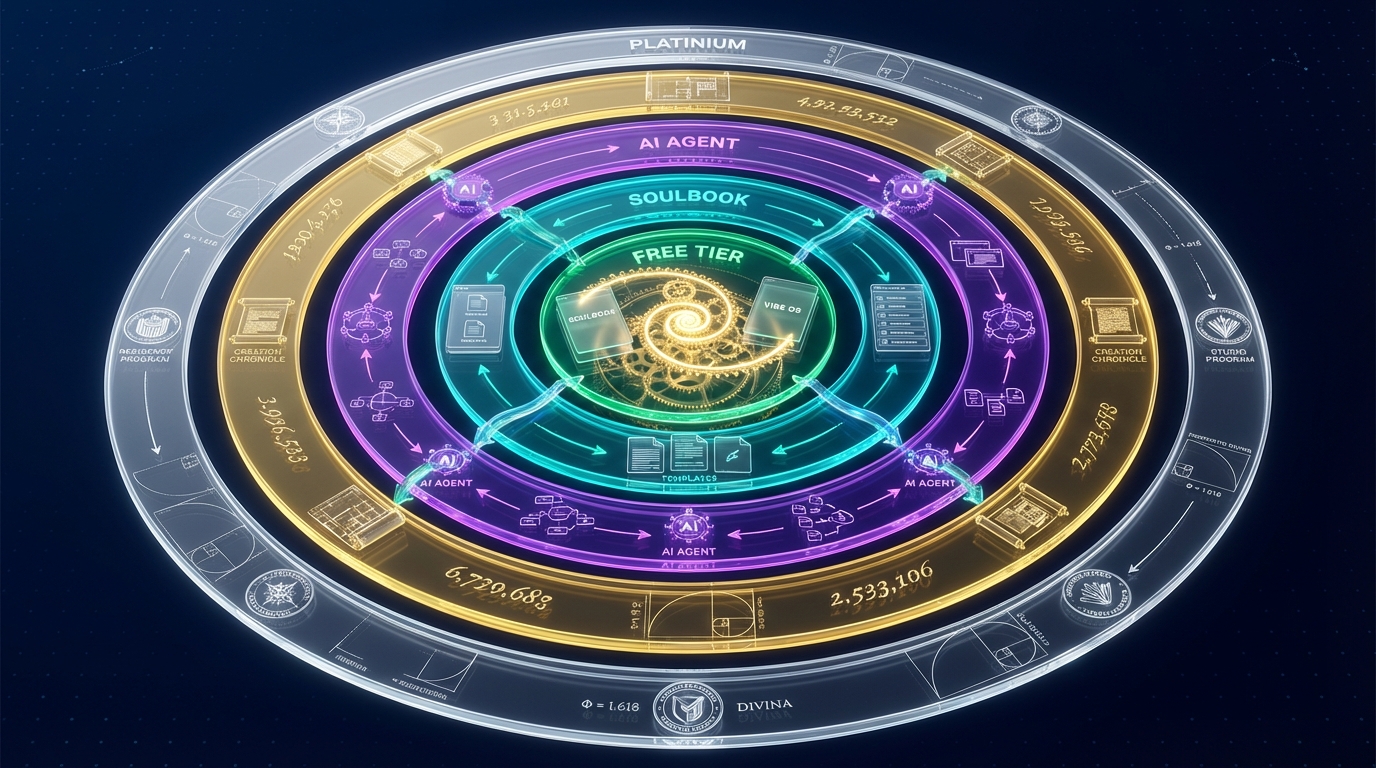
The ecosystem follows a deliberate value ladder — you can start for free and go as deep as you want:
Free Tier — Start Here
| Product | What You Get |
|---|---|
| Creator's Soulbook | 7-pillar creative intelligence vault (Obsidian) |
| Vibe OS | RPM-based creative state management |
| ACOS | Open-source Claude Code operating system |
| SIS v4 | Open-source intelligence layer |
Everything you need to build a functioning intelligence system. No credit card, no email wall for the code. The Soulbook requires an email — it's the start of a relationship, not a paywall.
Templates & Tools ($27–$47)
| Product | What You Get |
|---|---|
| Suno Prompt Library | 500+ genre-specific AI music prompts |
| Creative AI Toolkit | Templates for cross-modal creation |
| GenCreator Starter | Pre-configured multi-modal workflows |
Agents & Workflows ($97–$297)
| Product | What You Get |
|---|---|
| ACOS Pro Configuration | Pre-tuned agent profiles for specific industries |
| Workflow Blueprints | Production-tested automation sequences |
| Intelligence Accelerator | Advanced SIS configurations + pattern libraries |
Architectures & Programs ($297–$997)
| Product | What You Get |
|---|---|
| Creation Chronicles | Deep-dive documentation of real builds |
| Creator Lab | Community + live build sessions |
| Architecture Blueprints | Enterprise-grade system designs |
Studio & Residency ($2,500–$12,000+)
| Product | What You Get |
|---|---|
| Creator Studio | 1-on-1 system building |
| Creator Residency | Full ecosystem installation + training |
The key insight: the free tier is genuinely powerful. ACOS and SIS are fully open-source. You can build everything described in this article without spending a dollar. The paid tiers save time and provide pre-built configurations, not locked features.
Installing the Full Stack
Here's the practical installation order, from foundation to apex:
Week 1: Foundation (Vibe OS + Soulbook)
- Download the Creator's Soulbook
- Set up the Obsidian vault
- Complete the 7-pillar self-assessment
- Begin daily state engineering practice with AI music
Week 2: Operating System (ACOS)
- Install Claude Code (requires Claude Pro or Max)
- Clone ACOS configuration into your project
- Run your first ACOS-powered session
- Let the trajectory system begin recording
Week 3: Intelligence (SIS v4)
- Clone and build SIS v4
- Run your first trajectory sync
- Check your initial intelligence score
- Set up the ACOS hook bridge for automatic syncing
Week 4: Creation + Progression (GenCreator OS + Arcanea)
- Configure multi-modal generation workflows
- Read your current Arcanea Gate assessment
- Set Gate-specific creative goals
- Begin the first cross-modal project
By the end of Week 4, you have a fully operational intelligence ecosystem. Every session after that makes the system smarter.
Measuring What Matters
The ecosystem isn't faith-based. Everything is measured:
| Metric | How It's Measured | Current |
|---|---|---|
| Intelligence Score | SIS v4 4-component scoring | 91/100 (Grade S) |
| ACOS Intelligence | v10 self-assessment | 93/100 |
| Memory Entries | SIS vault count | 109 |
| Trajectories Synced | ACOS → SIS bridge | 59 |
| Pattern Success Rate | Avg trajectory success | 67% |
| Content Velocity | Articles shipped per week | 3-5 |
| Modalities Active | Cross-modal generation | 4/4 |
These numbers aren't aspirational. They're from npx starlight score run today.
The Compound Effect
Here's what happens after 30 days with the full ecosystem:
Day 1: You have a fresh ACOS install. Intelligence score: ~40/100. Sessions are functional but generic.
Day 7: ACOS has 10+ trajectories. SIS classifies early patterns. Experience replay starts injecting relevant context. Sessions feel noticeably faster.
Day 14: 30+ trajectories synced. The circuit breaker has prevented 3 repeated failures. Agent IAM has scoped your workflow. Intelligence score: ~65/100.
Day 30: 60+ trajectories, 100+ memories. The system knows your codebase, your brand voice, your deployment workflow, your common mistakes. Sessions that took 2 hours now take 45 minutes. Intelligence score: ~85/100.
Day 90: The system is yours. Not a generic AI assistant — a personalized intelligence layer that thinks like you, catches what you miss, and executes at a level that would take a team to match manually.
This is the compounding curve that separates an ecosystem from a toolbox.
Frequently Asked Questions
Do I need all five systems?
No. Each system works independently. Start with ACOS if you use Claude Code. Start with Vibe OS if you want better creative states. Start with Arcanea if you want creative direction. The systems are designed to be adopted incrementally.
Is this only for developers?
ACOS and SIS require Claude Code (technical). Vibe OS, GenCreator OS, and Arcanea are accessible to non-technical creators. The Soulbook requires zero coding knowledge.
How is this different from just using Claude Code?
Claude Code is the engine. ACOS is the operating system that makes the engine intelligent. SIS is the memory that makes the operating system learn. Without ACOS, Claude Code starts fresh every session. Without SIS, ACOS can't compound across sessions.
What does "intelligence score" actually measure?
Four things: how deep your memory is (entry count, category diversity), how reliable your patterns are (success rate), how much operational history exists (trajectory count, type diversity), and how fast you're learning (recent growth rate). It's a composite metric, not a single number.
Can I use this with Cursor or Windsurf instead of Claude Code?
SIS v4 generates context for multiple targets — Claude Code (CLAUDE.md), Cursor (.cursorrules), and Windsurf (.windsurfrules). ACOS is Claude Code-specific, but SIS provides the intelligence layer for any AI coding tool.
What's the total cost?
The core stack is free. Claude Code requires a Claude Pro ($20/month) or Max ($100/month) subscription. AI generation services (image, music) have their own costs. The paid products in the value ladder are optional accelerators.
Is this production-tested?
This ecosystem powers frankx.ai — the site you're reading right now. It's responsible for 12,000+ AI songs, 70+ blog articles, 15+ premium infographics, and enterprise consulting deliverables. It's not theoretical.
What's Next
The ecosystem is always evolving. Current roadmap:
- SIS v4.1: Vector similarity search for memory retrieval
- SIS v5.0: Multi-project intelligence aggregation
- ACOS v10.1: Enhanced experience replay with semantic matching
- GenCreator OS 2.0: Unified prompt chains across all four modalities
- Arcanea Interactive: Digital Gate assessment and progression tracking
The architecture is set. Now it compounds.
Build what matters. Let the systems handle the rest.
Ready to start? Download the Creator's Soulbook — it's free, and it's the fastest way into the ecosystem. Or jump straight to the code: ACOS on GitHub | SIS v4 on GitHub.
Related Articles
- Why Every Creator Needs an Intelligence System in 2026 — The case for personal AI systems
- The Complete Guide to Agentic Creator OS — Deep dive into ACOS
- Vibe OS: Engineering Neuro-State with the RPM Model — The foundation layer explained
- What is Agentic AI? — Understanding autonomous AI agents
- Getting Started with Agentic Creator OS — 30-minute setup walkthrough
Get Started
Build your first AI system
Step-by-step guide to setting up ACOS, creating your first agent, and shipping real products with AI.
Start buildingTemplates & Blueprints
Production-ready architecture
Download AI architecture templates, multi-agent blueprints, and prompt engineering patterns.
Browse templatesInner Circle
Join the builder community
Connect with creators and architects shipping AI products. Weekly office hours, shared resources, direct access.
Join the circleTags

Read on FrankX.AI — AI Architecture, Music & Creator Intelligence
Stay in the intelligence loop
Weekly field notes on AI systems, production patterns, and builder strategy.
Continue Reading
Product Updates7 min
ACOS v10: Autonomous Intelligence — The System That Improves Itself
ACOS v10 ships 5 new safety and intelligence systems. Intelligence score jumps from 72 to 93. Here's what changed and why it matters for AI-native creators.
Read article
AI Architecture5 min
AI Agents Need an Inner Family, Not Just a Task List
Most agent stacks are glorified workflow runners. The next leap is internal governance — an orchestrator that knows which sub-process is leading, and why.
Read article
Consciousness & Mind7 min
Your Body Is Part of Your AI Stack
The disembodied AI ceiling and the embodied creator OS. Why training, sleep, breath, and environment are cognitive infrastructure — for humans and for the agents we build.
Read article