Vibe SessionsJanuary 5, 20254 min read
The Science of Using Music to Change Your State
How tempo, mode, and lyrics create predictable emotional outcomes—backed by peer-reviewed research

🎯
Reading Goal
Learn the musical parameters that reliably shift emotional state and how to apply them.
What if you could engineer your emotional state as precisely as you mix a track?
Not metaphorically. Literally.
After diving deep into psychomusicology, music therapy, and neuroscience research, I discovered something that changed how I approach every creative session:
Specific musical parameters create predictable emotional outcomes.
This isn't woo-woo. It's peer-reviewed science. Let me show you.
The Map of Emotions
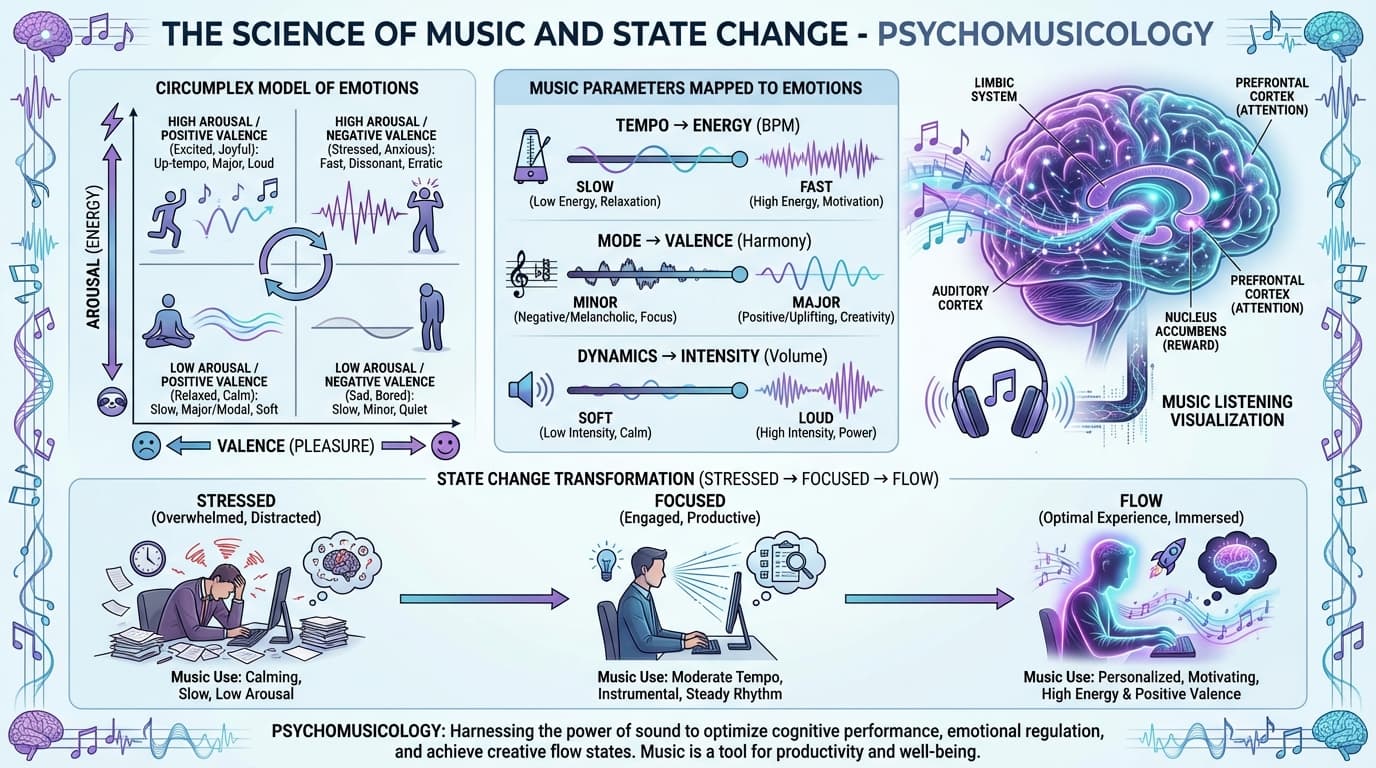
Every emotional state lives on a two-dimensional map called the Circumplex Model:
- Vertical axis: Arousal (energy level)
- Horizontal axis: Valence (positive/negative)
Here's the breakthrough: music parameters map directly to this space.
| Parameter | Controls | How |
|---|---|---|
| Tempo | Arousal | Faster BPM = higher energy |
| Mode | Valence | Major = positive, Minor = negative |
| Lyrics | Both | Direct emotional induction |
Want high energy + positive? High BPM + Major key.
Want calm + introspective? Low BPM + Minor key.
It's not magic. It's architecture.
The Numbers That Matter
Tempo
Research reveals specific ranges for each state:
| State | BPM | Why |
|---|---|---|
| Sleep/meditation | 50-70 | Matches theta brainwaves |
| Calm focus | 80-100 | Alpha state territory |
| Natural baseline | 100-120 | Human preference zone |
| High energy | 120-145 | Peak motivation |
Critical finding: There's a ceiling at ~145 BPM. Faster doesn't mean more motivated.
Key/Mode
The major-happy / minor-sad association isn't cultural—it's been documented since 1558 and holds across cultures.
But here's the nuance: minor keys aren't just "sad." They provide a safe container for processing difficult emotions. Use them strategically for emotional release.
Lyrics
A meta-analysis of 42 studies found that ALL of them showed psychological effects aligned with lyrical content.
Not most. Not many. All.
Lyrics are "particularly potent at inducing emotional states."
The Performance Numbers
This is where it gets wild.
Music as a performance enhancer:
| Metric | Improvement |
|---|---|
| Perceived exertion | -22% (exercise feels easier) |
| Physical performance | +31% |
| Motivation | +131% |
That motivation number isn't a typo.
"One could think of music as a type of legal performance-enhancing drug." — Costas Karageorghis, Brunel University
The ISO Principle
Here's the secret music therapists use:
Don't jump to your target state. Bridge to it.
Start with music that matches your current state, then gradually shift parameters toward your target.
Anxious → Calm:
110 BPM, A Minor → 90 BPM, D Minor → 75 BPM, G Major → 65 BPM, F Major
Your brain resists sudden shifts but follows gradual ones.
This is why a single "pump-up song" often fails when you're depleted. You need the bridge.
My State Library
I've built this into a system I call Vibe OS. Here are the states I use daily:
Morning Energy
- BPM: 120 | Key: G Major
- Instruments: Acoustic guitar, piano, light percussion
- Use: Start day positive
Deep Focus
- BPM: 90 | Key: C Major
- Instruments: Ambient synths, minimal piano
- Use: Writing, coding, deep work
Confidence
- BPM: 128 | Key: D Major
- Instruments: Brass, anthemic strings, driving drums
- Use: Before performances, important calls
Creative Flow
- BPM: 100 | Key: A Major
- Instruments: Piano, soft strings, nature sounds
- Use: Ideation, studio sessions
Relaxation
- BPM: 70 | Key: F Major
- Instruments: Soft piano, warm pads
- Use: Evening wind-down
The Protocol
- Identify where you are (current state)
- Identify where you need to be (target state)
- Match first (start with music for current state)
- Bridge gradually (transition tracks)
- Lock in target state music
- Enhance with binaural frequencies (optional)
The Tools
I've open-sourced everything:
- Prompt generator for AI music (Suno, Hailuo, Udio)
- Frequency mixer for binaural enhancement
- 15 research-backed state presets
- Full research documentation
Generate a prompt for any state:
python tools/vibe-prompt-generator.py --state confidence --with-lyrics
Output includes optimized prompts for AI music generation with the right BPM, key, instruments, and lyric themes.
The Shift
I used to shuffle play and hope something hit.
Now I engineer my state before every session.
Morning ritual. Studio prep. Performance confidence. Evening wind-down.
Same brain. Different inputs. Predictable outputs.
Music isn't background noise. It's a state-change technology.
Use it intentionally.
Read the full research in the Vibe OS Whitepaper.
Sources: PMC8167645, PMC11220113, Nature Scientific Reports 2025, Frontiers Psychology 2024
Related Articles
- Music as Consciousness Technology — 12,000 songs and what they taught me
- Suno Prompt Engineering Complete Guide — Create intentional soundscapes
- The Soul Frequency Framework — Finding your creative signature
Get Started
Build your first AI system
Step-by-step guide to setting up ACOS, creating your first agent, and shipping real products with AI.
Start buildingTemplates & Blueprints
Production-ready architecture
Download AI architecture templates, multi-agent blueprints, and prompt engineering patterns.
Browse templatesInner Circle
Join the builder community
Connect with creators and architects shipping AI products. Weekly office hours, shared resources, direct access.
Join the circle
Read on FrankX.AI — AI Architecture, Music & Creator Intelligence
Stay in the intelligence loop
Weekly field notes on AI systems, production patterns, and builder strategy.
Continue Reading
Creator Systems10 min read
The Creative OS: A Guide to Building Your Creative Operating System
Learn how to design and build your own Creative Operating System (Creative OS) to enhance your creativity, productivity, and impact.
Read article
Creator Tools7 min read
The Best AI Tools for Creators in 2026: A GenCreator's Production Stack
The complete AI creator toolkit — from Claude Code for development to Suno for music. Every tool battle-tested in daily production use.
Read article
Creator Systems6 min read
The 3-Tier Shipping System: How GenCreators Build Creative Momentum
Full Ship, Quick Ship, Micro Ship — energy-aware daily output. The system that turns sporadic creation into unstoppable momentum.
Read article