Content StrategyJanuary 27, 202611 min
SEO & AEO Optimization with ACOS: Rank in Search and AI Engines
Master search and AI engine optimization with ACOS. Question-based structure, FAQ schemas, AI citation optimization, and the /factory pipeline for publish-ready content.

🎯
Reading Goal
Implement SEO and AEO best practices using ACOS for maximum discoverability.
SEO & AEO Optimization with ACOS: Rank in Search and AI Engines
How to write content that Google AND ChatGPT want to cite.
TL;DR
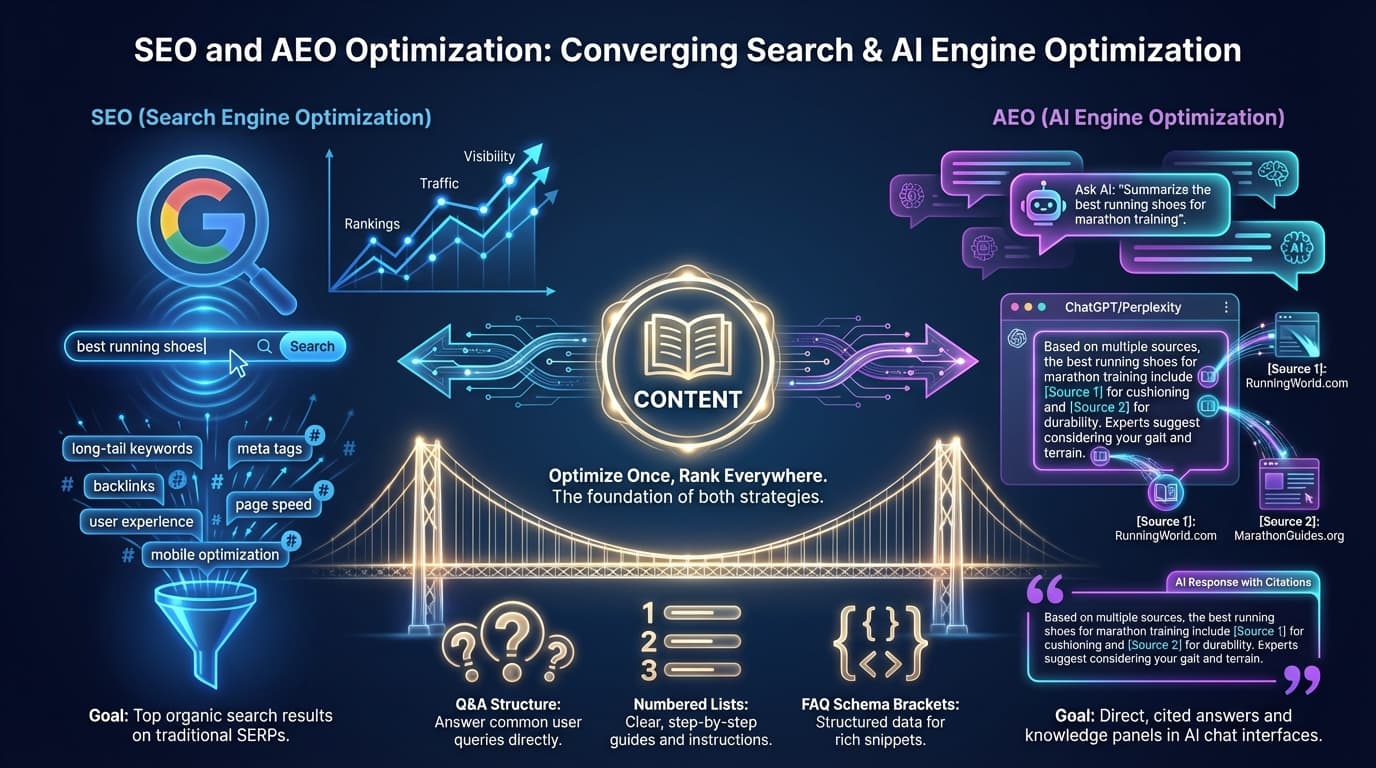
Traditional SEO optimizes for Google. AEO (AI Engine Optimization) optimizes for ChatGPT, Perplexity, and Claude. ACOS does both through: question-based H2 headings, FAQ schema markup, TL;DR in first 100 words, numbered lists for AI extraction, and the /factory pipeline that enforces these patterns automatically. This guide covers the framework and shows how to implement it.
What Is AEO (AI Engine Optimization)?
AEO is the practice of optimizing content for AI assistants to cite. When someone asks ChatGPT "What is the best AI productivity system?", you want your content cited as the answer.
SEO vs AEO:
| Dimension | SEO (Search) | AEO (AI Engines) |
|---|---|---|
| Target | Google, Bing | ChatGPT, Perplexity, Claude |
| Success | Rank #1 | Get cited/quoted |
| Format | Keywords, backlinks | Clear statements, lists |
| Intent | User clicks through | AI extracts and summarizes |
| Metrics | Rankings, traffic | Citations, brand mentions |
Why AEO Matters in 2026
The numbers tell the story:
- 40% of search queries now touch AI systems
- ChatGPT has 200M+ weekly users asking questions
- Perplexity growing 30% month-over-month
- AI Overviews appearing in 25%+ of Google searches
If your content isn't optimized for AI extraction, you're invisible to a growing segment of information seekers.
The ACOS Content Framework
ACOS enforces SEO/AEO best practices through the content pipeline. Here's the framework:
1. Question-Based H2 Headings
Why: AI engines look for questions to match user queries. Google loves them for featured snippets.
# Bad H2s

## Introduction

## Features

## Conclusion

# Good H2s (Question-Based)

## What Is Agentic Creator OS?

## How Does the Smart Router Work?

## Why Do Creators Need an AI Operating System?
ACOS Implementation:
The /article-creator command automatically structures articles with question-based headings:
/article-creator "Guide to AI productivity"

# ACOS generates:
## What Is AI Productivity?
## Why Do Traditional Tools Fall Short?
## How Does AI-Powered Productivity Work?
## What Are the Best AI Productivity Tools?
## How Do I Get Started?
2. TL;DR in First 100 Words
Why: AI engines often extract the first paragraph. Make it count.
# Bad Opening

In this comprehensive guide, we'll explore the many facets of AI productivity...

# Good Opening (TL;DR)

AI productivity systems automate repetitive work, coordinate multiple tools, and
maintain context across sessions. The best approach: use an operating system like
ACOS that combines 25 commands, 80+ skills, and 40+ agents. Start with `/acos`.
ACOS Implementation: Every article template includes a TL;DR section that's populated first.
3. FAQ Schema Markup
Why: FAQ schema gets featured snippets and AI citations.
## Frequently Asked Questions

### What is ACOS?

ACOS (Agentic Creator OS) is an open-source operating system for Claude Code
that adds 25 commands, 80+ skills, and 40+ agents.

### Is ACOS free?

Yes, completely free and open source on GitHub.

### How long does installation take?

Under 10 minutes for the full setup.
Schema Output:
{
  "@type": "FAQPage",
  "mainEntity": [
    {
      "@type": "Question",
      "name": "What is ACOS?",
      "acceptedAnswer": {
        "@type": "Answer",
        "text": "ACOS (Agentic Creator OS) is an open-source operating system..."
      }
    }
  ]
}
4. Numbered Lists for AI Extraction
Why: AI engines love extracting numbered lists. They're easy to parse and cite.
# Bad

There are several benefits including speed, quality, and consistency...

# Good

The 5 key benefits of ACOS:

1. **Speed**: 10x faster content creation
2. **Quality**: Built-in quality gates
3. **Consistency**: Brand voice enforcement
4. **Scale**: Handle more projects
5. **Learning**: Skills compound over time
5. Clear Definitions
Why: AI engines cite definitions verbatim.
# Bad

Multi-agent orchestration is kind of like having multiple AI helpers...

# Good

**Multi-agent orchestration** is the coordination of multiple specialized AI
agents to complete complex tasks. Each agent handles a specific domain while
an orchestrator manages handoffs and synthesizes outputs.
6. Internal Linking Strategy
Why: Both Google and AI engines follow links to understand content relationships.

ACOS Implementation:
The /article-creator automatically suggests relevant internal links from your content inventory.
The /factory Pipeline
The /factory command enforces all SEO/AEO best practices automatically:
/factory "Complete guide to AI agents for enterprise"

# Pipeline:
1. RESEARCH → Gather current data, competitor analysis
2. PLAN → Structure with question-based H2s
3. DRAFT → Write with TL;DR, lists, definitions
4. OPTIMIZE → Add FAQ section, internal links
5. VALIDATE → Check SEO/AEO checklist
6. PUBLISH → Deploy with schema markup
The SEO/AEO Checklist (Automated)
ACOS validates every article against:
- TL;DR in first 100 words
- Question-based H2 headings (5+ questions)
- FAQ section (5-10 questions)
- Numbered/bulleted lists (3+ per article)
- Clear definitions for key terms
- Internal links (3+ related articles)
- Meta title under 60 characters
- Meta description 150-160 characters
- Schema markup (Article + FAQPage)
- Reading time accurate
AI Citation Optimization Techniques
Technique 1: Definitive Statements
AI engines prefer citing clear, definitive statements over hedged language.
# Bad (hedged)

ACOS might help improve productivity for some users in certain situations.

# Good (definitive)

ACOS improves productivity by automating repetitive tasks and coordinating
AI agents. Users report 10x faster content creation.
Technique 2: Statistics and Numbers
AI engines love citing specific numbers.
# Bad

ACOS has many commands and skills.

# Good

ACOS includes 25 commands, 80+ skills, and 40+ agents.
Technique 3: Comparison Tables
Tables are easy for AI to parse and cite.
| Feature         | ACOS        | Traditional AI |
| --------------- | ----------- | -------------- |
| Commands        | 25          | 0              |
| Skills          | 80+         | 0              |
| Auto-activation | Yes         | No             |
| Orchestration   | Multi-agent | Single agent   |
Technique 4: Step-by-Step Instructions
AI engines frequently cite how-to content.
## How to Install ACOS

1. Clone the repository: `git clone https://github.com/frankxai/agentic-creator-os`
2. Enter the directory: `cd agentic-creator-os`
3. Run the installer: `./install.sh`
4. Launch Claude Code: `claude`
5. Start ACOS: `/acos`
Technique 5: Entity Optimization
Mention your brand name clearly and consistently.
# Bad

This system helps with productivity...

# Good

**Agentic Creator OS (ACOS)** is an open-source operating system...
Measuring AEO Success
Method 1: Manual Citation Checks
# Ask ChatGPT
"What is the best AI operating system for creators?"

# Ask Perplexity
"How do I set up an AI productivity system?"

# Check if your content is cited
Method 2: Brand Mention Tracking
Use tools like:
- Brand24
- Mention
- Google Alerts
Track mentions of "ACOS", "Agentic Creator OS", "FrankX" in AI responses.
Method 3: Referral Traffic Analysis
Analytics → Acquisition → Referral
Look for: chat.openai.com, perplexity.ai, claude.ai
Method 4: Featured Snippet Tracking
Use SEO tools to track featured snippet wins:
- Ahrefs → Position tracking → SERP features
- SEMrush → Position tracking → Featured snippets
The Content Calendar for SEO/AEO
Weekly Rhythm
| Day | Task | ACOS Command |
|---|---|---|
| Monday | Plan week's content | /plan-week |
| Tuesday | Research topics | /research |
| Wednesday | Write article 1 | /article-creator |
| Thursday | Write article 2 | /article-creator |
| Friday | Optimize & publish | /factory |
Content Types by SEO/AEO Value
| Type | SEO Value | AEO Value | Priority |
|---|---|---|---|
| How-to guides | High | High | 1 |
| Comparison articles | High | High | 1 |
| Definition pieces | Medium | High | 2 |
| Listicles | High | Medium | 2 |
| Case studies | Medium | Medium | 3 |
| Opinion pieces | Low | Low | 4 |
ACOS SEO Skills
ACOS includes specialized skills for SEO/AEO:
content-strategy Skill
Auto-activates on: "blog", "article", "content", "write"
Provides:
- Content structure templates
- Headline formulas
- SEO checklist
seo-optimization Skill
Auto-activates on: "SEO", "rank", "search", "keywords"
Provides:
- Keyword research patterns
- On-page optimization
- Technical SEO checks
Frequently Asked Questions
What is AEO (AI Engine Optimization)?
AEO is the practice of optimizing content to be cited by AI assistants like ChatGPT, Perplexity, and Claude. It focuses on clear statements, structured data, and definitive answers that AI can extract and quote.
How is AEO different from SEO?
SEO optimizes for search engine rankings (Google). AEO optimizes for AI citations. Both use similar techniques (clear structure, good content) but AEO emphasizes extractable statements and FAQ schemas.
Does ACOS automate SEO/AEO?
Yes. The /factory pipeline enforces SEO/AEO best practices: question-based headings, FAQ sections, schema markup, and internal linking are built into the content creation workflow.
How do I know if AI is citing my content?
Manually check by asking ChatGPT/Perplexity questions related to your content. Track brand mentions and referral traffic from AI platforms.
What's the most important AEO technique?
Clear, definitive statements that AI can quote directly. Avoid hedged language. State facts with numbers and specifics.
How often should I publish for SEO/AEO?
Consistency matters more than frequency. 2-3 quality articles per week with proper optimization beats daily thin content.
Next Steps
- Audit existing content — Check against the SEO/AEO checklist
- Use
/factory— Let ACOS enforce best practices - Track citations — Monitor AI mentions of your content
- Iterate — Double down on what gets cited
Related Articles
- The Complete Guide to Agentic Creator OS v6
- ACOS Use Cases by Creator Type
- Building Custom Skills for ACOS
Optimize once, rank everywhere. Search engines AND AI engines.
Get Started
Build your first AI system
Step-by-step guide to setting up ACOS, creating your first agent, and shipping real products with AI.
Start buildingTemplates & Blueprints
Production-ready architecture
Download AI architecture templates, multi-agent blueprints, and prompt engineering patterns.
Browse templatesInner Circle
Join the builder community
Connect with creators and architects shipping AI products. Weekly office hours, shared resources, direct access.
Join the circleRelated Research

Read on FrankX.AI — AI Architecture, Music & Creator Intelligence
Stay in the intelligence loop
Weekly field notes on AI systems, production patterns, and builder strategy.
Continue Reading

Creation Chronicles70 min read
Agentic SEO Publishing Masterplan: 12-Day Accelerator from September 19
Build a 15,000-word intelligence system that fuses Google's latest search dynamics with agentic AI production pipelines. This masterplan orchestrates the next twelve days of publishing, from flagship essays to automated supporting posts, distribution rituals, and crawl amplification.
Read article
Intelligence Dispatches14 min read
Golden Age of Intelligence: Reader-First Growth Playbook
A practical, reader-focused plan to translate the Golden Age of Intelligence into content, SEO, and distribution moves that meet your audience where they are.
Read article
Flagship52 min read
The Golden Age of Intelligence: Flagship Atlas for Agentic Marketing Teams
A 15,000-word masterwork that fuses SEO strategy, agentic operations, and automation to anchor FrankX.ai as the definitive intelligence partner for high-velocity creators and enterprises.
Read article