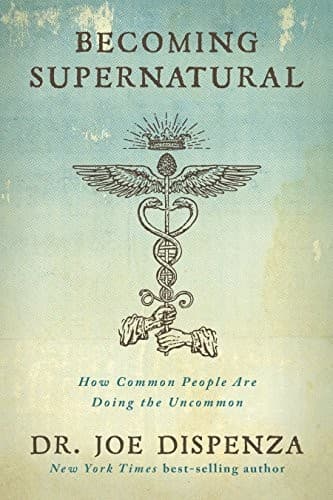
Becoming Supernatural
by Joe Dispenza
The Short Answer
Dispenza's synthesis of neuroscience, quantum field theory, energy psychology, and meditation practice. The thesis: ordinary humans can deliberately access "supernatural" states — coherent brainwaves, healed bodies, expanded perception — via specific, repeatable meditation protocols. Heavy on case studies; selectively backed by HeartMath and EEG measurements; controversial in mainstream physics.
The FrankX Newsletter
One book breakdown like this. One spotlight from the operating loop. Every Friday.
Key Insights
Tuning to a new "frequency" — a specific elevated emotional state held with focused attention — is the precondition for any deliberate change in physiology or circumstance
The body is the unconscious mind; lasting change requires reconditioning the body, not just rethinking the thought
The pineal gland, when activated through breath and elevated emotion, becomes an antenna for non-local information
Energy centers (chakras) map to specific neural and endocrine systems — clearing them is a measurable physiological practice
Time-space (the field) precedes space-time (matter); meditation that suspends ego-identity grants access to the field that physical reality crystallizes from
Quotes Worth Remembering
13 curated passages from Becoming Supernatural. Chapter references map back to the book so you can re-read them in context.
The moment you decide your future, the future does not exist as it once did.
Chapter 3 — Tuning In to New Potentials
Dispenza's thesis on what decision actually does at a quantum level. Whether you accept the physics or read it as metaphor, the practice it implies is the same.
You are no longer the body, an identity, a person, or a thing in space and time. You are pure consciousness.
Chapter 2 — The Present Moment
If you keep firing the same circuits in the same way, you keep wiring those networks into hardened patterns.
Chapter 1 — Opening the Door to the Supernatural
When you change your energy, you change your life.
Chapter 4 — Blessing of the Energy Centers
The body is the unconscious mind. Whatever the body has been emotionally conditioned to, it will recreate.
Chapter 5 — Reconditioning the Body to a New Mind
Coherence is when systems oscillate in unison and create a measurable energetic order.
Chapter 7 — Heart Intelligence
Dispenza relying on HeartMath Institute research — the most empirically grounded claim in the book.
The same emotions that drove a past condition into the body will drive that condition into the future.
Chapter 5 — Reconditioning the Body
The bigger the goal you choose, the more energy you will need.
Chapter 8 — Mind Movies and Kaleidoscope
If you can't feel the future state in the present moment, you can't become the future state.
Chapter 3 — Tuning In
Meditation is the means by which we change ourselves on a biological level.
Chapter 1 — Opening the Door
Your survival emotions — anger, frustration, fear, anxiety, sadness, grief — are addictive because they are familiar.
Chapter 5 — Reconditioning the Body
Dispenza's argument for why personal change feels chemically wrong before it feels right.
Trade the known for the unknown.
Chapter 12 — Project Coherence
Where you place your attention is where you place your energy.
Chapter 2 — The Present Moment
Chapter-by-Chapter
Each chapter distilled to a key idea + 2–4 sentence summary — so you can navigate the book's argument without re-reading it, and re-read it with fresh compass if you want.
01Chapter 1 — Opening the Door to the Supernatural
What looks supernatural is just neuroscience and physics applied with sustained attention.
+
Chapter 1 — Opening the Door to the Supernatural
What looks supernatural is just neuroscience and physics applied with sustained attention.
Dispenza opens by reframing his earlier work — habits and personality. He argues most "miraculous" healings and intuitive experiences are repeatable when the brain enters specific coherent states. The chapter is a manifesto: the supernatural is the natural, applied with discipline.
02Chapter 2 — The Present Moment
Most of life is spent in past conditioning or future anxiety — the present is where new neurology is forged.
+
Chapter 2 — The Present Moment
Most of life is spent in past conditioning or future anxiety — the present is where new neurology is forged.
Dispenza distinguishes the analytical mind (always referencing past or future) from the present moment (where pattern interruption is possible). The chapter is a primer on attention itself — without sustained presence, none of the rest of the book's practices work.
03Chapter 3 — Tuning In to New Potentials in the Quantum
Hold an elevated emotion paired with a clear intention; the body recognizes the future state before it arrives.
+
Chapter 3 — Tuning In to New Potentials in the Quantum
Hold an elevated emotion paired with a clear intention; the body recognizes the future state before it arrives.
Dispenza's core technique. He argues that combining elevated emotion (gratitude, joy, freedom) with focused intention creates an electromagnetic signal that "tunes" the body to a new potential. Mainstream physics objects to the mechanism; the practical result — placebo-style improvements in measured health markers — is documented.
04Chapter 4 — Blessing of the Energy Centers
The chakra system maps to neural and endocrine clusters that respond to focused attention.
+
Chapter 4 — Blessing of the Energy Centers
The chakra system maps to neural and endocrine clusters that respond to focused attention.
Dispenza walks through eight energy centers, mapping each to specific neurological and hormonal systems. The "Blessing the Energy Centers" meditation places attention on each in turn, infusing it with elevated emotion. Critics call this remapped chakra work; Dispenza argues the EEG signatures are specific and reproducible.
05Chapter 5 — Reconditioning the Body to a New Mind
The body remembers emotion as chemistry — change requires rewriting the chemistry, not just the thought.
+
Chapter 5 — Reconditioning the Body to a New Mind
The body remembers emotion as chemistry — change requires rewriting the chemistry, not just the thought.
The book's pivotal chapter. Thoughts produce chemicals; chemicals produce feelings; feelings reinforce thoughts. The loop is self-perpetuating. To break it, Dispenza argues you must hold the new feeling longer than the body's old chemical state can sustain — typically 30–60 minutes of meditation daily for several weeks.
06Chapter 6 — Case Studies: Living Examples of Truth
Without specific cases, the framework is theory; the cases ground it.
+
Chapter 6 — Case Studies: Living Examples of Truth
Without specific cases, the framework is theory; the cases ground it.
Dispenza presents detailed case studies — chronic illness remission, autoimmune reversal, dramatic mobility return. Names, before-and-after measurements, follow-ups. Read critically. The pattern is more important than any single case: each story features sustained, daily, hour-long meditation as the variable.
07Chapter 7 — Heart Intelligence
The heart's electromagnetic field is 60× stronger than the brain's — and trainable.
+
Chapter 7 — Heart Intelligence
The heart's electromagnetic field is 60× stronger than the brain's — and trainable.
Dispenza relies heavily on HeartMath Institute research. Coherent heart-brain states (measured via HRV) produce different cognitive performance and immunity markers than incoherent states. The chapter's claims are the most empirically grounded in the book.
08Chapter 8 — Mind Movies and Kaleidoscope
Visualization plus elevated emotion is meditation's active ingredient; without emotion, it is daydreaming.
+
Chapter 8 — Mind Movies and Kaleidoscope
Visualization plus elevated emotion is meditation's active ingredient; without emotion, it is daydreaming.
Practical chapter. Dispenza describes "Mind Movies" — short personal video clips depicting one's desired future — and the kaleidoscope visual technique to drop the analytical mind into trance. Both are tools for the same goal: hold a vivid future state with sustained elevated emotion.
09Chapter 9 — Walking Meditation
Embodying the new self in motion is what installs it as the new default.
+
Chapter 9 — Walking Meditation
Embodying the new self in motion is what installs it as the new default.
Dispenza's walking meditation is the practice of literally walking as the future self — the body movements, posture, expression of someone who has already become what you intend. The transition from sitting meditation to walking is what crosses the gap between visualization and identity.
10Chapter 10 — Case Studies: Making It Real
The case studies extend beyond healing into performance, relationships, and creativity.
+
Chapter 10 — Case Studies: Making It Real
The case studies extend beyond healing into performance, relationships, and creativity.
A second case-study chapter, broader in scope than Chapter 6. Includes professional and creative breakthroughs, not just health. The pattern is consistent: sustained daily meditation, elevated emotion, specific clear intention, persistence over weeks-to-months.
11Chapter 11 — Space-Time and Time-Space
Dispenza's most speculative chapter — there is a complementary "time-space" reality where information lives outside causality.
+
Chapter 11 — Space-Time and Time-Space
Dispenza's most speculative chapter — there is a complementary "time-space" reality where information lives outside causality.
The metaphysical core. Dispenza describes a reality of pure energy, information, and possibility (time-space) that crystallizes into matter and causation (space-time) when consciousness focuses on it. Treats this as a literal claim about reality. Read as either physical metaphysics or operational metaphor — the practice does not depend on which.
12Chapter 12 — Project Coherence
Coherent groups produce coherence-effects that exceed the sum of individuals.
+
Chapter 12 — Project Coherence
Coherent groups produce coherence-effects that exceed the sum of individuals.
Closing chapter on community practice. Dispenza describes group meditations that have allegedly produced measurable effects (HRV synchronization, reported regional well-being changes). The book's most ambitious claim. Dispenza presents it as direction of travel, not finished science.
Best For
Frequently Asked Questions
Is Becoming Supernatural scientifically valid?
+
Partly. The neuroscience portions (neuroplasticity, conditioned emotional response, HeartMath coherence research) are well-established. The quantum-field interpretations are speculative and not peer-reviewed in the way mainstream physics requires. Read the book for the practice; consult primary literature for the mechanisms.
Should I read this before or after Breaking the Habit of Being Yourself?
+
After. Breaking the Habit lays the foundational neuroscience and basic meditation. Becoming Supernatural assumes you have that foundation and pushes into more advanced practice — energy centers, walking meditation, time-space. Reading them in order prevents whiplash.
What is the Tuning In meditation?
+
Dispenza's core practice: hold an elevated emotion (gratitude, love, freedom) without an external trigger, while mentally rehearsing a future event as already-happened. The goal is to condition the body to "remember" the future state at a physiological level — a kind of placebo effect, deliberately and self-administered.
How long does a typical Dispenza meditation take?
+
Most meditations in the book are 45–60 minutes. Walking meditation is typically 30 minutes. Dispenza is explicit that the duration matters — the brain needs sustained time to drop into theta/gamma states where conditioned response actually changes. Five-minute meditations will not reproduce his case-study results.
What about the case studies — are the healings real?
+
The case studies (cancer remission, mobility return, PTSD resolution) are reported by Dispenza's organization, not independently audited. Some appear to have substantial documentation; others are anecdotal. The sensible reading: meditation, expectation, and elevated emotion are clinically known to affect health markers — Dispenza's claim is that the effects are bigger and more reliable than usually credited. The evidence supports a yes-with-caveats answer.
Continue Reading
If Becoming Supernatural opened a door, these books walk you through it. Curated for reason, not algorithm — each entry explains why it pairs with this book.
Breaking the Habit of Being Yourself
by Joe Dispenza
Dispenza's 2012 prequel and foundational text. Less metaphysical, more accessible. Read it first — Becoming Supernatural assumes the neuroscience and meditation basics it lays out.
Get the bookYou Are the Placebo
by Joe Dispenza
The middle book in the trilogy, focused specifically on mind-body healing through expectation. The most empirically defensible Dispenza book.
Get the bookThe Heart's Code
by Paul Pearsall
Dispenza's heart-intelligence chapter relies on HeartMath; Pearsall is the foundational text of cardio-energetic research. Read for the science behind Dispenza's claims.
Get the bookThe Biology of Belief
by Bruce Lipton
Adjacent territory — cellular biology and consciousness. Lipton's epigenetics framing gives Dispenza's "thoughts change genes" claims a scientific home.
Get the bookPower vs. Force
by David R. Hawkins
Hawkins's map of consciousness levels parallels Dispenza's elevated-emotion framework, with different vocabulary. Both argue specific emotional states have specific physical signatures.
Get the bookAltered States
by Steven Kotler & Jamie Wheal (Stealing Fire)
Where Dispenza is mystical, Kotler and Wheal are operational. Same territory of altered consciousness, framed by performance research and neurochemistry.
Get the bookGo Deeper — Videos
The book is the foundation. These talks and interviews are where the ideas sharpen, get challenged, and connect to adjacent work. Best watched after reading, not instead of.
Joe Dispenza on the London Real Podcast
London Real
Multi-hour interview that covers the full trilogy. Dispenza in his own voice, walking through the central claims with audience-level accessibility.
Joe Dispenza — How to Heal Yourself (TEDx)
TEDx
Short-form Dispenza for first exposure. The 18-minute version of his core argument.
Joe Dispenza on the Tom Bilyeu Impact Theory
Impact Theory
Bilyeu pushes harder on the science than most interviewers. Best video if you want Dispenza's claims under reasonable scrutiny rather than uncritical agreement.
Guided Meditation by Dr. Joe Dispenza
Dr Joe Dispenza
Free guided meditations on Dispenza's YouTube channel. The actual practice the books describe — most readers benefit from doing one before deciding whether the framework is for them.
If You Liked This, Read Ours
Our Book
Manifestation
The Architecture of Reality
Not wishful thinking. Not magic. The grounded, psychological, and strategic approach to turning thought into reality — updated for the AI age.
Read free