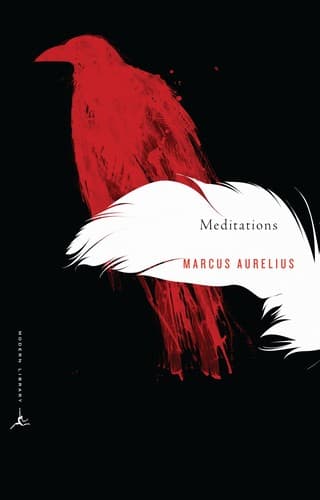
Meditations
by Marcus Aurelius
The Short Answer
The private notebook of a Roman emperor working out how to live well under the hardest conditions of his time. Twelve "books" of aphorisms on control, duty, mortality, and perception — not a treatise for publication, but a man arguing with himself in ink. The most practical philosophy ever written.
The FrankX Newsletter
One book breakdown like this. One spotlight from the operating loop. Every Friday.
Key Insights
You have power over your mind, not outside events. Realize this, and you will find strength.
The obstacle is the way: what stands in the path becomes the path. Every difficulty is training material.
Waste no more time arguing about what a good person should be. Be one.
Memento mori: the awareness of death is not morbid — it is clarifying. It removes the trivial and reveals the essential.
The soul becomes dyed with the color of its thoughts. Guard your mind as you would guard your home.
Quotes Worth Remembering
16 curated passages from Meditations. Chapter references map back to the book so you can re-read them in context.
You have power over your mind — not outside events. Realize this, and you will find strength.
Book VIII
The dichotomy of control, stated with Marcus's characteristic brevity. The entire book could be read as commentary on this one line.
The impediment to action advances action. What stands in the way becomes the way.
Book V
The line Ryan Holiday turned into a book title ("The Obstacle Is the Way"). The obstacle is raw material, not the enemy.
Waste no more time arguing about what a good man should be. Be one.
Book X
You could leave life right now. Let that determine what you do and say and think.
Book II
Memento mori, in its sharpest form. Marcus wrote this as emperor, on campaign, knowing it was literally true.
The soul becomes dyed with the color of its thoughts.
Book V
If it is not right, do not do it; if it is not true, do not say it.
Book XII
When you arise in the morning, think of what a precious privilege it is to be alive — to breathe, to think, to enjoy, to love.
Book V
Everything we hear is an opinion, not a fact. Everything we see is a perspective, not the truth.
Book IV
The best revenge is to be unlike him who performed the injury.
Book VI
Begin each day by telling yourself: today I shall be meeting with interference, ingratitude, insolence, disloyalty, ill-will, and selfishness — all of them due to the offenders' ignorance of what is good or evil.
Book II
Premeditatio malorum — imagining the day's friction before it arrives. The Stoic morning prep.
Confine yourself to the present.
Book VII
If you are distressed by anything external, the pain is not due to the thing itself, but to your estimate of it; and this you have the power to revoke at any moment.
Book VIII
Accept the things to which fate binds you, and love the people with whom fate brings you together — but do so with all your heart.
Book VI
Dwell on the beauty of life. Watch the stars, and see yourself running with them.
Book VII
How much time he gains who does not look to see what his neighbor says or does or thinks, but only at what he does himself, to make it just and pure.
Book IV
Loss is nothing else but change, and change is Nature's delight.
Book IX
Marcus's acceptance of impermanence — not resignation, but metabolic.
Chapter-by-Chapter
Each chapter distilled to a key idea + 2–4 sentence summary — so you can navigate the book's argument without re-reading it, and re-read it with fresh compass if you want.
01Book I — Debts and Lessons
Character is inherited from the people you pay attention to.
+
Book I — Debts and Lessons
Character is inherited from the people you pay attention to.
Marcus opens by thanking, one by one, the people who shaped him — his grandfather, his father, his teachers, his wife, the gods. Unusual for the book, it is retrospective and specific. A model for how to acknowledge the architecture of one's own character.
02Book II — On the River Gran, Among the Quadi
Start every day expecting friction and still choosing virtue.
+
Book II — On the River Gran, Among the Quadi
Start every day expecting friction and still choosing virtue.
Written on military campaign against Germanic tribes. Contains the morning premeditation — list the day's coming difficulties before you meet them, so you are not surprised. The first book to establish Marcus's voice: tired, specific, unsparing with himself.
03Book III — In Carnuntum
Prefer to be known than admired; prefer the real over the impressive.
+
Book III — In Carnuntum
Prefer to be known than admired; prefer the real over the impressive.
A deeper turn inward. Marcus argues that external rewards — fame, status, wealth — corrode the inner faculty that is the true self. Guard what you think about; that is where your life actually happens.
04Book IV — The World as a Stream
Everything flows; nothing you cling to will last, including you.
+
Book IV — The World as a Stream
Everything flows; nothing you cling to will last, including you.
The most Heraclitean book. Marcus repeats the argument that all things change, all memory fades, and that this is not tragic but cleansing. The universe is in motion; your job is to participate in the motion with justice and without complaint.
05Book V — On Rising from Bed
Do the work nature made you for, even when you do not feel like it.
+
Book V — On Rising from Bed
Do the work nature made you for, even when you do not feel like it.
Opens with the famous "in the morning when you rise unwillingly" passage. Marcus to himself: you were made to work, not to rest under blankets. Contains the "soul dyed by its thoughts" line, central to the entire book.
06Book VI — Matter, Time, Cause
See events as the causal chain they are — and your judgment as separate from them.
+
Book VI — Matter, Time, Cause
See events as the causal chain they are — and your judgment as separate from them.
More technical. Marcus analyzes any event into three parts: the material, the process, and the cause. Judgment attaches to none of them necessarily — it is always your addition. Remove the addition and the event becomes neutral.
07Book VII — How to Endure What You Must
If you can bear it for an hour, you can bear it for a lifetime.
+
Book VII — How to Endure What You Must
If you can bear it for an hour, you can bear it for a lifetime.
Many short reminders. Pain is not evil unless you judge it to be. Other people's opinions are not your concern. The present moment is always enough. Marcus is clearly rehearsing these lines for himself before needing them.
08Book VIII — The Inner Citadel
No external thing can harm your reasoning faculty without your consent.
+
Book VIII — The Inner Citadel
No external thing can harm your reasoning faculty without your consent.
The "inner citadel" metaphor is implicit throughout. You carry within you a place nothing external can reach unless invited. Contains the "pain is not due to the thing but to your estimate of it" line, possibly the most quoted in the book.
09Book IX — On Justice and Falsehood
Every lie is a crime against reason; every injustice is a crime against nature.
+
Book IX — On Justice and Falsehood
Every lie is a crime against reason; every injustice is a crime against nature.
Shifts to a social register. Marcus argues the cosmos is rational and cooperative, and humans are social animals by nature. Therefore lying, injustice, and laziness are not just pragmatically bad — they violate the fabric of what you are.
10Book X — Return to the Self
Stop waiting for the life you want and live the one you have.
+
Book X — Return to the Self
Stop waiting for the life you want and live the one you have.
Contains the "be one" line. Stop theorizing about virtue and practice it. The book gets more urgent here — Marcus is older, more ill, more aware of running out of time. The philosophy sharpens with the mortality.
11Book XI — On Anger and Charity
Understand why people act badly, and the anger dissolves into pity.
+
Book XI — On Anger and Charity
Understand why people act badly, and the anger dissolves into pity.
The most interpersonally focused book. Marcus develops the argument that people who wrong you are ignorant of the good, not malicious. Your job is to correct if you can, endure if you cannot, and — crucially — to not become them in the process.
12Book XII — A Proper End
Live each day as though leaving the theatre — and leave content.
+
Book XII — A Proper End
Live each day as though leaving the theatre — and leave content.
Closing reflections. Death comes for everyone and erases everyone equally. The only real question is whether, in the time you had, you lived in accord with reason and served your role. Marcus closes not with a conclusion but with a final self-address: it is time to go, do not complain.
Best For
Frequently Asked Questions
Did Marcus Aurelius write Meditations for publication?
+
No. Meditations was a private journal written in Greek for the emperor's own self-discipline, never intended for readers. That is precisely why it is so unvarnished — there is no audience for Marcus to perform for. We are reading over his shoulder as he argues with himself.
Which translation of Meditations should I read?
+
Gregory Hays (Modern Library, 2002) is the standard English entry point — fluent, direct, feels contemporary. Robin Hard (Oxford) is more literal and scholarly. George Long (public domain) is lofty Victorian and free. Start with Hays. If you love the book, read Hard for the precision.
What is the "dichotomy of control"?
+
The Stoic claim that every thing you encounter is either in your control (your judgments, actions, desires) or not (everything else — health, reputation, other people). Peace comes from investing effort only in the first category and treating the second as weather. Marcus applies this relentlessly throughout the twelve books.
How is Meditations different from other Stoic texts?
+
Epictetus teaches Stoicism (he was a former slave turned philosophy teacher). Seneca argues Stoicism (his letters are rhetorical). Marcus lives it under maximum difficulty — running an empire at war, losing children, managing a plague, dealing with a disloyal co-emperor. Meditations is not the theory; it is the practice journal.
Is Meditations religious?
+
Marcus is a religious Stoic — he speaks of "the gods" and "providence" throughout — but the framework is compatible with atheism, theism, or agnosticism. The practical discipline (control your mind, do your duty, accept fate) does not depend on any specific metaphysics. Most modern readers engage it as secular philosophy.
Continue Reading
If Meditations opened a door, these books walk you through it. Curated for reason, not algorithm — each entry explains why it pairs with this book.
Letters from a Stoic
by Seneca
Seneca's letters to Lucilius are the most readable Stoic primer ever written — wealthy, witty, and applied to real life (money, friendship, travel, death). Read Seneca for the persuasion, Marcus for the practice.
Get the bookDiscourses and Selected Writings
by Epictetus
The third pillar. Epictetus was a slave-turned-teacher; his Discourses are the source material Marcus was explicitly trained on. The dichotomy of control comes from him. Tougher prose than Marcus, more foundational.
Get the bookThe Obstacle Is the Way
by Ryan Holiday
Modern distillation built around one Meditations quote (Book V). Holiday makes the Stoic frame applicable to contemporary entrepreneurial life. Pair with Marcus for the contrast: Holiday is structured, Marcus is raw.
Get the bookA Guide to the Good Life
by William B. Irvine
The clearest academic treatment of Stoic practice for modern readers. Irvine reconstructs a coherent Stoic life program from the fragmentary ancient sources. Reads like a curriculum.
Get the bookHow to Think Like a Roman Emperor
by Donald Robertson
Robertson is a cognitive behavioral therapist. He argues Stoicism is the ancient source of modern CBT. Uses Marcus's life as the narrative spine — excellent if you want biographical context while reading Meditations.
Get the bookMan's Search for Meaning
by Viktor Frankl
The modern extreme-conditions application of the Stoic frame. Frankl in a concentration camp reaches Marcus's conclusions independently — your inner response to what happens is the one thing nobody can take. Dark mirror to Meditations.
Get the bookGo Deeper — Videos
The book is the foundation. These talks and interviews are where the ideas sharpen, get challenged, and connect to adjacent work. Best watched after reading, not instead of.
Ryan Holiday — How to Read Meditations
Daily Stoic
Practical guidance on which translation to pick, how to read in short doses, and why reading it cover-to-cover fails. Best first video for a new reader.
Marcus Aurelius — A Stoic Emperor
The School of Life
The biographical context. The Roman empire Marcus inherited, the wars he fought, the plague he endured. Explains why Meditations feels like journal entries rather than a treatise.
William B. Irvine on Stoicism
Closer to Truth
Irvine on negative visualization, the dichotomy of control, and modern applications. Closest thing to an academic primer in video form.
Donald Robertson — Marcus Aurelius and CBT
Modern Stoicism
Robertson's argument that Meditations anticipates Cognitive Behavioral Therapy by 1800 years. Useful counter-frame if you find Stoicism too ancient to feel practical.
Tim Ferriss — The Tao of Seneca & Stoic Practice
Tim Ferriss Show
Ferriss on why he reads Stoic texts daily. Practical entrepreneurial framing — Stoicism as the best ROI philosophy for operators under stress.
If You Liked This, Read Ours
Our Book
Spartan Mindset
The Discipline of One More
A manual for the relentless. Discipline, training, and the philosophy of pushing past limits. Every chapter is a rep you didn't think you had.
Read free