His life · 8 September 1969 — 9 July 2018
Pavlovka to Seesen
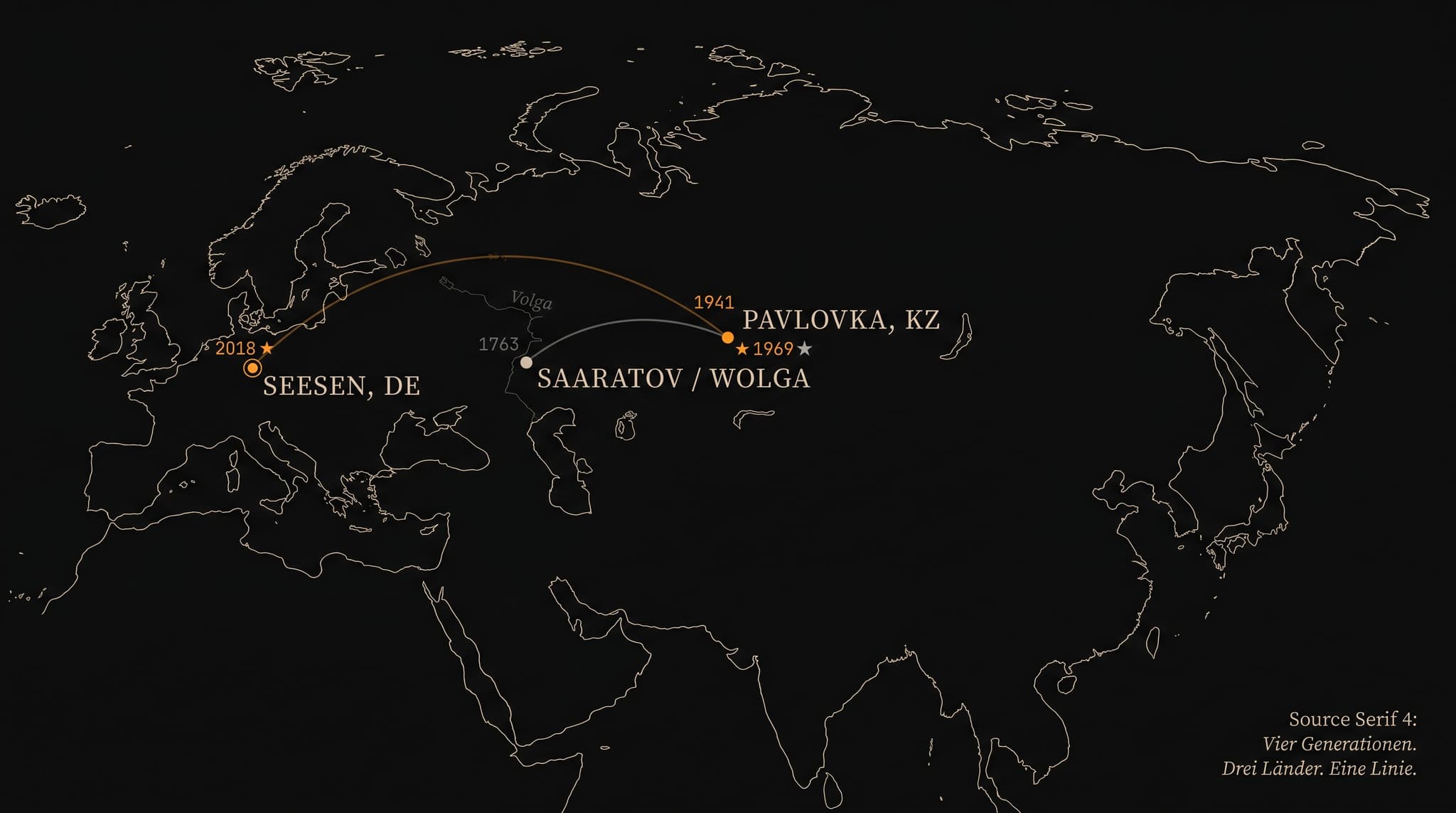
Forty-eight years. Three countries. Two languages. A line that brought a Volga German out of Stalin's Kazakhstan back to Lower Saxony — and a son who is now trying to give him the words.
Pavlovka, 1969
Witali Riemer was born on 8 September 1969 in Pavlovka — a village in Kazakhstan that would not have existed without Stalin. His father Alexander and his mother Paulina (née Schneider) were part of the German minority that had been deported from the Volga to Siberia and Central Asia in 1941. Russia was the country that had not wanted them. Kazakhstan was the country in which they had to grow up.
Being a Volga German in this generation meant: speaking German at home, Russian at school, having "Deutsch" written in your passport — and belonging nowhere fully. Witali inherited both as native languages. He moved between them his whole life, the way the family moved between countries.
The way back
In the 1970s and 1980s, the Federal Republic of Germany opened the door to the Russian Germans. Spätaussiedler, the word was. Late, because the ancestors had left 200 years before, four generations gone, and only now returning. Families like the Riemers filed applications, waited years, packed suitcases.
Exactly when Witali came to Germany is a question for the next version of this page — Mama, Opa and Oma have the dates and the stories. What is certain: he arrived, learned Germany, built a life in Seesen in southern Lower Saxony, married Dora Gorte (also Volga German, also Spätaussiedler), had me.
Seesen
Seesen is where the family arrived. Where I grew up. Where we built. Where Papa died on 9 July 2018, at 48 years old. A small town on the edge of the Harz mountains that most people never look up on a map, but for our family the end of a very long arc.
What he did there — for work, in private, what moved him, what he repaired, whom he made laugh — belongs in the Memories chapter. This page is the bone structure. The flesh grows when family writes.
What remains
What remains is not only a man. It is a line: four generations who were in the wrong place at the wrong time, four generations who did not give up, a grandfather and a grandmother who are still living and still hold stories, a mother who is still in Germany, a son who is now writing in Amsterdam, and a father whom I am trying to hold on to before whatever was not written down is lost.