Intelligence DispatchesJanuary 21, 20268 min read
AGI in 2026: What Current Progress Means for Students, Creators, and Your Career
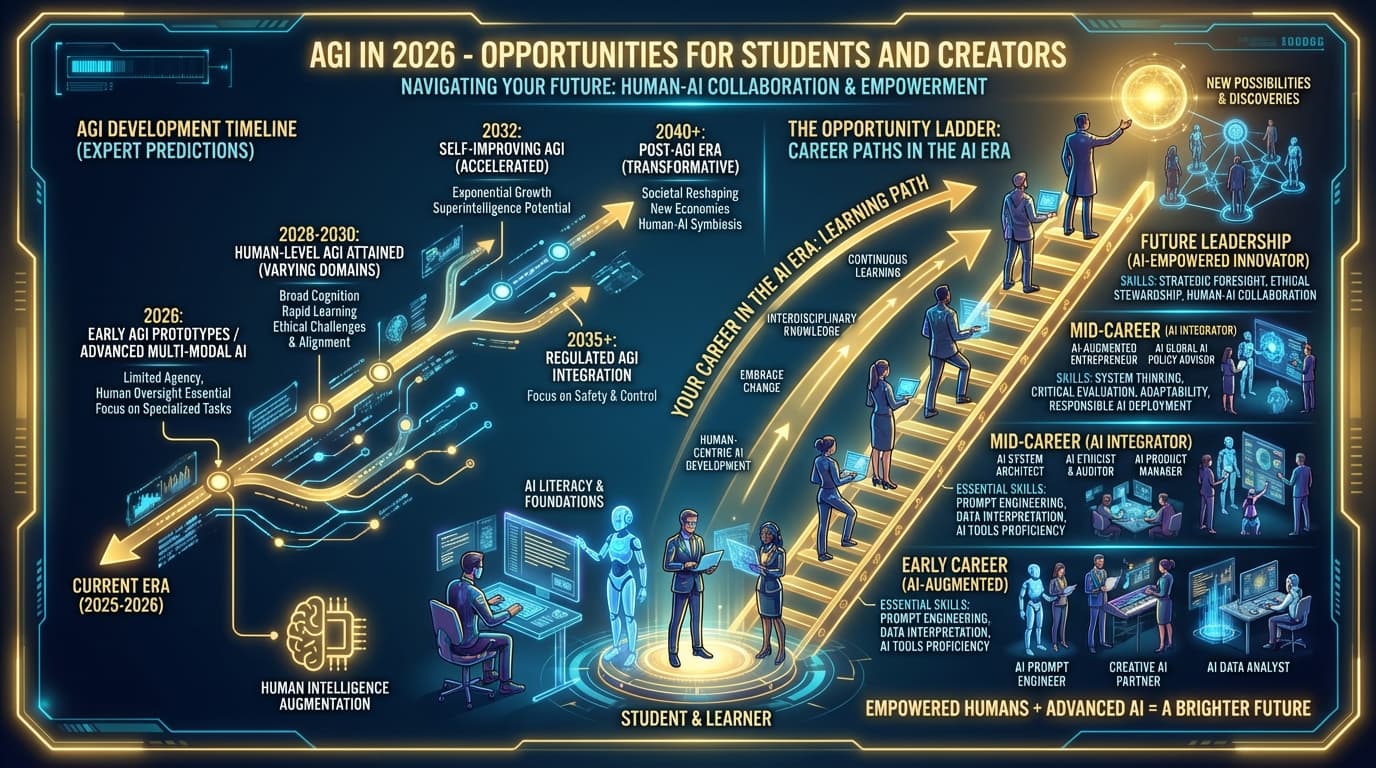
Expert predictions range from 'AGI by 2026' to 'decades away.' Here's what the actual progress means for students, personal growth, and economic opportunities right now.

🎯
Reading Goal
Understand where AGI progress actually stands and how to position yourself for opportunities
TL;DR: Expert predictions on AGI range wildly—Anthropic says "country of geniuses in a datacenter" by 2026-2027, while others say we're decades away. What matters for students and creators isn't when AGI arrives, but that AI capability is advancing rapidly right now. The opportunities are in learning to work with AI systems, not competing against them.
The Great AGI Debate: Where Do We Actually Stand?
Walk into any AI lab and you'll find brilliant people who fundamentally disagree on when—or if—AGI will arrive.
The Optimists (2026-2027)
- Anthropic's Jack Clark: AI will be "smarter than a Nobel Prize winner across many disciplines" by end of 2026 or 2027
- Elon Musk: AGI by 2026 "at the latest"
- Ray Kurzweil: AGI by 2029, singularity by 2045
- Ben Goertzel (who coined "AGI"): "A genuine breakthrough during 2026 is possible—not probable, but totally possible"
The Skeptics (5-20+ Years)
- Demis Hassabis (Google DeepMind): Five to ten years
- Yann LeCun: "3 to 5 years away, even in the best-case scenario"
- Andrej Karpathy: Agents "aren't anywhere close," puts AGI a decade out
- AI Researcher Surveys: Median prediction around 2040
Stanford's Reality Check
James Landay, HAI Co-Director at Stanford, offers perspective: "My biggest prediction? There will be no AGI this year."
Stanford faculty suggest 2026 may mark "the moment artificial intelligence confronts its actual utility"—the era of AI evangelism giving way to AI evaluation.
What's Actually Happening Right Now
Forget the AGI timeline debates. Here's what's measurably true:
GPT-5's Progress
Using a framework inspired by human intelligence theory, researchers tested GPT models with targeted benchmarks:
- GPT-4: AGI score of 27%
- GPT-5: AGI score of 57%
That's a doubling in capability between generations. Whether that's "AGI" is semantics—the improvement is real.
Enterprise AI Adoption
The market isn't waiting for AGI. Companies are deploying current AI systems at unprecedented scale:
- AI agents handling customer service
- Code assistants writing production software
- Research systems synthesizing thousands of papers
- Creative tools generating music, art, video
The Capability Explosion
What you can do with AI today was science fiction five years ago:
- Have a conversation indistinguishable from human
- Generate photorealistic images from text
- Write functional code from descriptions
- Analyze documents faster than any human team
Opportunities for Students
The AGI debate is academic. What's practical is positioning yourself for the AI-augmented economy that's already here.
1. AI-Native Skills (Highest Leverage)
Learn to work WITH AI, not against it.
- Prompt Engineering: The skill of getting AI to do what you want
- Agent Orchestration: Coordinating multiple AI systems for complex tasks
- AI Evaluation: Knowing when AI output is good vs. hallucinated
Where to start: OpenAI offers competitive internships for students "passionate about artificial intelligence." Amazon AGI teams recruit for ML engineers who can "advance the state of LLMs."
2. Human-Augmented Roles (Highest Security)
AI elevates the importance of what it can't do:
- Communication & Creativity: AI generates; humans curate and connect
- Leadership & Strategy: AI analyzes; humans decide and inspire
- Ethical Judgment: AI optimizes; humans ensure we're optimizing for the right things
The 2026 job market emphasizes "human-centered leadership"—blending technical expertise with people skills.
3. Domain Expertise + AI (Highest Value)
The killer combination isn't "AI expert" OR "domain expert"—it's both.
- Medicine + AI = AI-assisted diagnosis
- Law + AI = Automated legal research
- Education + AI = Personalized learning
- Creative + AI = Amplified artistic output
80,000 Hours advice: "If you can already get a job at a relevant, aligned organisation, simply trying to excel there is often the best path."
Personal Growth in the AI Age
AGI isn't just an economic phenomenon—it's a consciousness one. How do we grow as humans when machines handle more cognitive tasks?
Double Down on What's Human
- Physical embodiment: Machines process information; you live in a body
- Emotional intelligence: AI can analyze sentiment; you can feel
- Meaning-making: AI can correlate data; you can find purpose
- Presence: AI runs 24/7; you experience moments
Use AI for Self-Development
Current AI systems are extraordinary personal development tools:
- Journaling partners that ask better questions than you'd ask yourself
- Learning accelerators that explain concepts at your exact level
- Accountability systems that track progress without judgment
- Coaches available at any hour for any topic
The Mindfulness Paradox
As AI handles more cognitive labor, the ability to be present—to not be lost in thought—becomes more valuable, not less. Meditation, contemplative practice, and embodied awareness aren't becoming obsolete. They're becoming essential.
Economic & Business Opportunities
Regardless of when AGI arrives, the current AI capability curve creates specific opportunities:
1. AI Infrastructure Layer
The companies building the foundation:
- Chip designers (Nvidia's Rubin platform)
- Cloud providers (AWS, Azure, GCP, OCI)
- Model developers (OpenAI, Anthropic, Google)
Opportunity: These companies are hiring aggressively. Amazon AGI teams offer roles in ML engineering, research science, and product development.
2. AI Application Layer
Companies applying AI to specific domains:
- Healthcare diagnostics
- Legal research
- Financial analysis
- Creative production
Opportunity: Domain expertise + AI fluency is the winning combination. Pick your domain, master the AI tools.
3. AI Services Layer
Helping others adopt AI:
- Integration consulting
- Custom model development
- Training and education
- Safety and evaluation
Opportunity: Every company needs help adopting AI. Few have internal expertise. The gap is your opportunity.
4. Human-Centric Services
What AI can't do:
- Physical services (healthcare, construction, hospitality)
- High-trust relationships (therapy, coaching, advisory)
- Creative direction (not generation—direction)
- Ethical oversight
Opportunity: Premium positioning for human-delivered services in an AI-commoditized world.
What the World Is Working Toward
The AGI research agenda isn't just about making AI smarter. It's about:
Safety & Alignment
Ensuring AI systems do what we actually want:
- Value alignment research
- Interpretability (understanding why AI decides what it decides)
- Robustness (AI that doesn't fail catastrophically)
- Control (maintaining human oversight)
OpenAI's mission: "Committed to conducting the required research to make AGI safe."
Beneficial Deployment
Ensuring AI benefits humanity broadly:
- Access (not just for the wealthy)
- Distribution (economic benefits spread widely)
- Governance (democratic oversight of powerful systems)
Capability Extension
Making AI more generally capable:
- Multimodal understanding (text, image, audio, video)
- Reasoning and planning
- Tool use and agency
- Long-term memory and learning
Key Takeaways
-
The timeline doesn't matter as much as the trajectory - AI capability is advancing rapidly regardless of when "AGI" officially arrives
-
Position yourself as AI-augmented, not AI-replaced - Learn to work with AI systems, not compete against them
-
Domain expertise + AI fluency = highest value - Pick your domain, master the AI tools for it
-
Human skills become MORE valuable - Leadership, creativity, judgment, and presence appreciate as AI handles cognitive tasks
-
Opportunities exist at every layer - Infrastructure, applications, services, and human-centric work all have paths forward
Frequently Asked Questions
Will AGI take all jobs?
No. Even aggressive AGI timelines (2026-2027) predict augmentation before replacement. The immediate effect is that AI-fluent workers become dramatically more productive than AI-resistant ones.
Should students still pursue traditional degrees?
Yes, but augment with AI skills. Domain expertise remains valuable—perhaps more valuable—when combined with AI fluency. A lawyer who understands AI legal research tools outperforms both pure lawyers and pure AI.
What's the best way to learn AI skills?
Start using AI tools daily. The gap between "read about AI" and "use AI" is enormous. Build projects, take courses from OpenAI and Anthropic, and apply AI to problems you actually care about.
Is it too late to get into AI?
Absolutely not. The field is expanding faster than talent can fill it. Entry points exist at every level—from no-code AI tools to research positions. The constraint isn't opportunity; it's willingness to learn.
How do I stay current with AI developments?
Build a research system. Follow key researchers on Twitter. Subscribe to newsletters (The Batch, Import AI). Or use the FrankX Research Hub for synthesized intelligence briefs.
What if AGI doesn't arrive for decades?
Then you've spent years developing valuable AI skills and human-centric capabilities. There's no downside to the preparation—current AI systems are already transforming work.
Resources for Getting Started
- OpenAI Careers - Internships and full-time positions
- Amazon AGI - ML engineering and research roles
- 80,000 Hours AI Guide - Career planning for AGI scenarios
- FrankX Research Hub - Daily intelligence on AI progress
Sources: Stanford HAI, AI Frontiers, 80,000 Hours, Council on Foreign Relations, AI Multiple
Related Articles
- AI Guide for Families and Professionals — Navigating AI at home and work
- What is Agentic AI? — Understanding autonomous AI systems
- Agentic AI Roadmap 2026 — The year ahead
Get Started
Build your first AI system
Step-by-step guide to setting up ACOS, creating your first agent, and shipping real products with AI.
Start buildingTemplates & Blueprints
Production-ready architecture
Download AI architecture templates, multi-agent blueprints, and prompt engineering patterns.
Browse templatesInner Circle
Join the builder community
Connect with creators and architects shipping AI products. Weekly office hours, shared resources, direct access.
Join the circleTags
Related Research

Read on FrankX.AI — AI Architecture, Music & Creator Intelligence
Stay in the intelligence loop
Weekly field notes on AI systems, production patterns, and builder strategy.
Continue Reading

Creator Systems10 min
Why Every Creator Needs an Intelligence System in 2026
The creators who thrive in 2026 won't be those with the best tools—they'll be those with the best systems. Here's why personal AI intelligence systems are the new competitive advantage.
Read article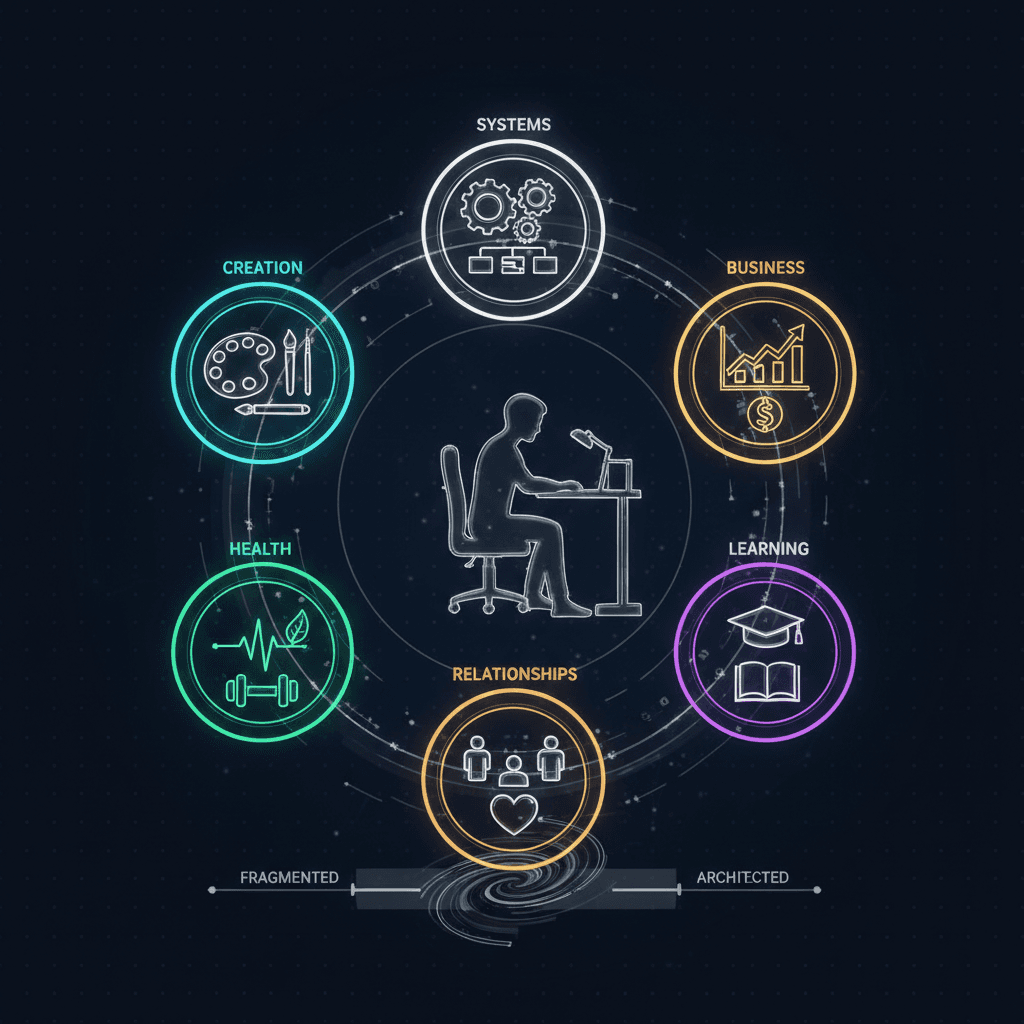
Consciousness7 min read
The Creator's Life Architecture: A System for Whole-Life Mastery
Most creators optimize one dimension of life while the others crumble. The 7-Pillar system changes that. Here's your complete guide to building an extraordinary life as a creator.
Read article