Build the system layer for serious AI work.
The same six-pillar operating model behind enterprise AI adoption, adapted for individuals, teams, and creator systems that need repeatable quality.
Six pillars
Strategy, governance, talent, technology, data, and ethics. The architecture is stable. The scale changes.
Operating model
The six pillars every AI system needs
A CoE is not a content calendar or a folder of prompts. It is the structure that decides what gets built, how quality is checked, where context lives, and how the system improves.
Strategy
Define the work AI should handle, the work humans keep, and the outcomes worth measuring.
Governance
Set rules for review, disclosure, privacy, source quality, and final human accountability.
Talent
Build fluency through prompts, playbooks, role-specific workflows, and repeated practice.
Technology
Choose the tool stack deliberately: models, agents, automations, interfaces, and observability.
Data
Turn documents, notes, research, and outputs into reusable context with clear ownership.
Ethics
Make values operational through checks, limits, review moments, and escalation paths.
Translation
One framework, two useful scales
The enterprise version coordinates departments. The personal version coordinates domains, tools, memory, and repeated work. Both need standards before they need more software.
Personal AI CoE
A one-person operating model
Use the six pillars to coordinate your tools, prompts, knowledge base, calendar, creative systems, and weekly review. This is the framework behind ACOS.
See ACOSTeam AI CoE
A capability layer for teams
Use the same structure for shared standards, reusable workflows, adoption planning, tool decisions, and governance across a small team or business unit.
Book the workshopCadence
The weekly loop keeps it alive
Most AI systems decay because no one owns the review rhythm. The smallest useful CoE is a weekly operating loop that sharpens one workflow at a time.
- 1Pick one domain where AI already saves time.
- 2Write the rules for what AI may draft, decide, and never touch.
- 3Build a reusable prompt or agent for the repeatable work.
- 4Store the useful outputs where future sessions can retrieve them.
- 5Review the system weekly and improve one bottleneck.
Resources
Start from the part you need now
Assessment, architecture, prompts, and workshops already exist across FrankX. This page is the front door.
Take the maturity assessment
Seven dimensions. Two minutes. A clear starting point.
Open resourceRead the core article
Why the enterprise AI CoE pattern works at personal scale.
Open resourceBrowse architecture blueprints
Production AI patterns, RAG, gateways, agents, and governance.
Open resourceUse the prompt library
Blueprint, assessment, weekly review, and domain-specific CoE prompts.
Open resourceSee the lab in action
Eight builds shipped on the agentic dev stack — Antigravity, Claude Code, Codex, Gemini.
Open resourceHire Frank for a sprint
One-day workshop or 5–10 day implementation sprint for your CoE team.
Open resourceQuestions
AI CoE, without the theater
A good CoE is not a committee name. It is a set of decisions, habits, and shared assets that make better AI work repeatable.
What is an AI Center of Excellence?
An AI Center of Excellence is an operating model for adopting AI with clear strategy, governance, talent, technology, data, and ethics practices. It coordinates tools, people, workflows, and standards.
Can one person build an AI CoE?
Yes. The personal version uses the same six pillars at smaller scale. Replace departments with life or work domains, and replace executive steering meetings with a weekly operating review.
How does this relate to ACOS?
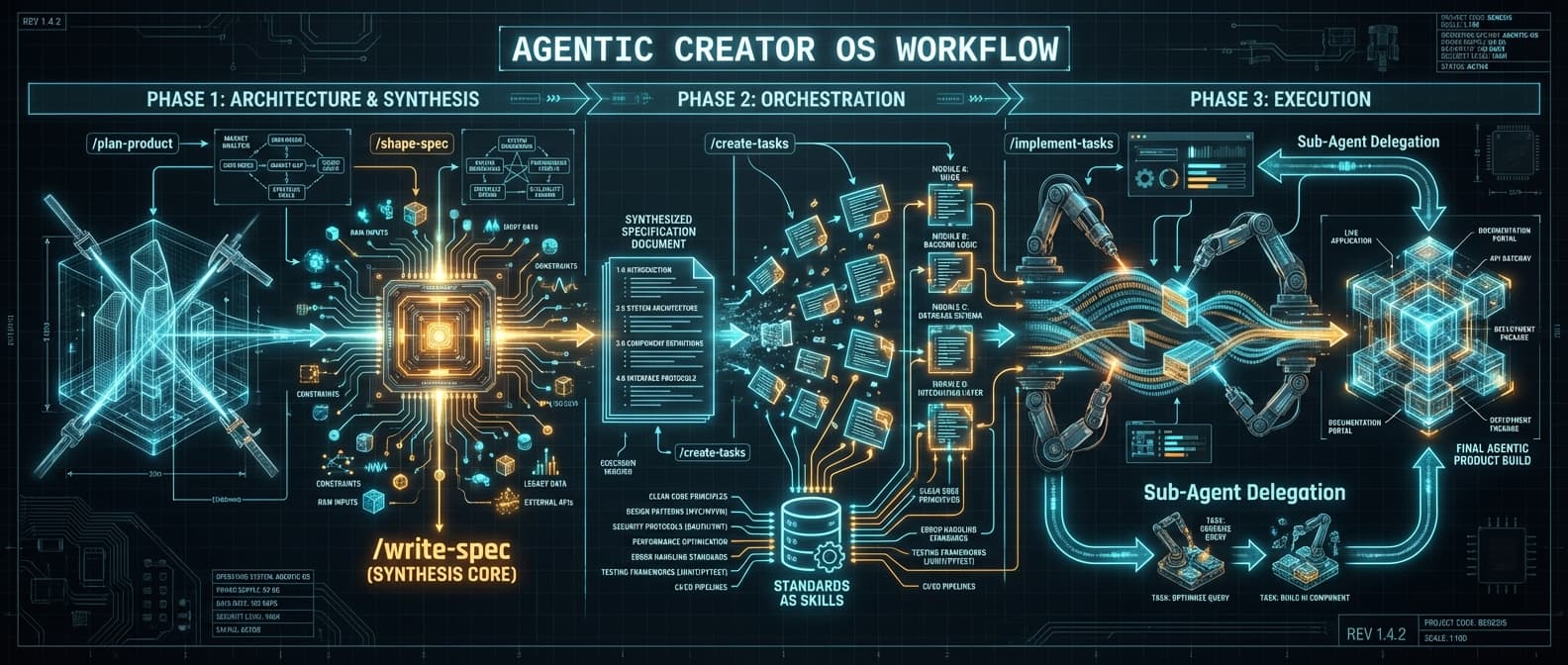
ACOS is one implementation of a personal AI CoE for creators and builders. The AI CoE is the framework. ACOS is the runtime, with agents, skills, memory, and workflows.
Where should a team start?
Start with one high-value workflow, a short governance rule set, a shared prompt library, and a review cadence. Expand only after the first workflow has measurable quality or time gains.