AI ArchitectureMay 3, 20267 min
Inner HR: The AI Agent for Your Internal Team
Most leadership failures are not strategy failures — they are part-capture failures. An Inner HR agent helps you lead your inner team so you can lead the outer one.


🎯
Reading Goal
Understand how an IFS-informed Inner HR agent supports leadership decisions, conflict prep, and burnout prevention without crossing into therapy.
Inner HR: The AI Agent for Your Internal Team
Where personal development becomes leadership architecture.
A founder's anxious part becomes the company culture. A manager's shame part becomes micromanagement. A salesperson's approval part becomes weak qualification. A product leader's control part becomes slow execution. An executive's exile around rejection becomes political behavior.
These are not strategy failures. They are part-capture failures — moments when an internal protector wins the system without the leader noticing it leading.
Traditional HR manages outer teams. Inner HR is the missing layer: an AI-assisted reflection interface that helps people lead their internal team so they can lead the external one without projecting unresolved parts into the organization.
This is the productized companion to No Bad Parts: What Richard Schwartz Teaches Us About Building Sovereign AI. For the architectural reasoning, start there. For the human-mind side, see Internal Family Systems.
What Inner HR is — and is not
What it is:
- A structured reflection surface that helps a leader notice which internal parts are active around a decision, conversation, or conflict.
- A pre-conversation prep tool — surface the projection before it walks into the meeting.
- A post-incident reflection tool — debrief without self-attack, identify which part was driving.
- A decision hygiene layer — separate Self-led action from fear-led action.
What it is not:
- Therapy. The product never claims to heal trauma or perform clinical work.
- A diagnostic tool that labels people. It works on present-moment role recognition, not personality typing.
- A replacement for a skilled coach or therapist. It is a daily governance interface for leaders who are already self-aware enough to use one.
The IFS Institute itself notes the clinical evidence base for IFS is still developing. So the right product posture is not medical overclaiming. It is architectural wisdom applied to leadership reflection.
Use cases
1. Pre-conversation prep
"I have a hard 1:1 with [name] tomorrow about [topic]. Help me prep."
The Inner HR agent walks the leader through:
- What protective part is about to lead this conversation? (control, avoidance, niceness, blame)
- What is it protecting? (status, comfort, the relationship, the team)
- What does the other person likely have active?
- What would a Self-led version of this conversation sound like?
- What is the one thing to say first to keep the system out of fear?
The output is not a script. It is a clear-headed leader walking into the room.
2. Decision hygiene
"I'm about to make this hire. Walk me through which part is leading the decision."
The Inner HR agent surfaces:
- Is this hire being driven by an unmet need (the "if I had a head of X, I'd be safer" pattern)?
- Is the decision urgency real or a firefighter wanting relief from operational pain?
- Which part wants this person? Which part is hesitant? What is each protecting?
- What would Self-led action look like — including saying no, slowing down, or hiring differently?
3. Burnout prevention
"I've been overworking for three weeks. Something is off."
The Inner HR agent helps the leader notice:
- Which manager part is producing the overwork? (perfectionism, status, fear of falling behind)
- Which exiled part is being suppressed? (rest, grief, dissatisfaction, the feeling that this isn't the company they wanted to build)
- What signal has the system been trying to send that the manager keeps drowning out?
- What is one Self-led action that honors the signal without panicking the manager?
4. Post-incident debrief
"I lost my temper in the standup yesterday. Help me understand what happened."
The Inner HR agent walks through:
- Which part flared? (frustration, contempt, rage, fear)
- What did it interpret as a threat? (loss of control, disrespect, a budget issue)
- Which exile got triggered? (an old wound around competence, abandonment, being unheard)
- What is the integrity move now? (repair conversation, structural change, a personal commitment)
The goal is not self-flagellation. It is integration — turn the incident into governance instead of more burden.
The signature prompt
Inner HR runs on a single repeatable structure. Use it directly with any capable LLM today, or build it into a dedicated interface tomorrow.
Act as my Inner HR reflection partner.

Help me map the internal parts active around this situation:
[describe the situation in 3-5 sentences]

Identify:
1. The manager parts trying to control the outcome
2. The protector parts trying to keep me safe
3. The firefighter parts seeking relief
4. The exiled fear or need underneath
5. The Self-led leadership position
6. The clean next action

Use plain language. No diagnosis. No labeling me as a person — just naming
which parts are loud right now. Be specific to the situation, not generic.
End with one action I can take in the next 24 hours.
This prompt produces useful output on its own. The product layer adds memory, longitudinal tracking, decision logs, and integration with the leader's calendar and team context.
Why this matters now
The leadership stack is reorganizing under AI pressure. Calendar, email, meeting notes, performance management — all getting agentic layers. Most of those layers manage tasks. Almost none manage the leader's internal state, which is the source of every consequential decision they make.
That gap is Inner HR.
It sits where personal development meets leadership architecture: a daily interface for the one resource no other tool touches — the part of a leader that is currently driving the system.
What ships first
A focused MVP, not a platform:
- Single-prompt reflection interface. Web + mobile. No social features.
- Memory across sessions (values, recurring themes, repair events, commitments).
- Pre-conversation prep mode + post-incident debrief mode + decision hygiene mode.
- Private by default. The product only works if the leader trusts it.
- Optional: weekly synthesis ("Here are the parts that have been loud this month").
Everything else — team rollups, manager dashboards, organizational alignment maps — comes later, only after the single-leader case proves out. The category is inner governance, not collaboration software.
Continue
- Architecture: No Bad Parts: Sovereign AI
- Daily practice: Internal Family Systems for Personal Development
- Research: Internal Family Systems
- Research: Self-Led AI Architecture
- Adjacent: Conscious AI for Entrepreneurs
Get Started
Build your first AI system
Step-by-step guide to setting up ACOS, creating your first agent, and shipping real products with AI.
Start buildingTemplates & Blueprints
Production-ready architecture
Download AI architecture templates, multi-agent blueprints, and prompt engineering patterns.
Browse templatesInner Circle
Join the builder community
Connect with creators and architects shipping AI products. Weekly office hours, shared resources, direct access.
Join the circle
Read on FrankX.AI — AI Architecture, Music & Creator Intelligence
Stay in the intelligence loop
Weekly field notes on AI systems, production patterns, and builder strategy.
Continue Reading

AI Architecture7 min
Memory as Exile: Why AI Systems Need Integration Loops
Long-term memory without integration creates psychological debt inside AI systems. The IFS exile pattern, applied to agent memory architecture — and why most production stacks are accumulating it without knowing.
Read article
AI Architecture10 min
No Bad Parts: What Richard Schwartz Teaches Us About Building Sovereign AI
Most AI agents are built around one voice, one objective, one persona. Human intelligence is not single-agent — and the next generation of agentic systems will not be either. The architectural lesson IFS gives AI.
Read article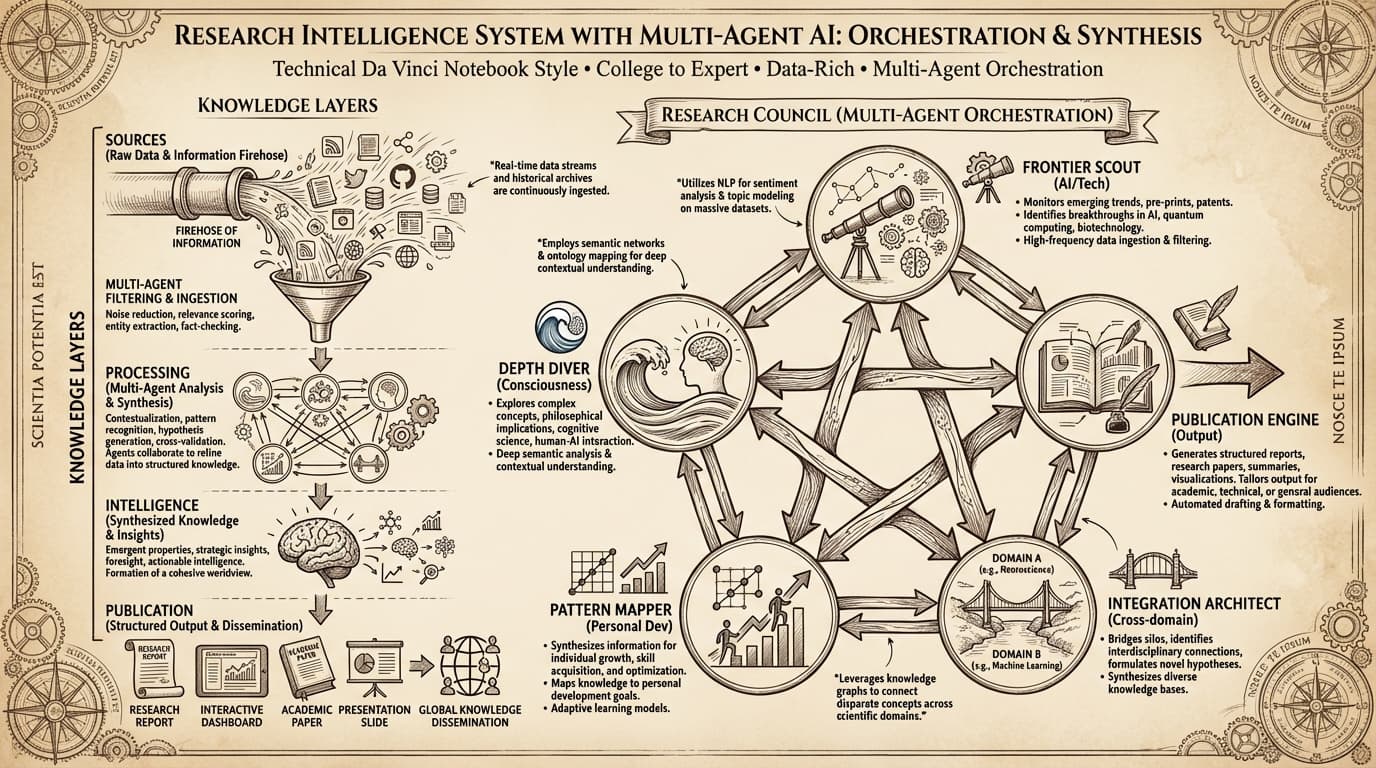
Creator Systems8 min read
Building a Research Intelligence System: How I Use AI Agents for Daily Knowledge Operations
A deep dive into the multi-agent research system powering FrankX.AI - five specialized agents, three workflow modes, and a publication pipeline optimized for the AI age.
Read article