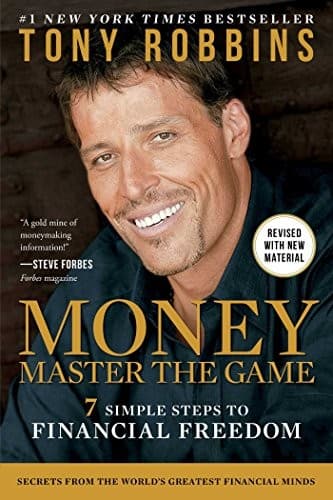
Money: Master the Game
by Tony Robbins
The Short Answer
Robbins interviews Ray Dalio, Carl Icahn, Warren Buffett, John Bogle, David Swensen and ~50 other top investors and synthesizes their patterns into a personal-finance system for ordinary readers. The thesis: index funds + asset allocation + tax efficiency + behavioral discipline beats almost everything else over a lifetime. Long, repetitive, pitchy in places — but the core financial guidance is sound and free.
The FrankX Newsletter
One book breakdown like this. One spotlight from the operating loop. Every Friday.
Key Insights
Most active fund managers underperform their benchmark over 10+ years — the index-fund route is mathematically dominant for almost everyone
Asset allocation accounts for ~90% of portfolio variance; security selection is much less important than where you place the buckets
Compound interest is the eighth wonder — but only if you start early, stay invested through downturns, and minimize fees
Fees compound the same way returns do — a 1% additional annual fee can cost 28% of your final balance over 50 years
Hedge against the inevitable winters — Dalio's All-Weather Portfolio is the closest thing to a free lunch in personal finance
Quotes Worth Remembering
12 curated passages from Money: Master the Game. Chapter references map back to the book so you can re-read them in context.
A real decision is measured by the fact that you've taken a new action.
Section 1 — Welcome to the Jungle
The most important financial decision of your life is what percentage of your income to save.
Section 2 — Become an Insider
Compounding is the eighth wonder of the world. He who understands it, earns it. He who doesn't, pays it.
Section 1 — The Power of Compounding
Robbins quoting (apocryphally) Einstein. The line is anchor for the entire book's "start now, however small" argument.
You don't have to be a millionaire to live like one — but you do have to be a saver.
Section 2 — Become an Insider
The single biggest factor in performance is asset allocation.
Section 4 — Make the Most Important Investment Decision
Most actively managed mutual funds will underperform their benchmark over time.
Section 2 — The 9 Myths
The fact that Vanguard built an empire on. Robbins makes it the spine of his recommendation: index funds for almost everyone, almost always.
Fees matter more than returns when returns are similar — and over time, fees compound to eat your wealth.
Section 2 — The 9 Myths
Diversification is the only free lunch in finance.
Section 4 — Make the Most Important Investment Decision
Robbins quoting Harry Markowitz, the Nobel laureate who created modern portfolio theory.
Winners take action — losers analyze and complain.
Section 7 — Just Do It
The wealthiest people in the world have a few things in common: they take 100% responsibility for everything in their life, they have a sense of certainty about themselves, and they are willing to do what most people are not.
Section 6 — Invest Like the .001%
The economy will go through cycles — your portfolio shouldn't care.
Section 5 — Create a Lifetime Income Plan
Money is meaningless if you don't know what you really want.
Section 7 — The Real Secret to Wealth
Chapter-by-Chapter
Each chapter distilled to a key idea + 2–4 sentence summary — so you can navigate the book's argument without re-reading it, and re-read it with fresh compass if you want.
01Section 1 — Welcome to the Jungle
You can master money or money will master you — there is no neutral middle.
+
Section 1 — Welcome to the Jungle
You can master money or money will master you — there is no neutral middle.
Robbins opens with motivation and the case for taking control. Personal stories, the "money is a game" framing, the cost of inaction. Sets up the seven-step structure that organizes the rest of the book.
02Section 2 — Become an Insider: Know the Rules Before You Get in the Game
The financial industry has nine major myths it sells — knowing them is the price of entry.
+
Section 2 — Become an Insider: Know the Rules Before You Get in the Game
The financial industry has nine major myths it sells — knowing them is the price of entry.
The book's most important section. Robbins debunks: "I'll beat the market," "fees are a small price," "your returns are what you see," "I have to take huge risks for big rewards," "your home is your best investment," "401(k) plans are designed for you to win," "you can't outlive your money," "you have to dig in to lose weight," "the lies we tell ourselves." Each myth gets evidence and counter-strategy.
03Section 3 — Make the Game Winnable
Calculate your number — the specific amount you need for financial security, independence, and freedom.
+
Section 3 — Make the Game Winnable
Calculate your number — the specific amount you need for financial security, independence, and freedom.
Robbins walks through three financial tiers — security (basic needs covered), independence (current lifestyle covered), freedom (current lifestyle plus optional luxury). Each has a specific monthly income requirement, multiplied by 12 and by your withdrawal rate (Robbins uses 4-5%) to get a target. Most readers find their security number is far closer than they assumed.
04Section 4 — Make the Most Important Investment Decision of Your Life
Asset allocation across uncorrelated buckets is the single biggest determinant of returns and survivability.
+
Section 4 — Make the Most Important Investment Decision of Your Life
Asset allocation across uncorrelated buckets is the single biggest determinant of returns and survivability.
The asset-allocation chapter. Robbins walks through the security bucket (cash, bonds, fixed income), risk/growth bucket (stocks, real estate, commodities), and dream bucket (the discretionary 5-10%). Then introduces Dalio's All-Weather Portfolio as a specific implementation. The chapter alone is worth the book.
05Section 5 — Upside Without the Downside: Create a Lifetime Income Plan
Plan for guaranteed income in retirement, not just accumulation — outliving your money is the real risk.
+
Section 5 — Upside Without the Downside: Create a Lifetime Income Plan
Plan for guaranteed income in retirement, not just accumulation — outliving your money is the real risk.
Robbins covers immediate annuities, deferred annuities, and the role of guaranteed income in a complete plan. This section is where Robbins's product recommendations are most prominent; readers should evaluate them against independent sources. The framework — guaranteed income matters — is durably correct.
06Section 6 — Invest Like the .001%: The Billionaire's Playbook
Twelve master investors share their core philosophies — patterns are more useful than predictions.
+
Section 6 — Invest Like the .001%: The Billionaire's Playbook
Twelve master investors share their core philosophies — patterns are more useful than predictions.
The book's interview section. Carl Icahn on activist investing, Ray Dalio on principles, Warren Buffett on patience, John Bogle on indexing, David Swensen on Yale's endowment, T. Boone Pickens on energy. Each interview is condensed; the patterns across them are the takeaway. Most prefer index funds for ordinary investors. Most preach patience and contrarian temperament.
07Section 7 — Just Do It, Enjoy It, and Share It
Wealth without meaning is misery — direct some of it toward contribution.
+
Section 7 — Just Do It, Enjoy It, and Share It
Wealth without meaning is misery — direct some of it toward contribution.
Robbins's closing section pivots from accumulation to use. Philanthropy, family financial education, the difference between "having" and "being." The section leans inspirational; readers expecting more technical content are sometimes underwhelmed. The argument that money should serve life — not the other way — is durably correct.
Best For
Frequently Asked Questions
Is Money: Master the Game worth reading if I already use index funds?
+
Partly. If you're already doing index funds + low fees + automation, you have the core 80% of the book. The remaining 20% (Dalio's All-Weather, behavioral coaching, immediate annuities, the philanthropy chapter) may still be worth your time. Skim, don't read straight through.
Is the book pitchy?
+
Yes, in places. Robbins promotes specific products (Stronghold Wealth Management — now Creative Planning), insurance products, and his own seminars. The promotional content is real but separable from the educational content. Read the strategy chapters, skip the pitches.
What is Ray Dalio's All-Weather Portfolio?
+
A diversification strategy designed to perform across all four economic environments (rising/falling growth, rising/falling inflation). The retail version Dalio shared with Robbins: 30% stocks, 55% bonds (split short and long-term), 7.5% gold, 7.5% commodities. Lower returns than 100% stocks in bull markets, dramatically less drawdown in crashes, surprisingly competitive long-term risk-adjusted returns.
What are Robbins's "7 Simple Steps"?
+
(1) Make the most important financial decision of your life — pay yourself first. (2) Become an insider — know the rules. (3) Make the game winnable — calculate your numbers. (4) Make the most important investment decision — asset allocation. (5) Create a lifetime income plan. (6) Invest like the .001%. (7) Just do it, enjoy it, and share it. The steps map cleanly to the book's parts.
Should I read this or Bogle's Common Sense on Mutual Funds?
+
Bogle for rigor. Robbins for accessibility. Bogle's book is the academic foundation Robbins draws from heavily. If you're analytical and want the math, Bogle. If you're overwhelmed and need a friendly comprehensive entry point, Robbins. Reading both sequentially is best — Robbins for the on-ramp, Bogle for the engineering.
Continue Reading
If Money: Master the Game opened a door, these books walk you through it. Curated for reason, not algorithm — each entry explains why it pairs with this book.
The Little Book of Common Sense Investing
by John C. Bogle
The 200-page rigorous version of Robbins's 600-page friendly version. Bogle is the Vanguard founder; the index-fund argument is in his words. Read Robbins for the on-ramp, Bogle for the engineering.
Get the bookA Random Walk Down Wall Street
by Burton Malkiel
The academic foundation Bogle and Robbins both stand on. Malkiel proves the random-walk hypothesis and its consequences for the small investor. Required reading for anyone serious about index investing.
Get the bookPrinciples
by Ray Dalio
Dalio's own book, longer and deeper than the Robbins interview can capture. The All-Weather Portfolio comes from his core "principles" framework — read Dalio directly to understand the system.
Get the bookThe Intelligent Investor
by Benjamin Graham
Buffett's own foundational text. Less applicable to ordinary readers than Robbins, but the source code for value investing as a philosophy.
Get the bookYour Money or Your Life
by Vicki Robin & Joe Dominguez
The personal-finance philosophy book. Where Robbins teaches you to play the game well, Robin and Dominguez ask whether the game is worth playing — and how much wealth you actually need.
Get the bookI Will Teach You to Be Rich
by Ramit Sethi
The practical operations manual for younger readers. Sethi covers the same ground as Robbins's Section 2-3, with more direct implementation — accounts to open, automatic transfers to set up, scripts to negotiate fees.
Get the bookGo Deeper — Videos
The book is the foundation. These talks and interviews are where the ideas sharpen, get challenged, and connect to adjacent work. Best watched after reading, not instead of.
Tony Robbins on the Tim Ferriss Show — Money
Tim Ferriss Show
Multi-hour interview specifically on the financial framework. Ferriss extracts the core moves — asset allocation, fees, indexing — without the seminar showmanship.
Ray Dalio Explains the All-Weather Portfolio
Various Dalio interviews
Dalio walking through the portfolio Robbins highlights in Section 4. Best to hear Dalio explain it in his own voice rather than through Robbins's summary.
John Bogle — The Case for Index Funds
Various Bogle talks
Bogle himself making the index-fund argument that anchors Robbins's investment recommendations. Listening to Bogle is listening to the source.
Tony Robbins — Money Master the Game (Talk)
Various
Robbins presenting the book's framework on stage. Best for readers who want the seven-step structure compressed before reading the long-form.
If You Liked This, Read Ours
Our Book
Manifestation
The Architecture of Reality
Not wishful thinking. Not magic. The grounded, psychological, and strategic approach to turning thought into reality — updated for the AI age.
Read free