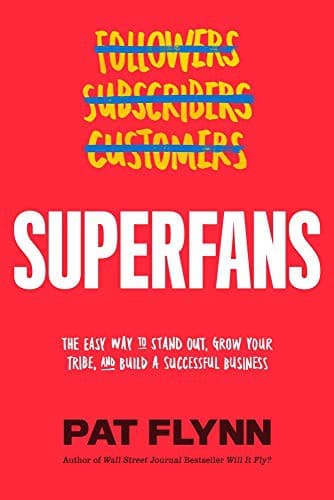
Superfans
by Pat Flynn
The Short Answer
Flynn's framework for turning casual followers into evangelistic superfans. The thesis: 1,000 superfans are worth more than 100,000 lukewarm followers, and you build them deliberately by progressing audiences up a ladder of engagement — from active audience to connected community to superfans. Practical, friendly, structurally simple. The book's Pyramid of Fandom is the visual readers most often re-cite.
The FrankX Newsletter
One book breakdown like this. One spotlight from the operating loop. Every Friday.
Key Insights
Most creators optimize for reach (followers, views, listens) when they should optimize for depth (the percentage of their audience who would attend an in-person event)
The Pyramid of Fandom — Casual Audience, Active Audience, Connected Community, Superfans — describes the progression any audience moves through, with specific tactics at each level
Superfans are made by deliberately exceeding expectation in small specific moments — handwritten notes, mentioning followers by name, surprise upgrades — not by big launches
The "Magical Detail" — knowing one specific personal thing about your audience members — is the unfair advantage that scales until it doesn't, and you build systems for what does
Community is built deliberately through repeated rituals, named in-jokes, and a shared identity — not as a side-effect of good content
Quotes Worth Remembering
10 curated passages from Superfans. Chapter references map back to the book so you can re-read them in context.
It's not about how many people follow you. It's about how many of them would walk through fire for you.
Introduction
Superfans are not the result of luck. They're the result of deliberate small acts compounded.
Chapter 1 — The Pyramid of Fandom
The smaller you make a person feel seen, the larger their loyalty grows.
Chapter 2 — From Casual to Active Audience
A community is not built on content. It is built on rituals.
Chapter 4 — From Connected Community to Superfans
You don't need a million fans. You need a thousand who would do anything to support you.
Introduction
Flynn extending Kevin Kelly's "1,000 True Fans" essay into operational language.
Surprise and delight are not strategies — they are operating principles.
Chapter 4 — From Connected Community to Superfans
The fastest way to grow a community is to deepen the existing one.
Chapter 3 — From Active Audience to Connected Community
Acknowledgment is the cheapest gift you can give and the one your audience values most.
Chapter 2 — From Casual to Active Audience
Every fan deserves to feel like the only fan.
Chapter 4 — From Connected Community to Superfans
Communities are built deliberately or not at all.
Chapter 3 — From Active Audience to Connected Community
Chapter-by-Chapter
Each chapter distilled to a key idea + 2–4 sentence summary — so you can navigate the book's argument without re-reading it, and re-read it with fresh compass if you want.
01Introduction — Why Superfans Matter
A small group of evangelistic fans creates more leverage than a large casual audience.
+
Introduction — Why Superfans Matter
A small group of evangelistic fans creates more leverage than a large casual audience.
Flynn opens with case studies — small businesses with thriving 200-person communities outperforming larger businesses with 50,000-follower lists. The economics: superfans buy everything, defend you publicly, refer high-quality leads, and create the social proof that converts new audience into active audience.
02Chapter 1 — The Pyramid of Fandom
Four layers, each built from the one below — Casual, Active, Connected Community, Superfans.
+
Chapter 1 — The Pyramid of Fandom
Four layers, each built from the one below — Casual, Active, Connected Community, Superfans.
The framing chapter. Flynn introduces the pyramid and the diagnostic question for each layer. How many casual followers? How many engage actively (comment, like, return)? How many know each other and refer to each other? How many would attend a paid event? The pyramid quickly reveals which layer needs work.
03Chapter 2 — From Casual to Active Audience
Acknowledgment, response, and the Magical Detail move people from passive consumption to active engagement.
+
Chapter 2 — From Casual to Active Audience
Acknowledgment, response, and the Magical Detail move people from passive consumption to active engagement.
Tactics for the first transition: respond to every comment in early stages, mention names in content, share user-generated content, create low-stakes interaction prompts, build the "you're seen" feeling at scale. Flynn covers specific patterns for each major platform.
04Chapter 3 — From Active Audience to Connected Community
Audiences become communities when members start interacting with each other, not just with you.
+
Chapter 3 — From Active Audience to Connected Community
Audiences become communities when members start interacting with each other, not just with you.
The pivot from one-to-many to many-to-many. Flynn covers private community spaces (Discord, Circle, Slack, Facebook Groups), naming the community, in-group rituals, regular synchronous events, and the deliberate cultivation of community-internal status. The chapter has the most operational detail of the book.
05Chapter 4 — From Connected Community to Superfans
Superfans are made by surprise-and-delight moments that exceed normal expectations.
+
Chapter 4 — From Connected Community to Superfans
Superfans are made by surprise-and-delight moments that exceed normal expectations.
Tactics for the last transition: handwritten notes, surprise upgrades, in-person meetups, exclusive previews, public shoutouts, custom content. The pattern: superfans are not bought; they're cultivated by repeatedly exceeding expectation in small ways. The chapter's case studies span from solo creators to mid-sized businesses.
06Chapter 5 — Designing for Reciprocity
Communities sustain themselves only when members feel they can give back, not just receive.
+
Chapter 5 — Designing for Reciprocity
Communities sustain themselves only when members feel they can give back, not just receive.
Flynn's framework for building reciprocity into a community. Mechanisms: featured-member spotlights, peer-to-peer help structures, referral systems, leadership ladders within the community. The principle: a community that only flows down (creator to audience) eventually stagnates; one that flows in all directions sustains.
07Chapter 6 — Avoiding Common Pitfalls
Specific antipatterns kill superfan dynamics — recognize and avoid them.
+
Chapter 6 — Avoiding Common Pitfalls
Specific antipatterns kill superfan dynamics — recognize and avoid them.
Flynn's pattern catalog from coaching: scaling tactics that worked at 100 fans break at 10,000; over-broadcasting kills community feel; ignoring veterans alienates the most loyal; failing to set norms invites toxicity. Each gets a specific recovery move.
Best For
Frequently Asked Questions
What is the Pyramid of Fandom?
+
Flynn's four-layer audience model. Bottom: Casual Audience (occasional readers, drive-by followers). Active Audience (consistent consumers, repeat visitors). Connected Community (engaged, named, recognize each other). Top: Superfans (evangelists, attend events, defend you publicly). Each layer is built from the layer below; you cannot skip steps.
How is this different from "1,000 True Fans" by Kevin Kelly?
+
Kelly's 2008 essay is the source idea Flynn extends. Kelly defined the concept; Flynn provides the operational playbook for moving people up the pyramid. Read Kelly's essay first (it's short and free), then Superfans for implementation.
What's the "Magical Detail" technique?
+
Knowing one specific personal thing about audience members — their kids' names, their hometown, their pet's name — and surfacing it in interactions. Flynn argues this small recognition is disproportionately powerful early in audience-building. As audience grows beyond memory, you build systems (CRM, audience research) to maintain the felt sense of being personally known.
Should I read Will It Fly? or Superfans first?
+
Will It Fly? if you don't have a product yet. Superfans if you have a product and an early audience but engagement feels superficial. They're different stages of the same business — Will It Fly? validates the offer; Superfans deepens the audience.
Is this only for online creators?
+
Mostly, but adaptable. Most examples are podcasters, course creators, YouTubers. The pyramid translates to any business with recurring customers — local restaurants, professional services, B2B SaaS. The specific tactics will need translation; the pyramid is universal.
Continue Reading
If Superfans opened a door, these books walk you through it. Curated for reason, not algorithm — each entry explains why it pairs with this book.
1,000 True Fans (Essay)
by Kevin Kelly
The free 2008 essay Superfans extends. Read first — it's 10 minutes — to internalize the core economic argument before Flynn's implementation.
Get the bookWill It Fly?
by Pat Flynn
Flynn's validation companion book. Will It Fly? proves the offer; Superfans grows the loyal audience around it. Read together for the complete creator playbook.
Get the bookTribes
by Seth Godin
Godin's 2008 manifesto on leading communities. The conceptual cousin of Superfans — Godin makes the case for why; Flynn shows how.
Get the bookGet Together
by Bailey Richardson, Kevin Huynh, Kai Elmer Sotto
The People & Company team's practical guide to building communities — different format than Flynn, similar territory. Read for additional tactics on the Connected Community → Superfans transition.
Get the bookBuilding a StoryBrand
by Donald Miller
The communication framework that makes Flynn's acknowledgment-and-recognition tactics land. Miller's "be the guide, not the hero" mirrors Flynn's creator-as-host posture.
Get the bookInfluence
by Robert Cialdini
Cialdini's reciprocity, commitment, and social-proof principles undergird Flynn's entire approach. Read for the academic foundation behind the practitioner playbook.
Get the bookGo Deeper — Videos
The book is the foundation. These talks and interviews are where the ideas sharpen, get challenged, and connect to adjacent work. Best watched after reading, not instead of.
Pat Flynn — How to Build Superfans (Talk)
Pat Flynn
Flynn presenting the Pyramid of Fandom and core tactics. Best video for the framework before reading the book.
Smart Passive Income Podcast — Community Episodes
Pat Flynn
Long-form interviews with creators who built strong communities. Specific case studies that deepen the patterns from Superfans.
Kevin Kelly on 1,000 True Fans
Various
Kelly discussing the original essay across various interviews. Useful context — Kelly is the philosopher; Flynn is the practitioner.
Pat Flynn on Building Connected Audiences
Various podcasts
Flynn across multiple podcast appearances on the Superfans framework. Different angles on the same material — useful for re-anchoring.
If You Liked This, Read Ours
Our Book
The Great Transition
Building in the Age of AI
A clear-eyed guide to the shift happening now — from employment to ownership, from credentials to capability. Eight chapters on what to build, why now, and how to position yourself.
Read free