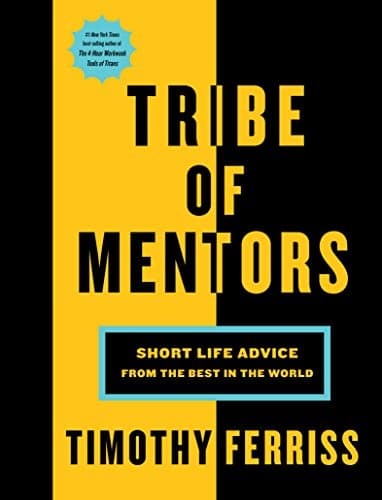
Tribe of Mentors
by Tim Ferriss
The Short Answer
Ferriss sends 11 questions to 130+ world-class performers and prints their unedited responses. Less depth than Tools of Titans; vastly more breadth. The format reveals patterns invisible at single-interview resolution — what books almost everyone recommends, what the most-cited failures-turned-into-wins were, which "morning routines" actually look the same.
The FrankX Newsletter
One book breakdown like this. One spotlight from the operating loop. Every Friday.
Key Insights
Eleven well-chosen questions reveal more than open-ended interviews — the constraint forces specifics
The most-cited single book across 130 respondents is The Untethered Soul (Singer), followed closely by Meditations (Aurelius) and Mans Search for Meaning (Frankl)
Most respondents recommend the same ~10 daily practices — meditation, journaling, exercise, deliberate solitude, gratitude — implemented differently but consistently across domains
The "best $100 or less" purchase question reveals an asymmetric category — small recurring tools (kettlebells, journals, books, blue-blocking glasses) compound massively
When asked what advice they'd give their 30-year-old self, the most common answer was a version of "say no more, focus harder, take more contrarian bets earlier"
Quotes Worth Remembering
12 curated passages from Tribe of Mentors. Chapter references map back to the book so you can re-read them in context.
When you say no, you're saying no to one option. When you say yes, you're saying no to every other option.
On Saying No
A theme that recurs across dozens of respondents — most successful people credit their no-list as more important than their to-do list.
The best advice I ever got was: 'Don't take advice from people whose lives you don't want.'
Question 8 — Advice for College Students
When in doubt, do the basics extraordinarily well.
Question 10 — When Overwhelmed
Be slow to take advice. Most of it comes from people who haven't lived through your specific situation.
Question 9 — Advice to Ignore
A very simple test: would I be doing this if I were not afraid?
Question 7 — New Behaviors
Most people are far more capable than they realize. The bottleneck is permission.
Question 4 — Billboard Message
I learned to write by writing badly until I wrote less badly.
Question 3 — Failure
Discipline is freedom — schedule your week or it will schedule you.
Question 7 — New Behaviors
The way you do anything is the way you do everything.
Question 4 — Billboard Message
Quoted by multiple respondents independently. A piece of folk wisdom that the format reveals as widely-internalized among the elite.
Your future is created by what you do today, not tomorrow.
Question 11 — When Unfocused
The biggest mistake I see ambitious people make is optimizing for opportunities instead of optionality.
Question 8 — Advice for College Students
You will be old too — start the practice now of being someone you'll be glad you became.
Question 4 — Billboard Message
Chapter-by-Chapter
Each chapter distilled to a key idea + 2–4 sentence summary — so you can navigate the book's argument without re-reading it, and re-read it with fresh compass if you want.
01Introduction — The Eleven Questions
A short list of well-chosen questions, asked of many, surfaces patterns invisible at small sample size.
+
Introduction — The Eleven Questions
A short list of well-chosen questions, asked of many, surfaces patterns invisible at small sample size.
Ferriss explains the format: 11 questions, 130+ respondents, minimal editing. The premise: at sample size > 100, common answers carry probative weight beyond any single response. The book is the demonstration.
02Question 1 — Most-Gifted Books
A short list of books recurs across respondents — read them as the contemporary canon for ambitious adults.
+
Question 1 — Most-Gifted Books
A short list of books recurs across respondents — read them as the contemporary canon for ambitious adults.
The Untethered Soul, Meditations, Mans Search for Meaning, Sapiens, The Hard Thing About Hard Things, Atlas Shrugged, Influence, Letters from a Stoic, The Bhagavad Gita. Most respondents gift one or two of these. The recommendations cluster tightly enough that ignoring them is a deliberate choice.
03Question 2 — Best Purchase Under $100
Small recurring tools compound — the cheapest interventions are often the highest-leverage.
+
Question 2 — Best Purchase Under $100
Small recurring tools compound — the cheapest interventions are often the highest-leverage.
Kettlebells, blue-blocking glasses, the 5-Minute Journal, specific knives, foam rollers, weighted blankets, sauna blankets, bidets. Most respondents cite items they use daily for years. The pattern: small infrastructure investments compound far more than any single luxury.
04Question 3 — How Failure Set Up Success
Almost every respondent has a specific failure-to-success arc — and most credit the failure rather than the recovery.
+
Question 3 — How Failure Set Up Success
Almost every respondent has a specific failure-to-success arc — and most credit the failure rather than the recovery.
The most-told story format in the book. Patterns: business failures that taught what the next venture needed; relationship failures that revealed values; health failures that forced lifestyle redesigns. The throughline: failures recovered from with curiosity, not bitterness, become competitive advantages.
05Question 4 — Billboard Message
Forced compression to one sentence reveals each respondent's core operating principle.
+
Question 4 — Billboard Message
Forced compression to one sentence reveals each respondent's core operating principle.
Many of the book's most-quoted lines come from this question. Examples: "You will die. Now go live," "The way you do anything is the way you do everything," "It's not about you." Read in aggregate, the section maps the values the elite actually try to live by, not just the ones they market.
06Questions 5-7 — Investments, Habits, and New Beliefs
Material investment, daily practice, and revised belief — the three layers most lives change at.
+
Questions 5-7 — Investments, Habits, and New Beliefs
Material investment, daily practice, and revised belief — the three layers most lives change at.
Question 5 surfaces meaningful financial and time investments (most cite people, education, and specific thinking time). Question 6 surfaces unusual rituals (cold plunges, deliberate boredom, regular fasting). Question 7 surfaces beliefs that have changed in 5 years — many cite a softening of certainty as the most useful upgrade.
07Questions 8-9 — Advice For and Against
Asked to advise the next generation, the elite repeatedly recommend less, not more.
+
Questions 8-9 — Advice For and Against
Asked to advise the next generation, the elite repeatedly recommend less, not more.
Q8 patterns: travel more, read more, take asymmetric bets earlier, choose mentors carefully, optimize for optionality. Q9 patterns: ignore most career advice from people in different industries, ignore "follow your passion" without specifics, ignore academic-success-as-life-success conflations, ignore "play it safe." The advice-to-ignore section is more useful than the advice section for most readers.
08Questions 10-11 — Overwhelm and Recovery
Specific protocols for navigating overwhelm recur across respondents — most are simple, physical, and immediate.
+
Questions 10-11 — Overwhelm and Recovery
Specific protocols for navigating overwhelm recur across respondents — most are simple, physical, and immediate.
Common answers: long walks, immediate exercise, deliberate solitude, journaling for 10 minutes, specific breathing protocols, calling a specific friend, returning to the most-basic version of the work. The pattern: when overwhelmed, the elite shrink the world rather than try to manage it.
Best For
Frequently Asked Questions
What are the 11 questions Ferriss asks?
+
1) What is the book(s) you've given most as a gift? 2) Purchase of $100 or less that's most positively impacted your life? 3) How has a failure set you up for later success? 4) If you could put a billboard message anywhere, what would it say? 5) What is one of the best or most worthwhile investments you've ever made? 6) An unusual habit or absurd thing you love? 7) In the last five years, what new belief, behavior, or habit has improved your life? 8) What advice would you give a smart, driven college student? 9) What advice should they ignore? 10) How do you respond when feeling overwhelmed? 11) When you feel unfocused or have lost your way, what do you do?
Should I read Tribe of Mentors or Tools of Titans first?
+
Tribe of Mentors first if you want breadth — it's designed for exploration, easier to scan, less commitment per profile. Tools of Titans first if you want depth — more useful per page once you've committed. They reward each other; many readers buy both and rotate.
What books appear most across the 130 responses?
+
The Untethered Soul (Singer), Meditations (Aurelius), Mans Search for Meaning (Frankl), Sapiens (Harari), The Hard Thing About Hard Things (Horowitz), Letters from a Stoic (Seneca), The Bhagavad Gita, Atlas Shrugged (Rand), and Influence (Cialdini). Together they form a kind of reading shortlist for anyone trying to understand the canon ambitious people are currently working from.
What's the best part of the book?
+
The "$100 or less" answers, by reader consensus. The recommendations cluster surprisingly tightly — kettlebells, blue-blocking glasses, the 5-Minute Journal, sauna blankets, specific knife sharpeners. The pattern is more useful than any single recommendation.
Are the answers ghostwritten?
+
The format makes that hard to do unobtrusively — answers are short, idiosyncratic, frequently in the respondent's clear voice. Some responses do read polished (likely edited for clarity); the substance reads authentic across 130 different writers, which would be hard to fake.
Continue Reading
If Tribe of Mentors opened a door, these books walk you through it. Curated for reason, not algorithm — each entry explains why it pairs with this book.
Tools of Titans
by Tim Ferriss
Tribe's deep-dive companion. Where Tribe gives you the surface pattern, Tools gives you the depth on dozens of specific performers. Read together for the complete view.
Get the bookThe Almanack of Naval Ravikant
by Eric Jorgenson
Naval is among the most-cited respondents in Tribe. The Almanack is his complete framework — read it after Tribe to deepen one of the most influential voices.
Get the bookThe Untethered Soul
by Michael A. Singer
The single most-gifted book in Tribe of Mentors. Read it next to understand what high performers are recommending to each other.
Get the bookThe Hard Thing About Hard Things
by Ben Horowitz
The most-recommended business book across founder respondents. Horowitz on the actual texture of running a company under pressure.
Get the bookSapiens
by Yuval Noah Harari
The most-cited recent non-business book in Tribe. The respondents' shared mental model of human history is approximately Sapiens.
Get the bookInfluence
by Robert Cialdini
The persuasion canon, recommended widely across Tribe respondents in business. Read for the operational toolkit most respondents have internalized.
Get the bookGo Deeper — Videos
The book is the foundation. These talks and interviews are where the ideas sharpen, get challenged, and connect to adjacent work. Best watched after reading, not instead of.
The Tim Ferriss Show — Best of Year-End Episodes
Tim Ferriss Show
Ferriss's annual "best of" compilations. Closest audio-version of Tribe of Mentors' format — short cuts of the most useful tactical answers across many guests.
Tim Ferriss — Why You Should Define Your Fears (TED)
TED
The 13-minute distillation of the framework that drives many of the questions in Tribe. Useful as primer or refresher.
Naval Ravikant — How to Get Rich (Without Getting Lucky)
Naval
The famous tweetstorm-turned-podcast. Naval's wealth framework, the most-cited single voice across Tools of Titans and Tribe of Mentors.
Yuval Noah Harari — Sapiens Talks
Various
Harari's lectures on the Sapiens framework. Useful context for the most-cited non-business book across Tribe respondents.
If You Liked This, Read Ours
Our Book
The Art of Self-Development
Seven Pillars of a Complete Life
A systematic approach to building every dimension of your life — energy, mind, soul, craft, capital, circle, and legacy. Not theory. Routines that work.
Read free