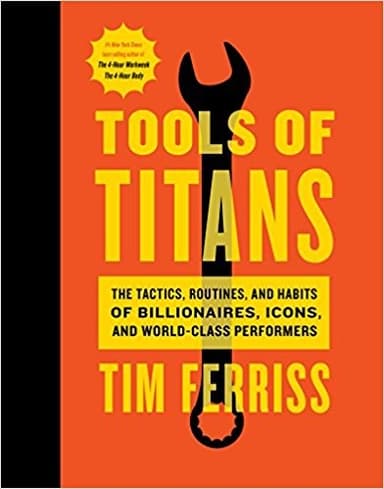
Tools of Titans
by Tim Ferriss
The Short Answer
Ferriss distills 200+ podcast interviews with world-class performers into a single 700-page reference book. Organized into three parts — Healthy, Wealthy, Wise — each profile is 5-15 pages of the guest's most useful tools, routines, beliefs, and recommendations. Not a book to read straight through. A book to keep on the desk and open at any page when you need a different angle on a problem.
The FrankX Newsletter
One book breakdown like this. One spotlight from the operating loop. Every Friday.
Key Insights
World-class performers across domains share surprising commonalities — daily mindfulness/meditation, journaling, weight training, deliberate exposure to discomfort
The "tools" most cited across interviews — fear-setting, cold exposure, kettlebell swings, "what would this look like if it were easy?", 5-Minute Journal — appear in dozens of profiles independently
Most performers attribute outsize impact to specific small habits, not grand strategies — the 80/20 of mastery hides in unsexy daily rituals
Reading recommendations from the interviewees, aggregated, surface a strikingly consistent canon of ~15 books cited by most guests
The book itself is a tool — designed for random-access browsing, not linear reading; readers report most value from re-opening to a random page when stuck
Quotes Worth Remembering
12 curated passages from Tools of Titans. Chapter references map back to the book so you can re-read them in context.
A "good" diet is one you can stick to.
Part 1 — Healthy
Compressed from multiple guests on the futility of "optimal" diets you abandon by week three.
Stress doesn't come from working too much. It comes from not knowing your priorities.
Part 2 — Wealthy
The superpower of saying no.
Part 2 — Wealthy
Naval Ravikant's framing. Most of the book's wealthy guests structure their lives around aggressive default-no policies.
When you complain, nobody wants to help you.
Part 3 — Wise
Stephen Covey via Ferriss. Operationally true even when the complaint is justified.
You don't become confident by shouting affirmations in the mirror, but by having a stack of undeniable proof that you are who you say you are.
Part 1 — Healthy
Quoting Alain de Botton, repeated across multiple performers.
Comparison is the thief of joy.
Part 3 — Wise
Theodore Roosevelt via Ferriss. Cited in interviews with a striking number of accomplished people.
A peaceful mind is the foundation of a productive day.
Part 1 — Healthy
What would this look like if it were easy?
Part 2 — Wealthy
The single most-cited Ferriss prompt. Forces you to question whether the difficulty is intrinsic or self-imposed.
Show me your friends and I'll show you your future.
Part 2 — Wealthy
You are the average of the five people you spend the most time with.
Part 2 — Wealthy
Jim Rohn via Ferriss. Repeated by enough successful interviewees to qualify as folk truth.
In a world of distraction, focus is your unfair advantage.
Part 3 — Wise
When in doubt, throw it out.
Part 3 — Wise
A decluttering principle that recurs across performers in different domains — physical objects, commitments, beliefs, partnerships.
Chapter-by-Chapter
Each chapter distilled to a key idea + 2–4 sentence summary — so you can navigate the book's argument without re-reading it, and re-read it with fresh compass if you want.
01Part 1 — Healthy: The Body
Physical mastery is the prerequisite — almost every titan has a daily training, recovery, and sleep ritual.
+
Part 1 — Healthy: The Body
Physical mastery is the prerequisite — almost every titan has a daily training, recovery, and sleep ritual.
Profiles include Wim Hof, Charles Poliquin, Jason Nemer, Pavel Tsatsouline, Coach Sommer, Christopher Sommer, Dom D'Agostino. Ferriss extracts: the 5-minute morning routine consensus, kettlebell swings as universal posterior-chain exercise, time-restricted eating, cold exposure, the ketogenic diet for specific contexts, sleep optimization protocols.
02Part 1 — Healthy: The Mind
Mental performance protocols are universal — meditation, journaling, deliberate solitude.
+
Part 1 — Healthy: The Mind
Mental performance protocols are universal — meditation, journaling, deliberate solitude.
Profiles include Tara Brach, Sam Harris, Tony Robbins, BJ Miller, Maria Sharapova. Ferriss extracts: the consistency of meditation across performers (often 10-20 min daily), the value of writing (especially morning pages or 5-Minute Journal), psychedelics in considered contexts, the under-discussed importance of relationships and grief work.
03Part 2 — Wealthy: Strategy and Mental Models
Wealth is generated by leverage — code, capital, content — applied via specific judgments.
+
Part 2 — Wealthy: Strategy and Mental Models
Wealth is generated by leverage — code, capital, content — applied via specific judgments.
Profiles include Naval Ravikant, Reid Hoffman, Peter Thiel, Marc Andreessen, Chris Dixon, Marc Benioff. Ferriss extracts: the leverage formula (specific knowledge × accountability × leverage = wealth), the contrarian-and-correct framework, the asymmetric-bet structure, why optionality matters more than commitment for early careers, the under-cited role of mentorship.
04Part 2 — Wealthy: Tactics and Operations
Most wealth-generating tactics are unglamorous — productized services, smart pricing, deliberate distribution.
+
Part 2 — Wealthy: Tactics and Operations
Most wealth-generating tactics are unglamorous — productized services, smart pricing, deliberate distribution.
Profiles include Ramit Sethi, Noah Kagan, Tim O'Reilly, Kevin Kelly, Derek Sivers, Seth Godin. Ferriss extracts: the 1,000-true-fans framework, productized service pricing, distribution as the bottleneck, the case for asymmetric niche-focus, why most marketing fails (no clear customer).
05Part 3 — Wise: Philosophy and Mental Models
How to think clearly is a meta-skill that compounds across every domain.
+
Part 3 — Wise: Philosophy and Mental Models
How to think clearly is a meta-skill that compounds across every domain.
Profiles include Stoic-influenced thinkers (Ryan Holiday, Tim Ferriss himself, William Irvine), philosophers, and serious readers (Maria Popova, Kevin Kelly). Ferriss extracts: Stoic practices (premeditatio malorum, the dichotomy of control), reading patterns of high performers (slow, repeated, marginalia), the case for first-principles thinking.
06Part 3 — Wise: Creativity and Lifestyle
Creative output is generated by constraint, ritual, and deliberate boredom — not by inspiration.
+
Part 3 — Wise: Creativity and Lifestyle
Creative output is generated by constraint, ritual, and deliberate boredom — not by inspiration.
Profiles include Brené Brown, Maria Popova, Cheryl Strayed, Margaret Cho, Mike Birbiglia, Robert Rodriguez. Ferriss extracts: the morning ritual consensus, the importance of constraints in creative work, the under-cited role of boredom and walks, the practice of "showing your work" for accountability.
07Across All Parts — The Most-Cited Tools and Books
A small set of books, practices, and tools recur across dozens of unrelated guests.
+
Across All Parts — The Most-Cited Tools and Books
A small set of books, practices, and tools recur across dozens of unrelated guests.
Ferriss highlights the items that appear most across interviews. Books: Meditations (Marcus Aurelius), Letters from a Stoic (Seneca), Man's Search for Meaning (Frankl), The Effective Executive (Drucker). Practices: meditation, journaling, kettlebell work, deliberate cold. Tools: 5-Minute Journal, Headspace/Calm, blue-blocking glasses, kettlebells. The pattern is the recommendation.
Best For
Frequently Asked Questions
Should I read Tools of Titans cover-to-cover?
+
No, and Ferriss explicitly says so. The book is a reference. Open to any profile. Read the ones whose name catches you. Skim the rest. Most readers report 80% of the value comes from 30% of the profiles — and that 30% is different for each reader.
How is this different from the podcast?
+
The book extracts the most useful tactics, frameworks, and recommendations from each interview, with Ferriss's own commentary on what stuck. Podcast episodes are 2-3 hours of conversation; the book's profile is 5-15 pages of the actionable distillation. Better signal-to-noise; less of the texture of the original conversations.
Which interviews are the most valuable?
+
Reader consensus tends to highlight: Naval Ravikant, Derek Sivers, Jocko Willink, Kevin Kelly, Maria Popova, Reid Hoffman, Peter Thiel, Ramit Sethi, BJ Miller, Joshua Waitzkin. But the book rewards browsing — the most valuable for you depends on what problem you're currently solving.
Should I read this or Tribe of Mentors first?
+
Tools of Titans first if you want the depth — each profile is detailed enough to internalize the person's framework. Tribe of Mentors if you want breadth — 130+ guests, each answering the same 11 questions, easier to scan for surface patterns. They complement; reading both produces compounding effects.
Is it dated?
+
Less than you'd expect for an interview compilation. Most of the tactics and frameworks are durably useful. Specific apps and services have changed; the underlying principles haven't. Ferriss's own footnotes catch most of the place where the original interview's recommendation needs updating.
Continue Reading
If Tools of Titans opened a door, these books walk you through it. Curated for reason, not algorithm — each entry explains why it pairs with this book.
Tribe of Mentors
by Tim Ferriss
Ferriss's 2017 follow-up. 130+ interviewees, each answering the same 11 questions. Less depth per profile, more surface area. The natural complement to Tools of Titans.
Get the bookThe 4-Hour Workweek
by Tim Ferriss
Ferriss's lifestyle-design book — the philosophy that informs his choice of guests and questions throughout Tools of Titans.
Get the bookThe Almanack of Naval Ravikant
by Eric Jorgenson
Naval is the most-cited single voice in Tools of Titans. The Almanack is his complete framework, distilled. Read this for depth on the wealth and happiness sections.
Get the bookThe Daily Stoic
by Ryan Holiday
A daily reader format that maps to Tools of Titans' browsable structure. Holiday is one of the most-cited Stoic-popularizers in the book.
Get the bookShow Your Work!
by Austin Kleon
The principle that recurs across the creative interviews in Part 3. Kleon makes the case for working in public; Ferriss's guests demonstrate it.
Get the bookMeditations
by Marcus Aurelius
The single book most often cited as life-changing across Ferriss's interviewees. If you've only read it once, re-read after Tools of Titans — many of the interview takeaways read like commentary on Marcus.
Get the bookGo Deeper — Videos
The book is the foundation. These talks and interviews are where the ideas sharpen, get challenged, and connect to adjacent work. Best watched after reading, not instead of.
The Tim Ferriss Show — Most-Listened Episodes
Tim Ferriss Show
The original-source podcast for Tools of Titans. The Naval, Jocko, Maria Popova, Kevin Kelly, BJ Miller, and Derek Sivers interviews are particularly recommended starting points.
Tim Ferriss on Working with Titans (Various talks)
Various
Ferriss presenting the book's patterns. Useful for understanding what Ferriss thinks the book is about, vs. what readers extract from it.
Naval Ravikant on the Tim Ferriss Show
Tim Ferriss Show
The single most-recommended interview from Tools of Titans by readers. If you can listen to one of the source episodes, this is it.
Jocko Willink on the Tim Ferriss Show
Tim Ferriss Show
The most-cited military leader profile. Jocko's discipline-and-extreme-ownership framework is a counterweight to the book's more contemplative voices.
If You Liked This, Read Ours
Our Book
The Art of Self-Development
Seven Pillars of a Complete Life
A systematic approach to building every dimension of your life — energy, mind, soul, craft, capital, circle, and legacy. Not theory. Routines that work.
Read free