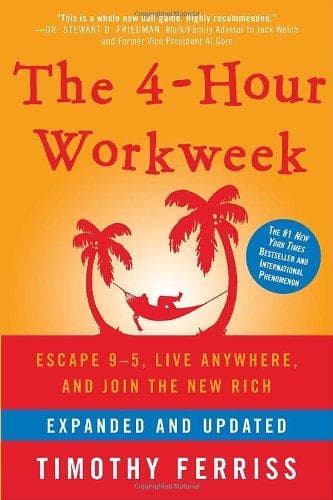
The 4-Hour Workweek
by Tim Ferriss
The Short Answer
The book that named "lifestyle design" and made escaping the 9-to-5 mainstream. Ferriss's DEAL framework — Definition, Elimination, Automation, Liberation — is a sequenced playbook for replacing time-for-money trades with location-independent income, automation, and "mini-retirements" instead of one terminal retirement. Some examples are dated; the operating principles aged surprisingly well.
The FrankX Newsletter
One book breakdown like this. One spotlight from the operating loop. Every Friday.
Key Insights
The "New Rich" trade time and mobility for status — measured by experiences and freedom, not income or net worth alone
The 80/20 principle (Pareto) plus Parkinson's Law (work expands to fill time) are the twin levers — apply both ruthlessly
Most "necessary" tasks are not necessary; most "responsive" emails do not require response; most meetings should not happen
Automate income through productized services or dropshipping muses, then use the resulting time for what you actually wanted
Mini-retirements (months-long deliberate breaks throughout your career) outperform deferred retirement at 65 on every measure that matters
Quotes Worth Remembering
14 curated passages from The 4-Hour Workweek. Chapter references map back to the book so you can re-read them in context.
Most people are fast to stop you before you get started but hesitant to get in the way if you're moving.
Step I: D — Definition
Ferriss's practical answer to the "everyone will object" objection. Speed creates social cover.
The question you should be asking isn't "What do I want?" or "What are my goals?" but "What would excite me?"
Step I: D — Dodging Bullets
Doing something unimportant well does not make it important.
Step II: E — The End of Time Management
Being busy is a form of laziness — lazy thinking and indiscriminate action.
Step II: E — Elimination
Lack of time is actually lack of priorities.
Step II: E — The End of Time Management
A person's success in life can usually be measured by the number of uncomfortable conversations he or she is willing to have.
Step I: D — Dodging Bullets
What we fear doing most is usually what we most need to do.
Step I: D — Dodging Bullets
If you are insecure, guess what? The rest of the world is, too. Do not overestimate the competition and underestimate yourself.
Step I: D — Dodging Bullets
For all of the most important things, the timing always sucks. Waiting for a good time to quit your job? The stars will never align and the traffic lights of life will never all be green at the same time.
Step I: D — Dodging Bullets
The bottom line is that you only have the rights you fight for.
Step IV: L — Mini-Retirements
'Someday' is a disease that will take your dreams to the grave with you.
Step I: D — Dodging Bullets
Conditions are never perfect.
Step I: D — Dodging Bullets
It is far better to do something remarkable than to make sure nothing goes wrong.
Step III: A — Automation
A real choice is choosing what to do with your time and where to spend it. The currency of the New Rich isn't money — it's time and mobility.
Step I: D — Definition
Chapter-by-Chapter
Each chapter distilled to a key idea + 2–4 sentence summary — so you can navigate the book's argument without re-reading it, and re-read it with fresh compass if you want.
01Step I — Definition: Cautions and Comparisons
Replace the deferred-life plan with a "lifestyle design" — define what you actually want before optimizing for the wrong target.
+
Step I — Definition: Cautions and Comparisons
Replace the deferred-life plan with a "lifestyle design" — define what you actually want before optimizing for the wrong target.
Ferriss opens with the concept of "lifestyle design" — a deliberate alternative to the conventional accumulation-then-retirement script. Introduces the New Rich (NR) framework: people who optimize for time and mobility rather than money alone. The chapter is mostly philosophical setup for the operational chapters that follow.
02Step I — Definition: Rules That Change the Rules
Ten counter-conventional rules that anchor the rest of the book.
+
Step I — Definition: Rules That Change the Rules
Ten counter-conventional rules that anchor the rest of the book.
Ferriss's ten rules: retirement is worst-case insurance, interest and energy are cyclical, less is not laziness, the timing is never right, ask for forgiveness not permission, emphasize strengths don't fix weaknesses, things in excess become opposites, money alone is not the solution, relative income matters more than absolute, distress is bad/eustress is good. Each becomes operational principle.
03Step I — Definition: Dodging Bullets
Most fear is unrealistic — dread-list it, evaluate the real downside, and you'll find the action becomes obvious.
+
Step I — Definition: Dodging Bullets
Most fear is unrealistic — dread-list it, evaluate the real downside, and you'll find the action becomes obvious.
Ferriss's "fear-setting" exercise. List worst-case scenarios in detail. Probability them. Then list the actions that would prevent or recover from each. Compare to the cost of inaction. The exercise systematically reveals that most "scary" decisions have small downside and large upside — the fear was the obstacle, not the math.
04Step I — Definition: System Reset
Use specific calculations — Target Monthly Income (TMI) and Dreamline — to replace vague aspirations with achievable plans.
+
Step I — Definition: System Reset
Use specific calculations — Target Monthly Income (TMI) and Dreamline — to replace vague aspirations with achievable plans.
Ferriss's practical exercise: Dreamlining. Make a list of what you'd like to have, be, and do (specific items, with timelines). Calculate the actual monthly income needed to support it. The exercise typically reveals "the dream lifestyle" requires far less monthly income than the current grinding job pays — the gap was psychological, not financial.
05Step II — Elimination: The End of Time Management
Effectiveness beats efficiency — being efficient at the wrong things just produces more of the wrong things faster.
+
Step II — Elimination: The End of Time Management
Effectiveness beats efficiency — being efficient at the wrong things just produces more of the wrong things faster.
Ferriss's critique of conventional productivity advice. Most time-management systems make you faster at low-value tasks. Real productivity is identifying the 20% of activities that produce 80% of the results, and ruthlessly cutting the rest — including high-status busywork that looks like work.
06Step II — Elimination: The Low-Information Diet
Information you can't act on within 48 hours is mostly entertainment masquerading as research.
+
Step II — Elimination: The Low-Information Diet
Information you can't act on within 48 hours is mostly entertainment masquerading as research.
Ferriss prescribes a one-week selective ignorance experiment: no news, no social media, minimal email, no books unrelated to current projects. The experiment reveals how much "information consumption" was filling time without producing useful output. Most readers report increased calm, focus, and decisions that were previously hung on "I should research more."
07Step II — Elimination: Interrupting Interruption
Most interruptions can be batched, scheduled, or eliminated — but only if you're willing to seem unresponsive.
+
Step II — Elimination: Interrupting Interruption
Most interruptions can be batched, scheduled, or eliminated — but only if you're willing to seem unresponsive.
Ferriss's tactical playbook for protecting attention. Email scheduling (twice a day, no exceptions), autoresponders that set expectations, batched calls, the "set and forget" recurring rules for repetitive decisions. The chapter's tactics work; many require some social courage to deploy.
08Step III — Automation: Outsourcing Life
Most knowledge work tasks can be outsourced to virtual assistants — including, surprisingly, parts of your job.
+
Step III — Automation: Outsourcing Life
Most knowledge work tasks can be outsourced to virtual assistants — including, surprisingly, parts of your job.
Ferriss's VA chapter. Practical examples of what to delegate (email triage, research, scheduling, simple reports), how to find quality VAs, how to write clear instructions, how to structure feedback loops. The chapter reads dated in places (specific services); the framework is durable.
09Step III — Automation: Income Autopilot I — Finding the Muse
A "muse" is a productized business that runs without your daily attention — find one with a specific testable methodology.
+
Step III — Automation: Income Autopilot I — Finding the Muse
A "muse" is a productized business that runs without your daily attention — find one with a specific testable methodology.
Ferriss's muse-discovery framework: identify a specific niche audience, find a product that already exists in adjacent niches, design a market test (Google AdWords), validate before building. The lean-startup playbook before lean-startup was named. Pre-validation saves most readers from building products no one wants.
10Step III — Automation: Income Autopilot II — Testing the Muse
Test for purchase intent with the smallest possible budget before building anything substantial.
+
Step III — Automation: Income Autopilot II — Testing the Muse
Test for purchase intent with the smallest possible budget before building anything substantial.
Practical chapter on micro-testing. Ferriss describes spending $200-500 on AdWords pointed at a fake landing page that captures clicks-to-buy. If conversion rates clear a threshold, build the product. If not, iterate or kill. The discipline is the point — most failed startups skipped this $500 test.
11Step III — Automation: Income Autopilot III — MBA — Management by Absence
Once income is automated, your job is to stay out of the way and resist the urge to "improve" working systems.
+
Step III — Automation: Income Autopilot III — MBA — Management by Absence
Once income is automated, your job is to stay out of the way and resist the urge to "improve" working systems.
Counter-intuitive chapter. Most entrepreneurs over-manage their automated businesses, introducing complexity that breaks the very things that worked. Ferriss prescribes deliberate absence: vacations during which you don't check the business. If it survives, you've built something real. If it doesn't, you've learned what needs fixing.
12Step IV — Liberation: Disappearing Act
Negotiate remote work or quit — most jobs are doable from anywhere; most companies allow it once shown the math.
+
Step IV — Liberation: Disappearing Act
Negotiate remote work or quit — most jobs are doable from anywhere; most companies allow it once shown the math.
Ferriss's playbook for negotiating remote work. Phase 1: be more valuable in-office for two weeks. Phase 2: propose a one-day-a-week trial. Phase 3: extend to two days. Phase 4: full remote, with documented productivity. The chapter is more relevant than ever — what was contrarian in 2007 is mainstream now.
13Step IV — Liberation: Beyond Repair — Killing Your Job
If remote negotiation fails, the math of quitting is usually better than the math of staying.
+
Step IV — Liberation: Beyond Repair — Killing Your Job
If remote negotiation fails, the math of quitting is usually better than the math of staying.
Ferriss walks through quitting calculations. Severance, healthcare bridges, the runway your savings actually give you, the speed at which a competent person can re-employ. The chapter is reassuring rather than reckless — most readers discover quitting is less catastrophic than feared, and recovery is faster than expected.
14Step IV — Liberation: Mini-Retirements
Take months-long breaks throughout your career instead of saving up for one terminal retirement.
+
Step IV — Liberation: Mini-Retirements
Take months-long breaks throughout your career instead of saving up for one terminal retirement.
Ferriss's alternative to retirement-at-65. Six-month or one-year breaks in interesting locations, repeated throughout the working life. The math: if your work is location-independent, the marginal cost of a mini-retirement is rent + food in a cheaper country, not lost income. Many readers report this single chapter was the most life-changing.
15Step IV — Liberation: Filling the Void
The hardest part of the New Rich life is figuring out what to do with the time you fought for.
+
Step IV — Liberation: Filling the Void
The hardest part of the New Rich life is figuring out what to do with the time you fought for.
The closing operational chapter and the most personal. Ferriss describes his own post-escape depression — without the structure of a 9-to-5, what is the point? His answer: continuous learning, service, and the deliberate cultivation of varied identities (athlete, language student, philanthropist). The book ends with the warning that freedom without purpose is its own trap.
Best For
Frequently Asked Questions
Is The 4-Hour Workweek dated?
+
Some examples are. Ferriss talks about specific apps, services, and tactics that have been replaced. The 2009 expanded edition refreshes much of this. But the core frameworks — DEAL, 80/20 elimination, mini-retirements, the New Rich definition — have aged remarkably well. Read the principles; substitute the modern tools.
What does DEAL stand for?
+
Definition (define what you actually want, redefine "rich"), Elimination (kill 80% of low-value time spend, learn to ignore unimportant input), Automation (income on autopilot via productized services, virtual assistants, dropshipping), Liberation (decouple location from income, take mini-retirements). The four phases are sequenced — you can't Liberate before you've Automated; you can't Automate before you've Eliminated.
Did Ferriss really only work 4 hours a week?
+
For some periods, yes — he ran the BrainQUICKEN supplement business with a few hours a week. The book's subtitle is more aspirational than literal for most readers. The realistic take: Ferriss demonstrates 80% of the lifestyle is achievable at 10-15 hours a week, with the remaining 20% requiring more strategic time at peak intensity.
Is "lifestyle design" still relevant in 2026?
+
More than ever. Remote work normalized everything Ferriss advocated for. The mini-retirement concept now has a cultural niche (sabbaticals, FIRE, slow travel). The operational tactics need updating; the philosophy is in its prime.
What's the difference between this and FIRE (Financial Independence, Retire Early)?
+
FIRE optimizes for accumulating enough wealth to never work again. Ferriss optimizes for designing a life so good you don't want to retire. FIRE is wealth-first; Ferriss is freedom-first. Many people find Ferriss's framework reaches the same place faster, with more interesting work along the way.
Continue Reading
If The 4-Hour Workweek opened a door, these books walk you through it. Curated for reason, not algorithm — each entry explains why it pairs with this book.
Tools of Titans
by Tim Ferriss
Ferriss's 700-page distillation of his podcast interviews with elite performers. The natural next book — see how the lifestyle-design philosophy compares with the operational habits of dozens of other top performers.
Get the bookCompany of One
by Paul Jarvis
The principled small-business version of Ferriss's muse concept. Jarvis argues for staying small and profitable rather than chasing scale — closer to Ferriss's actual philosophy than many readers extract from the book.
Get the bookThe E-Myth Revisited
by Michael Gerber
The systemize-your-business classic. Ferriss's automation chapter assumes Gerber's framework — read Gerber for the deeper case for "work on your business, not in it."
Get the bookThe 4-Hour Body
by Tim Ferriss
Ferriss applies the 80/20 mindset to physical performance. Same person, different domain. Useful for understanding Ferriss's thinking style across contexts.
Get the bookThe Lean Startup
by Eric Ries
Ries formalizes what Ferriss's muse-test chapter teaches informally. Build-measure-learn cycles, MVP, validated learning. Read after Ferriss for the structured methodology.
Get the bookDeep Work
by Cal Newport
Newport's argument for sustained focused effort is the necessary corrective to Ferriss's tactical efficiency. Both are right — Ferriss tells you what to skip; Newport tells you what to do with the time you've freed up.
Get the bookGo Deeper — Videos
The book is the foundation. These talks and interviews are where the ideas sharpen, get challenged, and connect to adjacent work. Best watched after reading, not instead of.
The Tim Ferriss Show — Most Popular Episodes
Tim Ferriss Show
Ferriss's podcast is the long-form continuation of the book. Best-of compilations let you sample the format before committing. Naval, Jocko, Maria Popova interviews are ideal entry points.
Tim Ferriss — Smash Fear, Learn Anything (TED)
TED
Ferriss's 2008 TED talk shortly after the book's release. The fear-setting framework from Chapter 3 in 16 minutes.
Tim Ferriss — Why You Should Define Your Fears Instead of Your Goals (TED)
TED
A 2017 TED talk doubling down on the dread-list/fear-setting exercise. More mature than the 2008 version. The single most useful 13 minutes of Ferriss content.
Tim Ferriss on Joe Rogan
JRE
Multiple appearances. Conversational long-form covering writing, lifestyle, psychedelics, and the long arc of his career. Best Ferriss-as-himself, rather than Ferriss-as-podcaster.
If You Liked This, Read Ours
Our Book
The Great Transition
Building in the Age of AI
A clear-eyed guide to the shift happening now — from employment to ownership, from credentials to capability. Eight chapters on what to build, why now, and how to position yourself.
Read free