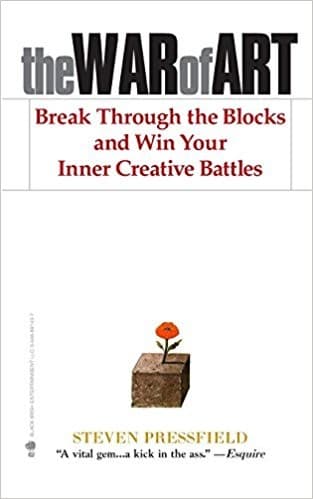
The War of Art
by Steven Pressfield
The Short Answer
Pressfield names the enemy every creator faces — Resistance, with a capital R — as a universal, personified, implacable force that opposes any work that requires us to grow. Short chapters, almost koans. The book itself is an act of defiance against Resistance, demonstrating its own argument.
The FrankX Newsletter
One book breakdown like this. One spotlight from the operating loop. Every Friday.
Key Insights
Resistance is the universal force that opposes any creative or ambitious endeavor — and it is internal, not external
The professional shows up every day regardless of mood, inspiration, or circumstance. The amateur waits for conditions to be right.
Resistance is most powerful at the finish line — the closer you get to shipping, the stronger the urge to quit
Turning pro is a decision, not a ceremony. You do not need permission. You need commitment.
The Muse favors the worker. Inspiration visits those who are already in motion, not those who are waiting.
Quotes Worth Remembering
13 curated passages from The War of Art. Chapter references map back to the book so you can re-read them in context.
Resistance will unfailingly point to true north — meaning that calling or action it most wants to stop us from doing.
Book One — Resistance
Pressfield's diagnostic trick. Whatever produces the most Resistance is what you most need to do. The feeling is a compass, not a warning.
The more scared we are of a work or calling, the more sure we can be that we have to do it.
Book One — Resistance
Are you paralyzed with fear? That's a good sign. Fear is good. Like self-doubt, fear is an indicator. Fear tells us what we have to do.
Book One — Resistance
The amateur believes he must first overcome his fear; then he can do his work. The professional knows that fear can never be overcome. He knows there is no such thing as a fearless warrior or a dread-free artist.
Book Two — Turning Pro
Don't cheat the muse. She knows.
Book Three — Beyond Resistance
The professional loves it so much he dedicates his life to it. He commits full-time.
Book Two — Turning Pro
Resistance has no strength of its own. Every ounce of juice it possesses comes from us.
Book One — Resistance
The professional has learned that success, like happiness, comes as a by-product of work. The professional concentrates on the work and allows rewards to come or not come, whatever they like.
Book Two — Turning Pro
Rule of thumb: The more important a call or action is to our soul's evolution, the more Resistance we will feel toward pursuing it.
Book One — Resistance
We must do our work for its own sake, not for fortune or attention or applause.
Book Two — Turning Pro
The professional cannot allow the actions of others to define his reality. Tomorrow morning the critic will be gone, but the writer will still be there facing the blank page. Nothing matters but that he keep working.
Book Two — Turning Pro
It's not the writing part that's hard. What's hard is sitting down to write.
Book One — Resistance
The central observation. The task is not the bottleneck. The beginning of the task is.
This is the other secret that real artists know and wannabe writers don't. When we sit down each day and do our work, power concentrates around us.
Book Three — Beyond Resistance
Chapter-by-Chapter
Each chapter distilled to a key idea + 2–4 sentence summary — so you can navigate the book's argument without re-reading it, and re-read it with fresh compass if you want.
01Book One — Resistance: Defining the Enemy
Every creator faces the same foe — name it, understand it, expect it.
+
Book One — Resistance: Defining the Enemy
Every creator faces the same foe — name it, understand it, expect it.
The first and longest book. Pressfield catalogs Resistance's qualities — invisible, internal, infallible, impersonal, evil — and its many disguises — procrastination, self-medication, perfectionism, fundamentalism, criticism, self-dramatization. Offers a taxonomy of activities that draw the most Resistance (creative work, diet, ambition, commitment, spiritual practice). The reader finishes Book One with a named antagonist.
02Book One — The Symptoms of Resistance
If you recognize yourself, you're not defective — you're human.
+
Book One — The Symptoms of Resistance
If you recognize yourself, you're not defective — you're human.
Pressfield describes the specific ways Resistance manifests day to day. Browser tabs, snacks, "research," relationship drama invented to justify stopping, physical symptoms that appear only before the work, grand plans that never start. The reader is not being diagnosed — they are being normalized. Everyone experiences this. The response is what differs.
03Book Two — Combating Resistance: Turning Pro
The amateur and the professional differ in one decision, made daily.
+
Book Two — Combating Resistance: Turning Pro
The amateur and the professional differ in one decision, made daily.
Pressfield's structural argument. The amateur approaches the work as hobby — wait for inspiration, quit when it's hard, blame external factors. The professional approaches it as job — show up, endure tedium, ignore mood, master the technique. The switch is a decision, not a ceremony. The book's chapter on the amateur vs. professional is the core of the whole work.
04Book Two — How a Pro Operates
Professionals have defined rituals, defined hours, defined standards — and stay inside them.
+
Book Two — How a Pro Operates
Professionals have defined rituals, defined hours, defined standards — and stay inside them.
Concrete qualities of the professional: shows up every day, stays all day, is committed over the long haul, the stakes are high and real, accepts pay (external or internal), masters the technique, does not take failure or success personally, endures adversity, self-validates, re-invents himself, is recognized by other pros. Reads like a job description for being an artist.
05Book Two — Fear, and the Professional's Relationship to It
Fear is the compass; the professional does not wait for fear to vanish.
+
Book Two — Fear, and the Professional's Relationship to It
Fear is the compass; the professional does not wait for fear to vanish.
Pressfield argues fear never disappears. The professional integrates it — fear becomes information about where growth lies. Most self-help books try to eliminate fear; The War of Art teaches you to work with it in the same room, permanently. This may be the book's most important paragraph.
06Book Three — Beyond Resistance: The Higher Realm
Once Resistance is defeated, something else — call it the Muse — responds.
+
Book Three — Beyond Resistance: The Higher Realm
Once Resistance is defeated, something else — call it the Muse — responds.
The mystical turn. Pressfield describes a realm — archetypal, spiritual, ancient — that responds to the disciplined professional with gifts: ideas, flow states, insights, energy. Offered as literal or metaphorical, reader's choice. The chapter on invoking the Muse is ritualistic — Pressfield himself performs a version of Homer's invocation before writing each day.
07Book Three — Testimony
The work is the reward. Everything else is a by-product.
+
Book Three — Testimony
The work is the reward. Everything else is a by-product.
Pressfield closes with personal testimony — his own turn from amateur to professional, the decades of obscure work before recognition, the acceptance of work-as-meaning. No triumphal arc. The closing argument is anti-romantic: the reward is the privilege of doing the work. Anything else is extra.
Best For
Frequently Asked Questions
What is "Resistance" as Pressfield defines it?
+
The universal negative force that opposes any act of elevation — creative work, spiritual practice, entrepreneurship, health, any move from a lower to higher state. Resistance is internal (it is you), invisible (it prefers you don't notice it), infallible (it always finds a weakness), impersonal (it is not personal to you), and evil (it kills the work). Capital R — Pressfield treats it as a named antagonist.
What does it mean to "turn pro" in Pressfield's framework?
+
The decision to approach your creative work the way a professional approaches their job — show up daily, ignore mood, accept pay (or its spiritual equivalent), work through adversity, master the technique, accumulate mastery over years. The amateur waits for inspiration. The professional installs habits that summon it.
Why is the book structured as tiny chapters?
+
Deliberate. Each chapter is a single blow against Resistance — a short, punchy, re-readable argument. The book is designed to be opened to any page during the day's struggle and provide one usable thought. Pressfield himself uses this method — quasi-daily re-reading is part of the practice.
Is the Muse section (Book Three) literal?
+
Pressfield says: "maybe." Book Three gets explicitly mystical — invocations, angels, the Muse, higher realms. He offers it as either literal belief or useful metaphor, reader's choice. Most readers find the first two books (defining Resistance, turning pro) sufficient on their own.
How does The War of Art relate to Deep Work?
+
Pressfield names the enemy; Newport engineers the defenses. Pressfield is psychology; Newport is systems. Read together: Pressfield tells you you're at war, Newport tells you how to fortify the battlefield. Both agree on the diagnosis.
Continue Reading
If The War of Art opened a door, these books walk you through it. Curated for reason, not algorithm — each entry explains why it pairs with this book.
Turning Pro
by Steven Pressfield
Pressfield's sequel to The War of Art, focused entirely on the amateur-to-professional transition that Book Two compresses into a few chapters. Essential if that transition is your current challenge.
Get the bookDo the Work
by Steven Pressfield
The practical operations manual of the trilogy. Pressfield applied to a specific project — start to finish. Reads like a field guide; complements the philosophical War of Art.
Get the bookBird by Bird
by Anne Lamott
The other great book on creative practice — softer, funnier, more honest about the shame. Lamott's "shitty first drafts" is the companion argument to Pressfield's turning pro. Both writers recommend each other.
Get the bookDeep Work
by Cal Newport
Pressfield names the enemy; Newport engineers the defenses. Read together for the complete psychology-and-systems framework for finishing creative work.
Get the bookShow Your Work!
by Austin Kleon
Kleon's companion volume to Pressfield's argument. Where Pressfield focuses on doing the work, Kleon focuses on sharing it. Both are necessary; neither is sufficient.
Get the bookThe Artist's Way
by Julia Cameron
The other enduring book on creative practice — more ritualistic, daily-page based. Cameron's Morning Pages ritual fits perfectly inside Pressfield's turn-pro framework.
Get the bookGo Deeper — Videos
The book is the foundation. These talks and interviews are where the ideas sharpen, get challenged, and connect to adjacent work. Best watched after reading, not instead of.
Steven Pressfield — The War of Art (Talk)
Various channels
Pressfield in his own voice. The talks are short (he is a writer, not a speaker), but direct. Best first video for anyone who hasn't read the book yet.
Steven Pressfield on the Tim Ferriss Show
Tim Ferriss Show
Ferriss interviews Pressfield in depth about writing routines, Resistance, and the long arc of an unknown-turned-established career. The practical version of the book's philosophy.
Pressfield on Joe Rogan
JRE
Wider-ranging conversation — Pressfield's screenwriting work, his military history novels, and the Resistance framework across domains beyond writing.
Writing Excuses — on Overcoming Resistance
Writing Excuses
Working writers discussing how they apply Pressfield's framework in their daily practice. Best for fellow writers who want peer-level application, not author interviews.
If You Liked This, Read Ours
Our Book
Imagination
Unlocking the Power of the Mind
Your imagination is the most powerful technology you possess. This book teaches you how to wield it — creative visualization, mental models, and the architecture of thought.
Read free