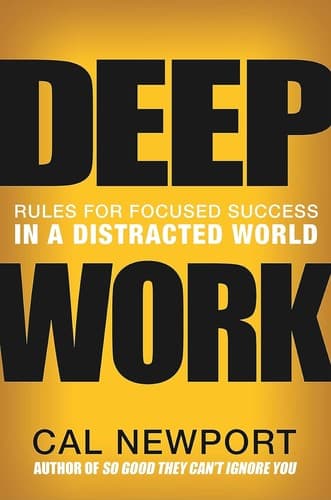
Deep Work
by Cal Newport
The Short Answer
Newport argues that the ability to focus without distraction on cognitively demanding work is becoming both increasingly rare and increasingly valuable — the defining skill of the knowledge economy. Part manifesto, part operating manual: four rules for actually doing deep work in a world engineered to prevent it.
The FrankX Newsletter
One book breakdown like this. One spotlight from the operating loop. Every Friday.
Key Insights
Deep work is the ability to focus without distraction on cognitively demanding tasks — and it is becoming increasingly rare and valuable
The two core abilities for thriving in the new economy: quickly mastering hard things, and producing at an elite level
Shallow work is non-cognitively demanding, logistical-style work that can be done while distracted — and it dominates most knowledge workers' days
Schedule every minute of your day. Not to be rigid, but to be intentional about how your finite time is spent
Embrace boredom. Train your brain to resist the urge to switch to something stimulating the moment the current task becomes challenging
Quotes Worth Remembering
13 curated passages from Deep Work. Chapter references map back to the book so you can re-read them in context.
Deep Work (Noun): Professional activities performed in a state of distraction-free concentration that push your cognitive capabilities to their limit. These efforts create new value, improve your skill, and are hard to replicate.
Introduction
Newport's formal definition — the reason the book has a new noun attached to his name.
The ability to perform deep work is becoming increasingly rare at exactly the same time it is becoming increasingly valuable in our economy.
Introduction
To remain valuable in our economy, therefore, you must master the art of quickly learning complicated things.
Chapter 1 — Deep Work Is Valuable
High-Quality Work Produced = (Time Spent) × (Intensity of Focus)
Chapter 1 — Deep Work Is Valuable
The formula the book is organized around. Every rule in Part 2 pushes the intensity coefficient higher.
Clarity about what matters provides clarity about what does not.
Rule #1 — Work Deeply
Don't take breaks from distraction. Instead take breaks from focus.
Rule #2 — Embrace Boredom
The inversion at the heart of the book — attention is the default, distraction is the scheduled exception.
Efforts to deepen your focus will struggle if you don't simultaneously wean your mind from a dependence on distraction.
Rule #2 — Embrace Boredom
Schedule every minute of your day.
Rule #4 — Drain the Shallows
Not for rigidity — for intentionality. Newport treats the schedule as a hypothesis to test, not a prison.
Who you are, what you think, feel, and do, what you love — is the sum of what you focus on.
Conclusion
Newport quoting Winifred Gallagher. The most cited line in the book.
A deep life is a good life.
Conclusion
The Craftsman Approach to Tool Selection: Identify the core factors that determine success and happiness in your professional and personal life. Adopt a tool only if its positive impacts on these factors substantially outweigh its negative impacts.
Rule #3 — Quit Social Media
To succeed with deep work you must rewire your brain to be comfortable resisting distracting stimuli.
Rule #2 — Embrace Boredom
Human beings, it seems, are at their best when immersed deeply in something challenging.
Chapter 3 — Deep Work Is Meaningful
Chapter-by-Chapter
Each chapter distilled to a key idea + 2–4 sentence summary — so you can navigate the book's argument without re-reading it, and re-read it with fresh compass if you want.
01Chapter 1 — Deep Work Is Valuable
Three groups thrive in the new economy — high-skilled workers, superstars, and owners — and deep work is how you join the first two.
+
Chapter 1 — Deep Work Is Valuable
Three groups thrive in the new economy — high-skilled workers, superstars, and owners — and deep work is how you join the first two.
Newport analyzes economic shifts: automation replaces routine tasks, superstars capture disproportionate value, and the ability to master hard things quickly is the currency. Deep work is the skill that creates both abilities. The formula: High-Quality Work = Time × Intensity.
02Chapter 2 — Deep Work Is Rare
Modern organizational culture actively prevents deep work — and everyone feels busy while accomplishing little.
+
Chapter 2 — Deep Work Is Rare
Modern organizational culture actively prevents deep work — and everyone feels busy while accomplishing little.
The culprits: open offices, Slack-like tools, constant connectivity, "busyness as proxy for productivity." Because these patterns make individuals feel busy, they resist examination. But they produce little deep output. The rarity is the advantage for those who resist.
03Chapter 3 — Deep Work Is Meaningful
Deep work is intrinsically satisfying — it produces the flow states that make work meaningful.
+
Chapter 3 — Deep Work Is Meaningful
Deep work is intrinsically satisfying — it produces the flow states that make work meaningful.
Drawing on Csíkszentmihályi's flow research and Gallagher's work on attention, Newport argues deep work is not just effective but existentially important. Craftsmen across history report that focused work is where meaning is made. Modern knowledge work has stripped this out at its peril.
04Rule #1 — Work Deeply
Willpower is finite; ritual is not. Design a deep-work philosophy and ritual that fits your life.
+
Rule #1 — Work Deeply
Willpower is finite; ritual is not. Design a deep-work philosophy and ritual that fits your life.
Newport offers four deep-work philosophies — monastic (extreme isolation, e.g. Knuth), bimodal (alternating seclusion and engagement, e.g. Jung), rhythmic (daily habit, e.g. Seinfeld's chain), journalistic (snatch deep blocks as they appear). Choose one. Then build rituals around location, duration, and structure so that starting deep work is automatic.
05Rule #2 — Embrace Boredom
Your ability to concentrate is only as strong as your tolerance for understimulation.
+
Rule #2 — Embrace Boredom
Your ability to concentrate is only as strong as your tolerance for understimulation.
Schedule distraction, not focus. Train by putting yourself in situations where boredom must be endured (waiting in line without a phone). Use "productive meditation" — hold a professional problem in your head during physical activity. Memorize things. The goal is to rebuild the atrophied muscle of sustained attention.
06Rule #3 — Quit Social Media
Apply the Craftsman Approach — tools must substantially clear a high bar, not just offer some benefit.
+
Rule #3 — Quit Social Media
Apply the Craftsman Approach — tools must substantially clear a high bar, not just offer some benefit.
Most tool decisions use the any-benefit approach (if it helps even a little, use it). The Craftsman Approach requires substantial benefit on the factors that drive your success. For most knowledge workers, this eliminates most social media. Newport also recommends the "packing party" experiment: abandon all non-essential tools for 30 days; readopt only what you actively missed.
07Rule #4 — Drain the Shallows
Shallow work is a tax — minimize it to make room for the deep work that pays the bills.
+
Rule #4 — Drain the Shallows
Shallow work is a tax — minimize it to make room for the deep work that pays the bills.
Tactics: schedule every minute of the day; quantify the depth of every activity; ask permission to spend time on shallow tasks; finish your work by 5:30 (fixed-schedule productivity forces efficiency); be hard to reach by default. The goal is not zero shallow work but making shallow work serve deep work, not crowd it out.
Best For
Frequently Asked Questions
What is the difference between deep work and shallow work?
+
Deep work is cognitively demanding, distraction-free, pushes your cognitive limits, and creates new value that is hard to replicate. Shallow work is non-cognitively demanding, can be done while distracted, and is easy to replicate. Most knowledge workers have drifted into spending 80-90% of their day in shallow work — answering emails, attending meetings, minor edits.
What are the Four Rules in Part 2?
+
Rule 1: Work Deeply (install rituals and environments that support sustained focus). Rule 2: Embrace Boredom (train your mind to tolerate the absence of stimulation). Rule 3: Quit Social Media (use the Craftsman Approach — keep a tool only if its benefits substantially outweigh its negatives). Rule 4: Drain the Shallows (reduce shallow work aggressively, schedule every minute, enforce fixed-schedule productivity).
What is the "Craftsman Approach" to tool selection?
+
Most people use the "any-benefit" approach — if a tool offers any benefit, use it. Newport argues for the Craftsman Approach: adopt a tool only if its positive impacts on the things you care about substantially outweigh its negatives. Twitter might have some benefit. The question is whether it substantially outweighs the cost in attention.
Is Deep Work compatible with open-office culture and Slack?
+
Newport's view: open-office + constant Slack is structurally hostile to deep work. He suggests specific patterns — monastic (isolation), bimodal (blocks of seclusion), rhythmic (daily deep-work habit), journalistic (snatch deep blocks when available). The organizational culture is a constraint; the individual rules still apply within any constraint.
How does Deep Work relate to Atomic Habits?
+
Complementary. Atomic Habits tells you how to install any habit. Deep Work tells you which habit matters most in the knowledge economy. Read Atomic Habits for the mechanism; read Deep Work for the target.
Continue Reading
If Deep Work opened a door, these books walk you through it. Curated for reason, not algorithm — each entry explains why it pairs with this book.
A World Without Email
by Cal Newport
Newport's 2021 follow-up, scaled from individual to organizational. Deep Work tells you how to focus; A World Without Email tells you how to redesign team workflows so focus is possible.
Get the bookSo Good They Can't Ignore You
by Cal Newport
Newport's earlier argument that skills beat passion. Deep Work explains HOW to build skill; this book explains WHY skill-first beats passion-first for career choice.
Get the bookFlow
by Mihály Csíkszentmihályi
The foundational research Newport builds on. Flow states map almost perfectly to deep work states. Read Csíkszentmihályi for the science; Newport for the practice.
Get the bookPeak: Secrets from the New Science of Expertise
by Anders Ericsson
The 10,000-hour rule, properly stated. Deliberate practice is the specific kind of deep work that actually builds expertise. Ericsson's distinction between regular practice and deliberate practice is what makes the 10,000-hour framing meaningful.
Get the bookDigital Minimalism
by Cal Newport
Newport applies Craftsman Approach logic to personal life, not just work. Less "how to focus" and more "why the attention economy is engineered against you."
Get the bookThe War of Art
by Steven Pressfield
Pressfield names what Newport analyzes — Resistance, the force that stops you from doing the work. Both books agree on the diagnosis, approach it differently. Newport is systems, Pressfield is psychology.
Get the bookGo Deeper — Videos
The book is the foundation. These talks and interviews are where the ideas sharpen, get challenged, and connect to adjacent work. Best watched after reading, not instead of.
Cal Newport — Why You Should Quit Social Media (TEDx Tysons)
TEDx
Newport's canonical short talk. The provocative title is a vehicle for his Craftsman Approach — most viewers leave with a framework, not the conclusion.
Cal Newport — Deep Work (Talks at Google)
Talks at Google
One-hour presentation of the full book framework in his own voice. Best video if you want the argument before committing to the book.
Cal Newport on Deep Work, Productivity, and Focus (Tim Ferriss Show)
Tim Ferriss Show
Ferriss pushes Newport on edge cases — entrepreneurs, parents, students. Excellent for translating the book into your specific context.
Deep Questions with Cal Newport
Cal Newport
Newport's ongoing podcast. Short Q&A episodes on specific deep-work challenges readers write in with. The practical application layer on top of the book.
If You Liked This, Read Ours
Our Book
The Art of Self-Development
Seven Pillars of a Complete Life
A systematic approach to building every dimension of your life — energy, mind, soul, craft, capital, circle, and legacy. Not theory. Routines that work.
Read free