Intelligence DispatchesMarch 21, 202614 min read
Claude, GPT, Gemini, DeepSeek: Which Model for Which Task?
Every major frontier model compared — architecture, capabilities, pricing, and which to use for coding, research, creative work, and enterprise deployment.

Reading Goal
You will understand every major frontier model family — their architecture, sweet spots, and which to choose for different tasks.
Updated 2026-06-05. The landscape turned over since spring: OpenAI retired the entire o-series and unified reasoning into GPT-5.5, Claude reached Opus 4.8, Gemini moved to 3.x, and DeepSeek V4 reset the cost curve. Versions and prices below reflect the current state.
TL;DR: The frontier model landscape in mid-2026 is no longer a two-horse race, and context size stopped being the differentiator — nearly every flagship now runs 1M+ tokens, so the real contest is agentic task completion. Claude Opus 4.8 leads agentic coding and long-horizon reasoning (it powers Claude Code, the category leader). OpenAI folded its separate o-series reasoning models into a single GPT-5.5 line. Gemini 3.1 Pro and the new 3.5 Flash bring frontier multimodal at aggressive prices. DeepSeek's open-weight V4 trades blows with the closed flagships on coding at roughly a tenth of the cost. Meta's Llama 4 still anchors the open-weight ecosystem (though Meta pivoted to a closed model, Muse Spark). Mistral anchors European data sovereignty. The right model depends on your task — and the best practitioners use several simultaneously.
Why 2026 Is Different
A year ago, "best AI model" was a simpler question. Today it depends on whether you mean coding, research synthesis, image understanding, long documents, cost-sensitivity, or open-weight deployability. Each dimension has a different answer.
Three structural shifts define 2026:
Reasoning became mainstream. Chain-of-thought and extended thinking are no longer premium features — they ship in mid-tier model variants.
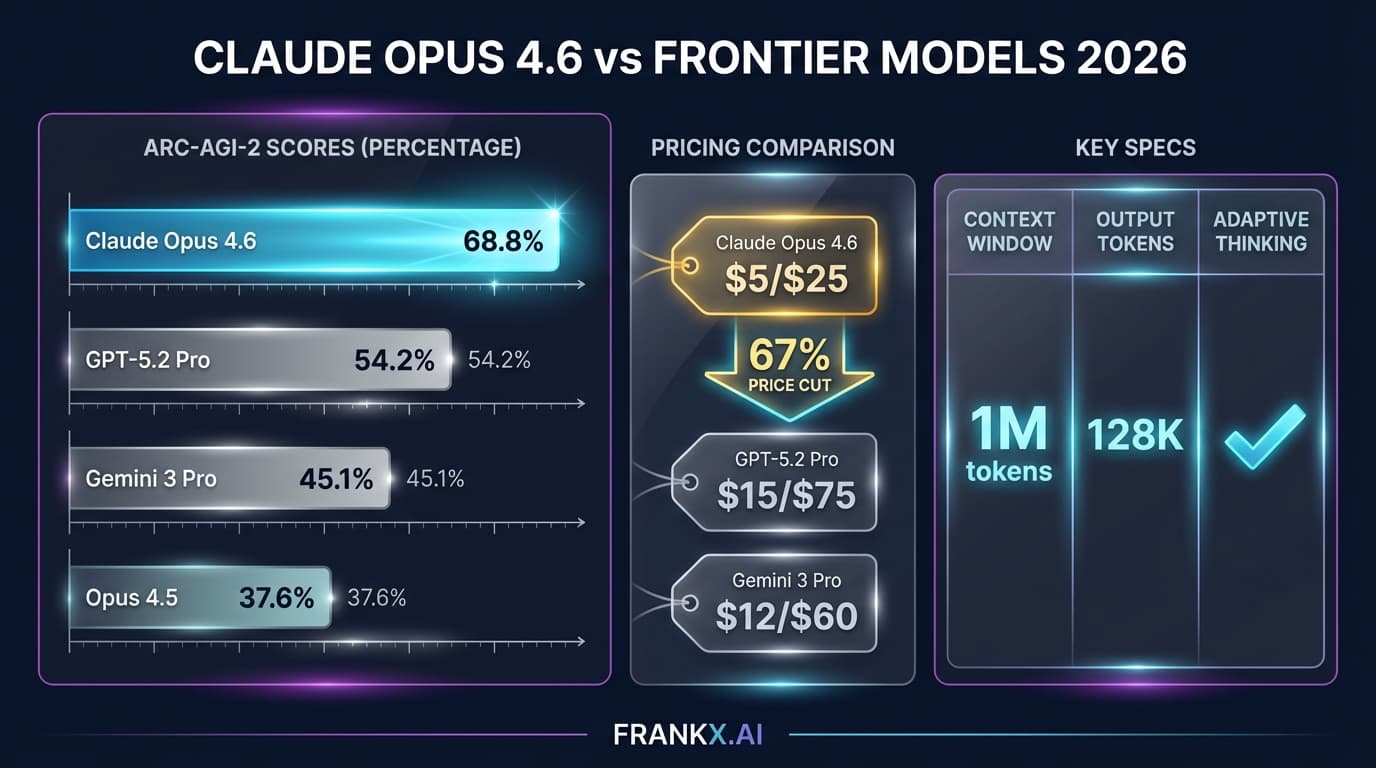
Context commoditized. 1M-token windows are now standard across nearly every flagship (Grok 4.1 Fast pushes 2M). Context size stopped being a differentiator — the harder problem is whether a model attends to that context faithfully and completes long-horizon agentic tasks.
Open-weight models reached the frontier on coding. DeepSeek V4-Pro now trades blows with GPT-5.5 and Claude Opus on coding benchmarks at roughly a tenth of the price. The gap that remains is ecosystem maturity, not raw capability.
Anthropic Claude — Opus 4.8, Sonnet 4.6, Haiku 4.5
Claude is Anthropic's flagship model family, built around constitutional AI training that prioritizes interpretability, safety, and reasoning depth. In mid-2026 it's the model the rest of the field is chasing on coding, largely on the back of Claude Code.
Claude Opus 4.8
The ceiling of the Claude family — designed for tasks where quality matters more than speed. Extended thinking mode allows multi-step reasoning chains that surface before the final answer, making it possible to verify logic rather than just the output. (Opus 4.6 and 4.7 are now legacy but still available.)
Context window: 1M tokens. Opus handles long context faithfully — document retrieval deep in the window is nearly as accurate as near the start. A "Fast mode" runs ~2.5x quicker at a price premium when latency matters.
Coding is where Opus earns its premium. Claude Code — Anthropic's agentic coding environment — handles multi-file refactors, dependency management, and test generation with consistency that shorter-context models cannot match.
Tool use and MCP (Model Context Protocol) are native to Claude. Opus connects to external systems through a structured protocol designed to be composable and auditable.
Sweet spot: Complex agentic workflows, large codebase work, research synthesis, any task where extended thinking produces verifiably better outputs.
Claude Sonnet 4.6
The balance point. Most of Opus's capability at significantly lower cost and latency. The practical default for most production deployments. For content generation, analysis, coding assistance, and document work, Sonnet is where most teams spend the majority of their tokens.
Claude Haiku 4.5
Speed and efficiency — sub-second responses, low cost. Handles classification, summarization, extraction, and lightweight generation. Improved substantially on instruction following compared to its predecessor.
Pricing (input/output per 1M): Haiku 4.5 ~$1 / $5. Sonnet 4.6 ~$3 / $15. Opus 4.8 ~$5 / $25.
For a deeper dive: Claude Opus analysis.
OpenAI — the unified GPT-5.5 line
The biggest structural change since spring: OpenAI retired the entire o-series (o3, o4-mini) along with GPT-4o and GPT-4.1 in early 2026, and folded explicit reasoning into a single unified model line. There is no o5. Reasoning is now a mode of the GPT-5 family, not a separate product.
GPT-5.5
The current flagship (released April 2026). It unifies what used to be two tracks — general multimodal intelligence and explicit chain-of-thought reasoning — into one model that allocates reasoning compute as the task demands. It leads on agentic coding, computer use, and long-horizon tool workflows (strong Terminal-Bench and SWE-Bench results).
Context window: ~1M tokens, 128K max output. A GPT-5.5-pro variant trades cost for maximum accuracy on the hardest problems.
Pricing (input/output per 1M): GPT-5.5 ~$5 / $30. GPT-5.5-pro ~$30 / $180. (Confirm against OpenAI's live pricing page — these moved at launch.)
Google Gemini — 3.1 Pro, 3.5 Flash
Google moved to the Gemini 3 line in 2026, keeping its structural advantages in anything touching Google's data infrastructure or requiring million-token context — and competing hard on price.
Gemini 3.1 Pro
The reasoning + multimodal flagship, operating at ~1M token context natively. Gemini's architecture maintains recall quality across the full window with reasonable faithfulness — for research synthesis tasks like reading entire paper corpora or full codebases, this is the operational advantage.
Grounded search integration remains a distinct capability: Gemini calls Google Search natively and synthesizes results with citations, collapsing the gap between "what the model knows" and "what is currently true."
Gemini 3.5 Flash
Google's cheap-and-fast play, launched May 2026 — near-frontier quality at a fraction of Pro's cost, built to deploy at billions-of-users scale. The production workhorse for high-volume Google AI deployments. (There's no GA "Gemini 3.5 Pro" yet — Pro and Flash are separate tiers.)
Pricing (input/output per 1M): 3.1 Pro ~$2 / $12. 3.5 Flash ~$1.50 / $9. Cheaper Flash-Lite tiers run lower still.
DeepSeek — R1, V3, and the Open-Weight Disruption
DeepSeek's releases did more to reshape frontier model economics than any other development in the period.
DeepSeek V4-Pro
The current open-weight flagship (V4 shipped April 2026) — a Mixture-of-Experts model at 1.6T total / ~49B active parameters, 1M token context. This is the release that reset frontier economics: V4-Pro now sits at the top of coding benchmarks (LiveCodeBench, Codeforces ELO ahead of GPT-5.5, SWE-bench Verified statistically tied with Claude Opus) at roughly a tenth of the closed flagships' price.
As an open-weight model (downloadable, self-hostable, fine-tunable), it enables workloads closed APIs cannot: air-gapped deployments, custom fine-tuning on proprietary data, and unlimited inference at compute cost rather than per-token pricing.
DeepSeek V4-Flash
The price-performance extreme — 284B / ~13B active, 1M context, around $0.10/$0.20 per million in/out. Near-frontier coding (90%+ LiveCodeBench) at a price that makes high-volume self-hosted pipelines trivial.
Note: there was never a "DeepSeek R2." Reasoning was folded into the V-series "Think/Speciale" variants rather than shipped as a separate R-series model.
Where DeepSeek fits: Cost-sensitive production. Air-gapped deployments. High-volume coding pipelines. Research requiring model inspection.
Pricing (input/output per 1M): V4-Pro ~$0.44 / $0.87. V4-Flash ~$0.10 / $0.20. (Or free, self-hosted.)
Meta Llama 4 — Scout and Maverick
Llama 4 marks the maturation of the open-source frontier.
Llama 4 Scout
Efficiency-optimized — 17B active parameter MoE model with a 10M token context window. The largest context of any publicly available model. For document-scale applications at low cost on commodity hardware, Scout's architecture is distinctive.
Llama 4 Maverick
Scales to 17B active from a 400B total MoE pool. Benchmark performance that competes on many general tasks — though by mid-2026 Meta has fallen off the frontier-coding conversation that Anthropic, OpenAI, and DeepSeek now dominate.
The state of Llama in 2026: Scout and Maverick remain the current open releases — there is no Llama 5 (it slipped to a 2027 forecast), and the larger Llama 4 Behemoth was effectively shelved (used internally as a teacher model, never publicly released). The notable shift: Meta's Superintelligence Labs released Muse Spark, its first closed-weight, API-only reasoning model — a pivot away from the open-frontier race.
The Llama ecosystem advantage: Community. The broadest fine-tuning ecosystem of any open-weight model family. Hundreds of domain-specific fine-tunes. Mature tooling (LlamaIndex, Ollama, llama.cpp, vLLM).
Mistral — European Sovereignty
Mistral Large 3 (released late 2025) competes with the GPT-5-class field, with particular strength in multilingual tasks and European language support — and an aggressive price cut (~$0.50/$1.50 per M, roughly 75% below the prior generation). For enterprises with EU data residency requirements, Mistral Large on EU infrastructure is often the only compliant frontier option.
Codestral is Mistral's code-specialized model — competitive on pure coding benchmarks, efficient enough for real-time IDE integration, with fill-in-the-middle support (~$0.30/$0.90 per M, 32K context).
Also in the Field
Grok 4.3 (xAI): Real-time X data integration as a native capability, 1M context, aggressive pricing (~$1.25/$2.50 per M). A Grok 4.1 Fast variant offers a 2M-token context — the largest of any model here — at ~$0.20/$0.50. DeepSearch mode synthesizes web and X data uniquely.
Qwen3.7-Max (Alibaba): The strongest Chinese frontier model outside DeepSeek — 1M context, closed-weight and API-only, built for agent-grade long-horizon reasoning (multi-step agentic runs measured in hours). It ships an Anthropic-protocol drop-in for easy migration. Particular strength in Chinese and Asian multilingual applications.
The Comparison Table
Prices are input / output per 1M tokens, as of 2026-06-05. Confirm against live pricing pages before committing volume.
| Model | Context | Coding | Research | Creative | Enterprise | Price (in/out) |
|---|---|---|---|---|---|---|
| Claude Opus 4.8 | 1M | ★★★★★ | ★★★★★ | ★★★★ | ★★★★★ | ~$5 / $25 |
| Claude Sonnet 4.6 | 1M | ★★★★ | ★★★★ | ★★★★ | ★★★★ | ~$3 / $15 |
| Claude Haiku 4.5 | 200K | ★★★ | ★★★ | ★★★ | ★★★★ | ~$1 / $5 |
| GPT-5.5 | 1M | ★★★★★ | ★★★★★ | ★★★★ | ★★★★★ | ~$5 / $30 |
| Gemini 3.1 Pro | 1M | ★★★★ | ★★★★★ | ★★★★ | ★★★★ | ~$2 / $12 |
| Gemini 3.5 Flash | 1M | ★★★★ | ★★★★ | ★★★ | ★★★★ | ~$1.50 / $9 |
| DeepSeek V4-Pro | 1M | ★★★★★ | ★★★★ | ★★★★ | ★★★ | ~$0.44 / $0.87 |
| DeepSeek V4-Flash | 1M | ★★★★ | ★★★★ | ★★★ | ★★★ | ~$0.10 / $0.20 |
| Llama 4 Maverick | 1M | ★★★★ | ★★★★ | ★★★ | ★★★ | Self-hosted |
| Mistral Large 3 | 128K | ★★★★ | ★★★ | ★★★★ | ★★★★ | ~$0.50 / $1.50 |
| Grok 4.3 | 1M | ★★★★ | ★★★★ | ★★★★ | ★★★ | ~$1.25 / $2.50 |
| Qwen3.7-Max | 1M | ★★★★ | ★★★★ | ★★★ | ★★★ | ~$2.50 / — |
How I Use Multiple Models
Running a single model for everything is a beginner pattern. Here is my actual workflow:
Claude Code for development. Claude Sonnet 4.6 through Claude Code is my primary development environment. Long context, extended thinking, and MCP-native tool integration make it the most capable agentic coding environment. For complex architectural decisions, I escalate to Opus.
Gemini 3.1 Pro for deep research synthesis. When I need to read an entire industry report or a set of academic papers simultaneously, Gemini's million-token context plus native grounded search is the right tool.
Gemini (Nano Banana) for image generation. For image generation workflows integrated into content pipelines, Google's Gemini image models route through specific tooling in my stack.
Claude for long-form writing. Blog posts, documentation, course content — Claude Sonnet is my default. Voice is more natural for long-form, instruction following on brand voice guidelines is more consistent.
GPT-5.5 or DeepSeek V4 for reasoning-intensive analysis. When I need explicit steps I can verify — pricing models, algorithm selection, multi-constraint optimization — I reach for the reasoning-mode flagships (and DeepSeek V4 when I want it self-hosted and cheap).
Llama 4 for experiments requiring full model control. Fine-tuning on proprietary data, sensitive documents that cannot leave local infrastructure — Llama 4 via Ollama.
For ongoing research: State of AI 2026 and Generative AI research hub.
For students building AI fluency: AI Briefing.
The Model Selection Framework
Stop asking "what's the best model?" Start asking "what's the best model for this task at this cost tolerance?"
For coding: Claude Opus/Sonnet via Claude Code (the category leader). Budget option: Gemini 3.5 Flash or Codestral. Self-hosted: DeepSeek V4 (now top-tier on coding) or Llama 4 Maverick.
For long document research: Gemini 3.1 Pro for grounded search at scale. Claude Opus when reasoning quality matters more than raw context.
For creative writing: Claude Sonnet for voice consistency. GPT-5.5 for diverse style range. Mistral Large 3 for multilingual.
For enterprise with SLA: GPT-5.5 or Claude Sonnet — most mature API infrastructure and compliance certifications.
For cost-sensitive production: Gemini 3.5 Flash or Claude Haiku for API. DeepSeek V4-Flash or Llama 4 Scout for self-hosted (an order of magnitude cheaper).
For data sovereignty: Llama 4 Maverick or DeepSeek V4 for max self-hosted capability. Mistral Large 3 for European regulatory contexts.
What Matters More Than Benchmarks
Context faithfulness at depth. Test retrieval at multiple depths in your actual document lengths before committing.
Tool use consistency. A model that calls tools correctly 95% vs 98% creates compounding failure modes in multi-step pipelines.
Instruction following on complex constraints. Format, length, persona, forbidden topics, required inclusions — across long outputs, this degrades substantially in some models.
API reliability. Uptime, rate limits, and predictable latency matter as much as raw capability for production systems.
Cost at your actual consumption. Models with prompt caching often cost less than models with lower list prices, at real-world usage patterns.
FAQ
Which AI model is best for coding in 2026?
Claude Opus 4.8 via Claude Code is the most capable for complex, multi-file agentic coding — coding is the battleground of 2026 and Anthropic leads it. GPT-5.5 is the closest challenger. For self-hosted at a fraction of the cost, DeepSeek V4 now trades blows with the closed flagships on coding benchmarks. Most serious developers use at least two.
Is DeepSeek as good as GPT-5.5 or Claude?
On coding benchmarks, DeepSeek V4-Pro is genuinely competitive — statistically tied with Claude Opus on SWE-bench Verified and ahead of GPT-5.5 on some Codeforces measures, at roughly a tenth of the price. The meaningful gap is ecosystem maturity, API reliability, compliance certifications, and tool-use consistency. (Note: there was never a "DeepSeek R2" — reasoning folded into the V4 line.)
What does 1M token context actually mean in practice?
Roughly 750,000 words in a single session. By 2026 nearly every flagship offers 1M+ tokens (Grok 4.1 Fast reaches 2M), so context size is no longer a differentiator — the useful limit is governed by faithfulness, whether the model attends to information at all positions equally.
Should I use one model or multiple models?
Multiple, with intention. One primary model for your core workload, one reasoning model for analysis, one low-cost model for high-volume tasks. Three models covers 95% of use cases.
Is Llama 4 good enough to replace commercial API models?
For many use cases, yes — if you have GPU infrastructure and ML ops capacity. Llama 4 Maverick competes with GPT-4o on general benchmarks. The gaps are in instruction following, tool use consistency, and the surrounding ecosystem of integrations.
What is MCP and why does it matter for model selection?
MCP is Anthropic's open standard for connecting AI models to external tools and data sources. Claude models are MCP-native. Other models support function calling, but MCP provides a more standardized interface for building agentic workflows. For enterprise agentic deployments, native MCP support reduces integration complexity.
Get Started
Build your first AI system
Step-by-step guide to setting up ACOS, creating your first agent, and shipping real products with AI.
Start buildingTemplates & Blueprints
Production-ready architecture
Download AI architecture templates, multi-agent blueprints, and prompt engineering patterns.
Browse templatesInner Circle
Join the builder community
Connect with creators and architects shipping AI products. Weekly office hours, shared resources, direct access.
Join the circleFrankX.AI / AI Architecture, Creator Systems, and Builder Intelligence
Stay in the intelligence loop
Weekly field notes on AI systems, production patterns, and builder strategy.
Continue Reading

Intelligence Dispatches10 min read
ChatGPT vs Claude vs Gemini 2026: Which AI Assistant for Everyday Use?
An honest, results-first comparison of the three $20 AI subscriptions — ChatGPT Plus, Claude Pro, and Google AI Pro — for writing, research, images, voice, memory, and everyday questions. Pick by use case.
Read article
Intelligence Dispatches15 min read
Prompt Engineering in 2026: What Still Works
The prompting techniques that survived the model upgrades — structured output, chain-of-thought, few-shot, and what to stop doing.
Read article
Intelligence Dispatches11 min read
Anthropic Paused the Claude Agent SDK Credit Change. Here's What Builders Should Do Now.
Anthropic paused the Claude Agent SDK credit change. What it means for claude -p, OpenClaw, OpenCode, Codex, and agent pricing.
Read article