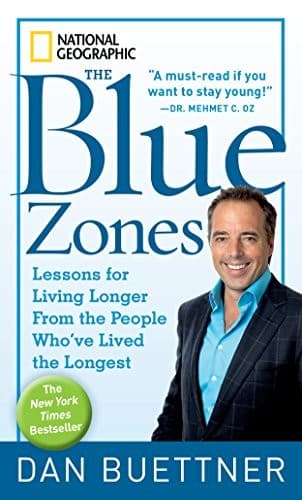
The Blue Zones: Lessons for Living Longer From the People Who've Lived the Longest
by Dan Buettner
The Short Answer
A National Geographic explorer identifies five regions on Earth where people consistently reach a hundred with the cognition of a sixty-year-old — Sardinia, Okinawa, Nicoya, Ikaria, Loma Linda — and reverse-engineers nine practices common to all five. The 2005 NatGeo cover story put the Japanese word "ikigai" on Western newsstands for the first time. The book is the field-work argument that longevity is structural, not heroic — built into how people eat, move, belong, and answer the question of what to do today.
The FrankX Newsletter
One book breakdown like this. One spotlight from the operating loop. Every Friday.
Key Insights
Five Blue Zones, identified between 1999 and 2009 — Sardinia (Italy), Okinawa (Japan), Nicoya (Costa Rica), Ikaria (Greece), Loma Linda (California Seventh-day Adventists)
The Power 9 — nine practices shared across all five regions: natural movement, purpose (ikigai / plan de vida), downshift (stress dissipation), 80% rule (hara hachi bu), plant-forward diet, moderate alcohol in community, faith / belonging, family first, right tribe (moai)
Diet patterns cluster at ~95% plant-based — sweet potato in Okinawa, beans in Nicoya, sourdough in Sardinia — meat is the exception, not the rule
Movement is structural, not athletic — gardens, livestock, hilly terrain, multi-generational households arranged so daily life is the workout
Centenarians overwhelmingly belong to a faith community and a committed small group; structural belonging is as load-bearing as diet or movement
Quotes Worth Remembering
7 curated passages from The Blue Zones: Lessons for Living Longer From the People Who've Lived the Longest. Chapter references map back to the book so you can re-read them in context.
The world's longest-lived people are not the ones with the strongest will — they're the ones who never had to use it.
Buettner's recurring framing of the difference between American longevity-optimization and the Blue Zones pattern. The Blue Zones inhabitants are not disciplined; their environments are.
In Okinawa, there is no word for retirement. Instead, they have one word that imbues their entire life — ikigai — which loosely translated, means "the reason for which you wake up in the morning."
Okinawa, Japan
Hara hachi bu — eat until you are 80 percent full.
Okinawa, Japan
A Confucian-derived Okinawan practice. Buettner cites this as one of the most actionable Power 9 practices for Western readers — the 20% margin compounds over decades.
The world's oldest people don't pump iron, run marathons, or join gyms. Instead, they live in environments that constantly nudge them into moving without thinking about it.
Power 9
You can't outrun a bad diet. But you might be able to outsit a bad one — at a table, with people you love, eating slowly.
Buettner's paraphrase of the convergent Blue Zones eating pattern — what matters is what, how much, and with whom.
Belonging to a faith-based community — irrespective of denomination — added between four and fourteen years to life expectancy.
Loma Linda, California
A moai is a circle of friends who commit to each other for life.
Okinawa, Japan
Okinawan tradition: 5-6 people who pool resources, show up, and stay in each other's lives until one of them dies. Buettner argues this single structural fact is among the most powerful longevity variables in the Blue Zones data.
Chapter-by-Chapter
Each chapter distilled to a key idea + 2–4 sentence summary — so you can navigate the book's argument without re-reading it, and re-read it with fresh compass if you want.
01The Quest for Longevity
Longevity is not random — five geographically distinct regions converge on the same outcomes via different toolkits.
+
The Quest for Longevity
Longevity is not random — five geographically distinct regions converge on the same outcomes via different toolkits.
Buettner sets up the project — funded by National Geographic, joined by demographers Gianni Pes and Michel Poulain. The thesis is that if multiple regions arrive at exceptional longevity through different cultures, diets, and climates, the shared practices across regions are the actual longevity variables. The first Blue Zone (Sardinia) is introduced as proof-of-concept.
02Sardinia, Italy
A pastoral mountain culture produces the highest male centenarian rate on Earth.
+
Sardinia, Italy
A pastoral mountain culture produces the highest male centenarian rate on Earth.
Buettner travels to Nuoro province, interviews shepherds in their nineties, documents the diet (whole-grain sourdough, fava beans, pecorino from grass-fed sheep, Cannonau wine), the structural daily movement (shepherding hilly terrain), and the family-first culture that keeps elders socially central. Sardinia's longevity profile is sharply male-skewed — the only Blue Zone where men outlive women in centenarian counts.
03Okinawa, Japan
The Okinawans named their longevity factor. The word is ikigai.
+
Okinawa, Japan
The Okinawans named their longevity factor. The word is ikigai.
The book's most-cited chapter. Buettner interviews Ogimi-village centenarians, documents the sweet-potato-and-soy diet, the moai (committed friendship circle), the hara hachi bu practice (stop eating at 80%), the multi-generational households, and the recurring centenarian self-report that the operating principle is ikigai — the daily reason to wake. This is the chapter that put one Japanese word on Whole Foods checkout newsstands in November 2005.
04Loma Linda, California
The principles reproduce inside Western contexts — Seventh-day Adventists in suburban California outlive other Americans by 7-10 years.
+
Loma Linda, California
The principles reproduce inside Western contexts — Seventh-day Adventists in suburban California outlive other Americans by 7-10 years.
Buettner documents the only Blue Zone in the developed Anglo world. Adventists practice a plant-based "biblical diet," observe a weekly Sabbath downshift, belong to a faith community, exercise structurally, and avoid alcohol and tobacco. The chapter is the proof that the Blue Zones pattern is not exotic; it is reproducible inside Western infrastructure when the structural variables align.
05Nicoya, Costa Rica
A Central American peninsula reaches Okinawa-grade longevity with a completely different cultural toolkit.
+
Nicoya, Costa Rica
A Central American peninsula reaches Okinawa-grade longevity with a completely different cultural toolkit.
Identified in 2007. Nicoyans show similar centenarian rates to Okinawa with a Mesoamerican diet (corn, beans, squash, papaya), Catholic faith community, multi-generational households, and a parallel "plan de vida" concept that maps closely onto ikigai. The chapter is structurally important — two cultures, different toolkits, same outcome means the underlying variables (purpose, plants, movement, belonging) are real.
06Ikaria, Greece
A Greek island where people "forget to die" — Mediterranean diet meets island time.
+
Ikaria, Greece
A Greek island where people "forget to die" — Mediterranean diet meets island time.
Added in 2009. Ikarians show low rates of dementia and chronic disease, a Mediterranean diet (olive oil, wine, herbs, fish, garden vegetables), an irregular relaxed daily structure, daily naps, and remarkably persistent social engagement into the 90s. The Ikarian phrase "we forget to die" appears throughout the chapter — life is structured so that ageing happens almost without notice.
07The Power 9
Nine practices distill the five Blue Zones into actionable variables.
+
The Power 9
Nine practices distill the five Blue Zones into actionable variables.
Buettner's synthesis chapter. The Power 9 — move naturally, purpose, downshift, 80% rule, plant slant, wine at 5, belong, loved ones first, right tribe — are presented as the cross-Blue-Zones invariants. The argument is that any individual or community that adopts the Power 9 structurally (not as discipline) should expect compounding healthspan returns.
08Building Your Own Blue Zone
The pattern is not geographic — it is structural, and reproducible at the household and town level.
+
Building Your Own Blue Zone
The pattern is not geographic — it is structural, and reproducible at the household and town level.
The book closes with implementation. Buettner argues that the Power 9 are not lifestyle prescriptions but environment-design principles — change the kitchen, the route to work, the social calendar, the household composition. Subsequent Blue Zones projects (Albert Lea MN, Beach Cities CA, etc.) have applied the framework to whole towns with measurable mortality reductions. The thesis: most individual longevity advice fails because it asks for willpower; Blue Zones reproduce because they remove the need for it.
Best For
Frequently Asked Questions
What are the five Blue Zones?
+
Sardinia, Italy (identified 1999, Gianni Pes and Michel Poulain) — highest concentration of male centenarians on Earth, particularly in the Nuoro province. Okinawa, Japan (2004) — historically highest female centenarian rate; the source of the Japanese ikigai chapter. Nicoya, Costa Rica (2007) — comparable longevity to Okinawa with a different cultural toolkit ("plan de vida"). Ikaria, Greece (2009) — low rates of dementia and chronic disease, Mediterranean diet, daily wine in community. Loma Linda, California (ongoing) — Seventh-day Adventists, who outlive other Americans by ~7-10 years, demonstrating that the principles are reproducible inside Western contexts.
What is the Power 9?
+
The nine practices Buettner's team identified as common to all five Blue Zones: (1) Move naturally — structural daily movement, not workouts. (2) Purpose — a reason to wake up; ikigai in Okinawa, plan de vida in Nicoya. (3) Downshift — daily rituals to dissipate stress (nap, prayer, ancestor remembrance). (4) 80% rule — hara hachi bu, stop eating when 80% full. (5) Plant slant — mostly plants, meat ~5x/month. (6) Wine at 5 — moderate alcohol in community context. (7) Belong — faith community attendance. (8) Loved ones first — multi-generational households. (9) Right tribe — committed social circles (the Okinawan moai).
Does the Blue Zones methodology hold up under scrutiny?
+
Mixed. Saul Justin Newman's 2024 working paper documented data-quality issues in claimed centenarian counts — pension fraud, missing birth records, and old-age clustering that didn't match plausible demographic models — in several Blue Zones. The core finding that certain regions show longer healthspan via plant-forward diet, daily movement, structural community, and purpose survives the critique. The questionable part is the centenarian-count precision; the practical wisdom about meaning, food, movement, and belonging remains useful regardless of how many people actually reach 110.
Why does Buettner emphasize ikigai over diet?
+
Because the Okinawan elders did. When Buettner's team asked centenarians what they attributed their longevity to, diet and exercise consistently came after the single factor they themselves pointed at: their daily reason to get out of bed. The diet and movement matter — Buettner doesn't soften that — but ikigai shows up first in the centenarians' own self-reports. It is the variable they say they pay attention to, not the one researchers expected to find central.
How does this differ from typical longevity books?
+
Most longevity books focus on individual biological interventions — supplements, fasting protocols, exercise prescriptions, biomarkers. Blue Zones is anthropological. It argues that the longest-lived populations did not optimize for longevity; they happened to live inside structures that produced it as a byproduct. The book's implication is that environment design matters more than discipline, and that any individual longevity protocol that has to be forced will lose to a community pattern that is structural.
Continue Reading
If The Blue Zones: Lessons for Living Longer From the People Who've Lived the Longest opened a door, these books walk you through it. Curated for reason, not algorithm — each entry explains why it pairs with this book.
The Blue Zones Solution
by Dan Buettner
Buettner's follow-up — the implementation playbook. Where the original book documents the regions, this one is the cookbook + town-redesign manual. Read together for diagnostic-plus-prescription.
Get the bookIkigai: The Japanese Secret to a Long and Happy Life
by Héctor García & Francesc Miralles
The 2016 fieldwork-based sequel-by-other-authors. García & Miralles visit Ogimi (the same Okinawan village Buettner profiles) and go deeper on the ikigai variable specifically. Read after Blue Zones to drill from cross-cultural finding to single-culture practice.
Get the bookThe Little Book of Ikigai
by Ken Mogi
Mogi, a Japanese neuroscientist, reframes ikigai through five pillars (start small, release yourself, harmony, joy of little things, here and now). Pairs with Buettner's anthropological cover by adding the neuroscience-aware Japanese-native interpretation.
Get the bookOutlive
by Peter Attia
The 2023 longevity-medicine counterpart. Attia argues for individual biological intervention — VO2 max, glucose disposal, training prescription — where Buettner argues for structural community design. Reading both gives the full lifespan-vs-healthspan picture; they disagree on emphasis more than facts.
Get the bookLifespan
by David Sinclair
The Harvard geneticist's case that ageing is a treatable disease at the cellular level. Read against Buettner for the molecular-vs-structural debate — Sinclair on what cells do, Buettner on what villages do.
Get the bookGo Deeper — Videos
The book is the foundation. These talks and interviews are where the ideas sharpen, get challenged, and connect to adjacent work. Best watched after reading, not instead of.
How to live to be 100+ — Dan Buettner (TED)
TED
Buettner's 2009 TED talk distilling the Blue Zones findings to twenty minutes. The strongest first exposure if you want the framework before committing to the book.
Live to 100: Secrets of the Blue Zones
Netflix
The 2023 Netflix docuseries Buettner hosted across all five Blue Zones. The visual companion to the book — strong on Okinawa (ikigai) and Loma Linda. Some health-claim caveats apply but the on-location footage is the closest thing to fieldwork most readers will get.
Dan Buettner on the Blue Zones — Tim Ferriss Show
Tim Ferriss
Long-form interview going beyond the book — the politics of the National Geographic project, the centenarian-data critique, the Blue Zones Project town-redesign work. Best audio source for the meta-context.
Are Blue Zones Real? — Saul Justin Newman critique
Multiple discussions
The most-cited methodological critique of Blue Zones centenarian counts. Newman is not a denier — his point is the demographic numbers are noisier than Buettner reports — but anyone serious about the data should hear his case before forming a view.
The Blue Zones of Happiness — Dan Buettner
National Geographic
Buettner's 2017 follow-up framework, applying the Blue Zones method to happiness rather than longevity. Less famous than the original but useful for connecting longevity research to meaning research.
If You Liked This, Read Ours
Our Book
The Art of Self-Development
Seven Pillars of a Complete Life
A systematic approach to building every dimension of your life — energy, mind, soul, craft, capital, circle, and legacy. Not theory. Routines that work.
Read free