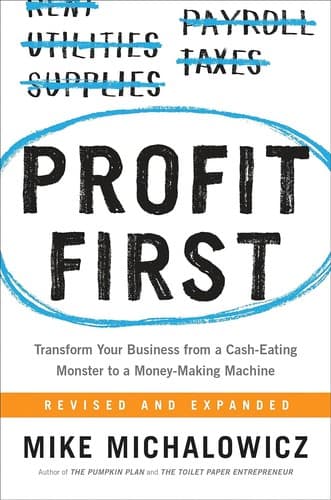
Profit First
by Mike Michalowicz
The Short Answer
Profit First inverts the GAAP formula (Sales − Expenses = Profit) into Sales − Profit = Expenses. By routing every deposit through five dedicated bank accounts before expenses are paid, Michalowicz forces small businesses to become profitable today rather than "eventually."
The FrankX Newsletter
One book breakdown like this. One spotlight from the operating loop. Every Friday.
Key Insights
Invert GAAP: profit is not a leftover — it is a pre-allocated deposit. The formula becomes Sales minus Profit equals Expenses, not the other way around.
Parkinson's Law applies to cash: the money you see is the money you spend. Hide profit from yourself — into a separate account at a separate bank — to stop consuming it.
The five-account system (Income, Profit, Owner's Pay, Tax, Operating Expenses) enforces discipline through physical separation at the bank, not through willpower or spreadsheets.
Small plates, not bigger discipline: when the operating account shrinks, expenses contract to match. Structure beats intention every quarter.
Quarterly profit distributions create a reward loop that turns profitability from an accounting abstraction into a felt, recurring experience for the owner — the habit that compounds everything else.
Quotes Worth Remembering
11 curated passages from Profit First. Chapter references map back to the book so you can re-read them in context.
Sales − Profit = Expenses. Simple math, revolutionary result.
Chapter 2 — The Core Principles of Profit First
The single sentence that reorders a decade of accounting instinct.
Your business is a cash-eating monster. Treat it like one.
Chapter 1 — Your Business Is a Cash-Eating Monster
The more money we see, the more money we spend. The less we see, the less we spend.
Chapter 3 — Setting Up for Profit First
Parkinson's Law applied directly to business cash.
Small plates equal less food. Small bank balances equal smaller expenses.
Chapter 3 — Setting Up for Profit First
Profit is not an event. Profit is a habit.
Chapter 6 — Implementing Profit First
The traditional accounting formula — Sales minus Expenses equals Profit — is logical but not behavioural. Humans do not save what is left over.
Chapter 2 — The Core Principles of Profit First
You are not in business to be profitable on paper. You are in business to be paid.
Chapter 4 — Assessing Your Business
If you want to grow your business, first learn to be profitable at the level you are.
Chapter 8 — Advanced Profit First
Debt is the symptom. The disease is living to your top line.
Chapter 7 — Destroy Your Debt
The question is not "Can I afford it?" The question is "Can my Operating Expenses account afford it?"
Chapter 6 — Implementing Profit First
The shift from founder-as-deciders to system-as-guardrails.
Profit First works because it is a system for humans, not a system for accountants.
Chapter 10 — The Big Plan
Chapter-by-Chapter
Each chapter distilled to a key idea + 2–4 sentence summary — so you can navigate the book's argument without re-reading it, and re-read it with fresh compass if you want.
01Your Business Is a Cash-Eating Monster
Traditional accounting rewards revenue growth, not survivability.
+
Your Business Is a Cash-Eating Monster
Traditional accounting rewards revenue growth, not survivability.
Michalowicz opens with the pattern most entrepreneurs know intimately — growing top-line revenue while bleeding cash. The cause is not laziness; it is the accounting system itself, which treats profit as a leftover.
02The Core Principles of Profit First
Flip the formula: Sales − Profit = Expenses.
+
The Core Principles of Profit First
Flip the formula: Sales − Profit = Expenses.
The system rests on four principles: use small plates, serve sequentially, remove temptation, and enforce a rhythm. Together they convert profit from intention into structure.
03Setting Up for Profit First
Use the bank itself as your behavioural firewall.
+
Setting Up for Profit First
Use the bank itself as your behavioural firewall.
Open five accounts at one bank and two "vault" accounts at a second, unrelated bank. The physical separation is the system — it removes the possibility of seeing profit as operating capital.
04Assessing Your Business — The Profit First Way
Your Target Allocation Percentages depend on your revenue range, not your industry.
+
Assessing Your Business — The Profit First Way
Your Target Allocation Percentages depend on your revenue range, not your industry.
Michalowicz gives TAP tables by revenue bracket. A sub-$250K business has different healthy ratios than a $5M business. Start with your current allocation, compare to the target, close the gap incrementally.
05The Four Core Accounts (Plus One)
Income, Profit, Owner's Pay, Tax, Operating Expenses — in that order.
+
The Four Core Accounts (Plus One)
Income, Profit, Owner's Pay, Tax, Operating Expenses — in that order.
Every deposit lands in Income. Twice a month, it is allocated by percentage into the other four. Expenses can only be paid from Operating Expenses. This is the mechanical heart of the system.
06Implementing Profit First
The 10th and 25th of each month are your allocation days.
+
Implementing Profit First
The 10th and 25th of each month are your allocation days.
A disciplined rhythm: on those two dates, move the accumulated Income balance into the other accounts by the pre-set percentages. Quarterly, take a profit distribution. The ritual creates the habit.
07Destroy Your Debt
Profit distributions can be redirected to debt — but the distribution itself must happen.
+
Destroy Your Debt
Profit distributions can be redirected to debt — but the distribution itself must happen.
Until debt is gone, 99% of each profit distribution goes to debt, 1% to the owner for the reward loop. Never skip distribution day; the habit of rewarding profit is more important than the size of the reward.
08Finding Hidden Money
You already have the profit; you just cannot see it.
+
Finding Hidden Money
You already have the profit; you just cannot see it.
Once operating expenses are constrained, previously invisible efficiencies appear — cancelled subscriptions, renegotiated leases, removed offerings. Constraint is creativity's forcing function.
09Advanced Profit First
Multi-entity structures, partnerships, and family businesses each need adapted TAPs.
+
Advanced Profit First
Multi-entity structures, partnerships, and family businesses each need adapted TAPs.
The pattern extends: holding companies, agencies with subcontractors, and partnerships can all run Profit First — but with custom allocation pairs that reflect their unique cash flow shape.
10The Big Plan
Profit First is a 10-year habit, not a one-quarter fix.
+
The Big Plan
Profit First is a 10-year habit, not a one-quarter fix.
The closing chapter reframes the system as a generational practice. Businesses that run Profit First for a decade accumulate reserves, optionality, and resilience that growth-at-all-costs competitors never do.
Best For
Frequently Asked Questions
What is the core idea of Profit First?
+
Take profit first, before paying expenses. Michalowicz rewrites the traditional accounting equation from Sales − Expenses = Profit to Sales − Profit = Expenses, forcing the business to live within what remains after profit is set aside.
What are the five Profit First bank accounts?
+
Income (the single deposit account), Profit, Owner's Pay, Tax, and Operating Expenses. Revenue flows into Income, then is allocated on the 10th and 25th of each month to the other four accounts by pre-set percentages.
Who is Profit First for?
+
Primarily small businesses, freelancers, and service operators doing $0–$10M in revenue who want an owner-level cash discipline system that does not require an accountant to maintain. It is less useful for venture-backed companies optimizing for growth over profitability.
What is the main criticism of Profit First?
+
Accountants note it is behavioral psychology wrapped around basic cash envelopes, not a new accounting principle. That is also its strength: it works because it is behavioral, not because it is clever.
Continue Reading
If Profit First opened a door, these books walk you through it. Curated for reason, not algorithm — each entry explains why it pairs with this book.
The E-Myth Revisited
by Michael Gerber
The foundational text on systemising small business. Profit First is one specific system; E-Myth is the mental shift that makes any system work.
Get the bookClockwork
by Mike Michalowicz
Michalowicz's follow-up. Profit First solves cash; Clockwork solves owner dependency. Read together they cover the two most common ways small businesses kill their owners.
Get the bookThe Richest Man in Babylon
by George S. Clason
The ancient precedent. Clason's "pay yourself first" for personal finance is the exact same behavioural lever Michalowicz scaled to business.
Get the bookSimple Numbers, Straight Talk, Big Profits!
by Greg Crabtree
For the numbers-curious reader. Crabtree's labour-efficiency ratio and 10-15% net profit target dovetail with Profit First's account structure.
Get the bookProfit First for Professional Services / Contractors / E-commerce
by Various (Michalowicz-endorsed)
Industry-specific adaptations. If your business does not map cleanly to the general TAP tables, start with the variant closest to your model.
Your Money or Your Life
by Vicki Robin & Joe Dominguez
The personal side of the same lesson. If you run Profit First at the company and Your Money or Your Life at home, you will be in the top 1% of founders for financial health.
Get the bookGo Deeper — Videos
The book is the foundation. These talks and interviews are where the ideas sharpen, get challenged, and connect to adjacent work. Best watched after reading, not instead of.
Mike Michalowicz — Profit First Explained
Mike Michalowicz
Michalowicz's own explainer covering the five accounts, the allocation rhythm, and the behavioural rationale. Start here if you want the system in the author's own words.
Profit First in 10 Minutes
Various summarisers
Compressed walkthroughs for readers who want the system before committing to the book. Multiple quality versions exist; pick one with clean whiteboard or motion graphics.
Setting Up Profit First Bank Accounts — Step by Step
Profit First Professionals
Practical implementation: which banks work best, how to structure the accounts, what to automate. Essential if you are implementing this month.
Mike Michalowicz on Entrepreneurs on Fire
John Lee Dumas — EOFire
Long-form conversation covering Michalowicz's journey, the books, and the counter-intuitive mindset behind running a lean profitable business in growth-obsessed markets.
If You Liked This, Read Ours
Our Book
Manifestation
The Architecture of Reality
Not wishful thinking. Not magic. The grounded, psychological, and strategic approach to turning thought into reality — updated for the AI age.
Read free